Chapter 5: The Equivalence Principle — The Equivalence of Acceleration and Gravity
Story so far:
In Ch. 1, we saw the successes and limitations of Newton's gravitational model. Universal gravitation assumes "instantaneous action at a distance," which contradicts special relativity's prohibition of information transfer faster than light. In Ch. 2, we introduced tensors — tools for writing physical laws that don't depend on coordinate systems — and laid out the blueprint showing that Einstein's gravitational model consists of two pillars: "the equation determining particle motion (the geodesic equation)" and "the equation determining the shape of spacetime (the Einstein equation)." In Chapters 3–4, as the first piece, we derived the Lorentz transformation and time dilation from the principle of the constancy of the speed of light, establishing the physics of special relativity (Ch. 3), and then developed the mathematical language of index notation, Minkowski metric, 4-vectors, and tensors, constructing the framework of Minkowski spacetime including \(E = mc^2\) (Ch. 4). However, this framework still does not include gravity.
Goals of this chapter
- Starting from the contradiction between Newton's gravitational model and special relativity, understand Einstein's "equivalence principle"
- Through elevator thought experiments, become convinced that "gravity and acceleration are locally indistinguishable," and derive gravitational redshift
- Understand why the conceptual shift — "gravity is not a force but a property of spacetime" — is unavoidable
Unit system in this chapter: To compute concrete numerical values in quantitative evaluations of gravitational redshift (such as the Pound-Rebka experiment), we use SI units with \(c\) written explicitly. See Appendix D.6 for conversion rules.
5.1 Confirming the Contradiction — Why Newton's Gravity Is Incompatible with Special Relativity
🟡 Lina: In Chapters 3–4, we learned the framework of special relativity — Minkowski spacetime and Lorentz transformations. But that framework is missing something critical.
🔵 Kai: Gravity, right? At the end of Ch. 1, there was a discussion about how "Newton's gravitational model contradicts special relativity."
🟡 Lina: That's right. Let's confirm the heart of the contradiction once more. Recall Newton's law of universal gravitation.
🔵 Kai: \(\mathbf{r}_1(t)\) and \(\mathbf{r}_2(t)\) are positions at the same time \(t\), right?
🟡 Lina: Yes, and that's exactly the problem. This formula requires position information at "the same time" to calculate the force. But as we learned in Ch. 3, in special relativity simultaneity differs between observers. "Now" as seen from Earth and "now" as seen from a spaceship moving at high speed relative to Earth give different position relationships between the Sun and Earth.
🔵 Kai: Ah, the relativity of simultaneity. So which inertial frame's "now" should we use to calculate gravity?
🟡 Lina: That's the fatal issue. If you choose any single inertial frame, you violate the special principle of relativity — "the laws of physics have the same form in all inertial frames." More intuitively, Newton's gravity assumes instantaneous action at a distance. If the Sun suddenly disappeared, in Newton's model the Earth would immediately leave its orbit. But according to special relativity, the information that the Sun disappeared can only travel at the speed of light, so Earth wouldn't "know" about it for about 8 minutes.
🔵 Kai: Gravity propagating faster than light directly contradicts special relativity.
🟡 Lina: Exactly. Looking at the field equation of Newton's model — the Poisson equation — makes the structure of the contradiction even clearer. In Ch. 1, we introduced the gravitational potential \(\Phi\) (a quantity representing the gravitational potential energy per unit mass) through the universal gravitational force \(\mathbf{F} = -m\,\nabla\Phi\). The Poisson equation expresses "how \(\Phi\) is determined at locations where there is mass density \(\rho\) (mass per unit volume, kg/m\(^3\))" and forms the foundation of Newtonian gravity. \(\nabla^2\) is an operator called the Laplacian, specifically \(\nabla^2 \Phi = \frac{\partial^2 \Phi}{\partial x^2} + \frac{\partial^2 \Phi}{\partial y^2} + \frac{\partial^2 \Phi}{\partial z^2}\) — where \(\partial \Phi / \partial x\) is the partial derivative representing "the rate of change of \(\Phi\) when only \(x\) changes while \(y, z\) are held fixed" (the multivariable version of high school's \(d/dx\)), and differentiating once more with respect to \(x\) gives \(\partial^2 \Phi / \partial x^2\). So the Laplacian is the sum of second partial derivatives in all directions — an operator representing spatial "change of change."
🔵 Kai: Wait, this equation doesn't have \(t\) in it. The left side is only spatial derivatives?
🟡 Lina: Yes, and that's the critical point. The absence of time derivatives means that the instant the source \(\rho\) changes, \(\Phi\) must change instantaneously throughout all of space. In contrast, the wave equation of electromagnetism contains the time derivative \(\partial^2/\partial t^2\), and changes in the electromagnetic field propagate at the speed of light \(c\). To make gravitational theory consistent with special relativity, we need to rebuild Newton's model from the ground up.
🔵 Kai: But how? Can't we just "add retardation effects" like in electromagnetism?
🟡 Lina: Actually, many physicists tried exactly that. But it didn't work. The reason is that gravity has properties that are fundamentally different from the electromagnetic force. To understand this difference, we first need to dig deeper into the concept of "mass."
✅ Comprehension Check: What is the fundamental reason Newton's law of universal gravitation contradicts special relativity?
Answer
The force calculation requires position information at "the same time," but in special relativity simultaneity differs between observers (relativity of simultaneity). Also, the Poisson equation has no time derivatives, assuming that changes in gravity propagate instantaneously, which contradicts special relativity's prohibition of information transfer faster than light.
📝 Exercises:
- Newtonian gravity and the Poisson equation → Problem B-1. Comparison of Poisson's Equation and the Wave Equation
5.2 Inertial Mass and Gravitational Mass — The Mysterious Coincidence of Two "Masses"
🟡 Lina: Kai, what do you think "mass" is?
🔵 Kai: Um, the weight of something... no, how hard it is to move?
🟡 Lina: Actually, your answer contains two different concepts mixed together. In physics, "mass" has two entirely different meanings.
Inertial Mass \(m_I\)
🟡 Lina: The first is inertial mass \(m_I\). This is the quantity representing "how hard an object is to accelerate," appearing in Newton's equation of motion \(F = m_I\,a\). It's defined purely as "resistance to acceleration," independent of gravity.
⚪ Mei: So when the same force is applied, an object with larger inertial mass has smaller acceleration.
Gravitational Mass \(m_G\)
🟡 Lina: The second is gravitational mass \(m_G\). This is the quantity representing "how much force an object receives from a gravitational field." At a location with gravitational acceleration \(g\), it experiences a force \(F = m_G\,g\).
🔵 Kai: Inertial mass is "resistance when pushed," gravitational mass is "how strongly gravity pulls"... but aren't these the same thing?
🟡 Lina: Logically, these two are completely separate concepts. It's easier to understand with an analogy to electromagnetism.
Table 5.1: Comparison of force recipients in electromagnetic and gravitational forces
| Electromagnetic force | Gravity | |
|---|---|---|
| "Recipient" of the force | Electric charge \(q\) | Gravitational mass \(m_G\) |
| Field strength | Electric field \(E\) | Gravitational acceleration \(g\) |
| Resistance to acceleration | Inertial mass \(m_I\) | Inertial mass \(m_I\) |
⚪ Mei: Looking at Lina's table, electric charge \(q\) and inertial mass \(m_I\) are completely unrelated quantities. The charge-to-mass ratio \(q/m_I\) is totally different for electrons and protons. By the same logic, gravitational mass \(m_G\) could perfectly well be unrelated to inertial mass \(m_I\).
🟡 Lina: Exactly. Let's write the equation of motion for an object in a gravitational field.
🔵 Kai: Ah, if \(m_G/m_I\) differed between materials, the acceleration of falling would be different for each material! Just like in electromagnetism where electrons and protons have completely different accelerations.
🟡 Lina: But when you actually experiment, something remarkable happens. \(m_G/m_I\) is the same value for all materials.
Experimental Verification
🟡 Lina: Experiments verifying this equivalence began with Eötvös's torsion pendulum experiment in the late 19th century, and modern experiments have reached extraordinary precision. A torsion pendulum is a device where different materials are attached to both ends of a bar suspended by a thin wire, and tiny differences in the balance between gravity and centrifugal force are detected as twisting of the wire. In the 1994 experiment by Su et al., they used Beryllium and Copper — materials with completely different atomic numbers and densities — to measure how much the value of \(m_G/m_I\) differs between materials. The metric quantifying this difference is the Eötvös parameter \(\eta\).
Here \(A\) = Beryllium, \(B\) = Copper.
🔵 Kai: The numerator is the difference in \(m_G/m_I\) between materials A and B, and the denominator is their average... so if \(m_G/m_I\) is the same for all materials, \(\eta = 0\). But why divide by the average?
🟡 Lina: If you only look at the difference, the meaning of the number changes depending on whether \(m_G/m_I\) itself is large or small. By dividing by the average to make it dimensionless (a pure number without units), it becomes a ratio — "how much deviation relative to the whole." This way you can directly compare different material combinations and different experiments. And the experimental result is consistent with zero within the error bars, confirming the universality of \(m_G = m_I\).
🔵 Kai: \(10^{-12}\)... one trillionth!? But if we increase precision even further in the future, could we find \(m_G \neq m_I\)?
🟡 Lina: Currently it's perfectly consistent with zero within experimental error. The 2017 MICROSCOPE satellite experiment reached \(\eta < 10^{-14}\), and the 2022 final results improved precision to \(\eta < 10^{-15}\). If a deviation from zero is ever found, it would be a discovery of new physics beyond general relativity — that's precisely why experiments continue. Let me summarize the historical progression in a table.
Table 5.2: History of experimental precision for the equivalence of \(m_G/m_I\)
| Year | Experiment | Precision (Eötvös parameter \(\eta\)) | Method |
|---|---|---|---|
| 1889 | Eötvös | \(\sim 10^{-9}\) | Torsion pendulum |
| 1964 | Roll-Krotkov-Dicke | \(\sim 10^{-11}\) | Torsion pendulum (improved) |
| 1994 | Su et al. | \(< 10^{-12}\) | Torsion pendulum (Be-Cu) |
| 2017 | MICROSCOPE | \(< 10^{-14}\) | Satellite (microgravity environment) |
| 2022 | MICROSCOPE (final) | \(< 10^{-15}\) | Satellite (full data analysis) |
⚪ Mei: So \(m_G = m_I\) is one of the most precisely verified assumptions in all of physics.
🟡 Lina: Yes. And Einstein found profoundly deep meaning in this "coincidence."
✅ Comprehension Check: State the difference between inertial mass \(m_I\) and gravitational mass \(m_G\) in one sentence.
Answer
Inertial mass is "resistance to acceleration" (\(F = m_I a\)), while gravitational mass is "the strength of force received from a gravitational field" (\(F = m_G g\)). They are logically separate concepts, but experiments have confirmed their equality to better than \(10^{-15}\) precision (MICROSCOPE satellite, 2022).
📝 Exercises:
- Inertial mass and gravitational mass, Eötvös parameter → Problem B-2. Free-Fall Acceleration from Inertial and Gravitational Mass, Problem B-3. Linear Approximation of the Eötvös Parameter, Problem M-1. Free-Fall Elevator Experiment with Different Materials
5.3 The Equivalence Principle — Einstein's "Happiest Thought of My Life"
The Elevator Thought Experiment
🟡 Lina: In 1907, while working at the patent office in Bern, Einstein later recalled:
"For an observer falling freely from the roof of a house — at least in his immediate surroundings — there exists no gravitational field."
🔵 Kai: There's no gravity for someone falling off a roof? What does that mean?
🟡 Lina: Think of it this way. Suppose an elevator cable snaps and the elevator is in free fall. If a person inside takes a key from their pocket and releases it, what happens?
🔵 Kai: Well... the key and the elevator are both falling with the same acceleration \(g\), so the key just floats where it was released!
🟡 Lina: Exactly. Whether it's an iron key, a wooden ball, or a feather, everything falls with the same acceleration, so inside the elevator everything appears to float. As if there were no gravity.
🔵 Kai: Everything floating is amazing. But why does everything float the same way... the iron key and the feather have completely different masses.
🟡 Lina: Good question. This works because of \(m_G = m_I\), which we confirmed in the previous section. Because \(m_G = m_I\), all objects fall with the same acceleration. If the acceleration of falling differed by material, the key wouldn't float but would hit the floor or fly to the ceiling — gravity "disappearing" in a free-falling frame relies entirely on this equivalence.
⚪ Mei: So because \(m_G = m_I\) holds, simply free-falling makes the gravity of all objects disappear simultaneously. Regardless of the type of material.
🟡 Lina: A modern example would be the International Space Station (ISS). Even at about 400 km above ground, Earth's gravity is about 90% of its surface value. But because both the ISS and the astronauts are in free fall toward Earth with the same acceleration, everything inside appears to float.
🔵 Kai: So when astronauts say "zero gravity," what's actually happening is "free fall."
🟡 Lina: Exactly. Now here's the crucial part. So far we've discussed "free fall makes gravity disappear," but now consider the reverse — accelerating makes gravity appear.
Distinguishing from an Accelerating Rocket
🟡 Lina: Consider a rocket floating in space, firing its engines and accelerating upward at acceleration \(g\) (Fig. 5.1 "Pseudo-gravity inside an accelerating rocket"). A person inside feels a force pulling them toward the floor. As shown in the figure, if they release a ball it "falls" toward the floor, and a spring scale shows their weight as \(mg\) — exactly the same value as on Earth's surface.
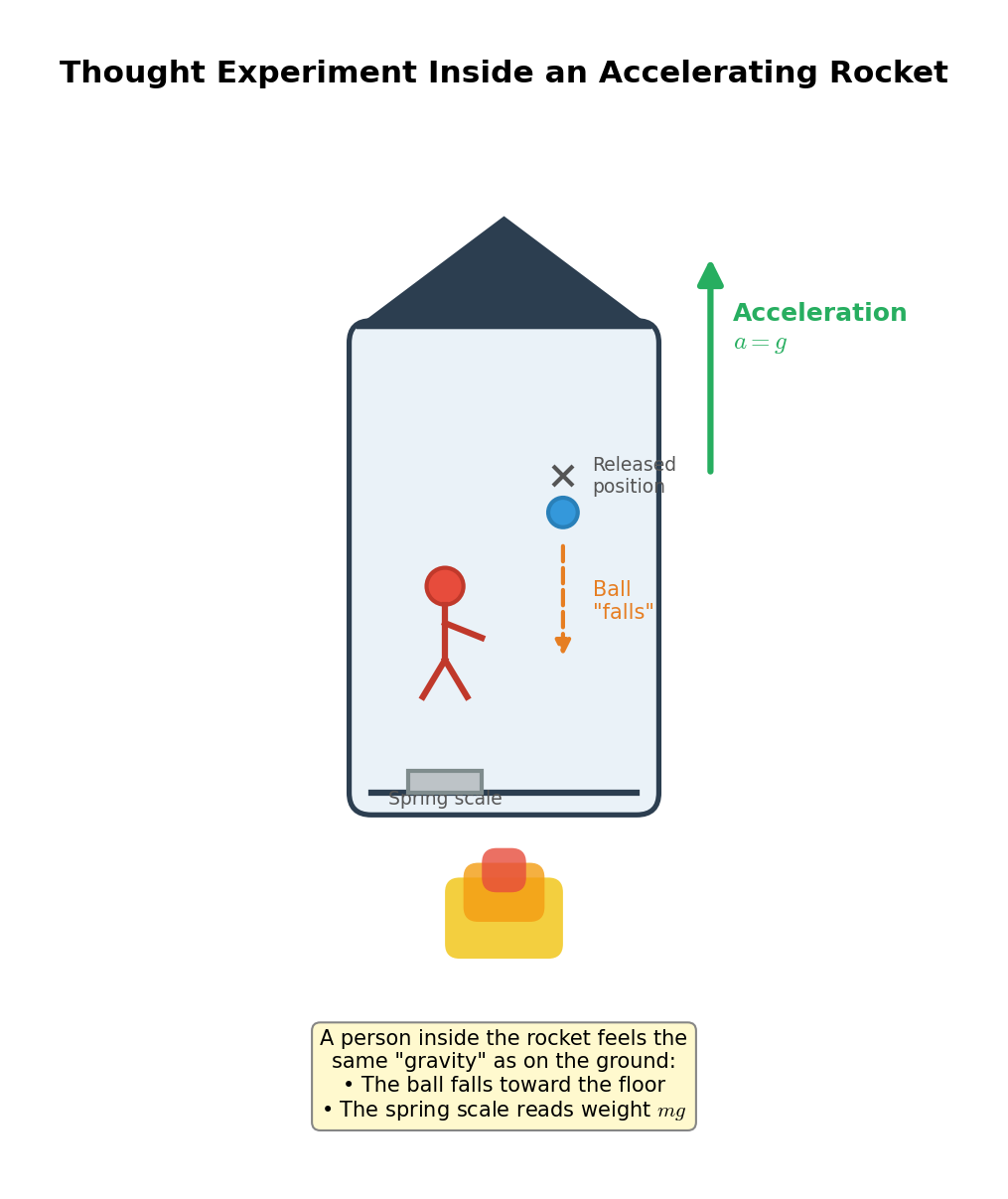
Fig. 5.1: Pseudo-gravity inside an accelerating rocket. Inside the accelerating rocket, a ball "falls" toward the floor and a spring scale reads weight \(mg\). The person inside the rocket experiences the same "gravity" as on the ground.
🔵 Kai: Exactly the same sensation as standing on Earth's surface...
🟡 Lina: Here's the question. With no view of the outside, can you distinguish these two situations?
- Situation A: The rocket is stationary on the surface of a planet, experiencing gravitational acceleration \(g\)
- Situation B: The rocket is in outer space accelerating upward at acceleration \(g\)
🟡 Lina: Look at Fig. 5.2 "The elevator thought experiment. (a) In free fall". It compares three situations side by side. (a) is the free-fall situation we just discussed, (b) is stationary on the ground, and (c) is the rocket situation. The core of the equivalence principle is that (b) and (c) are locally indistinguishable.
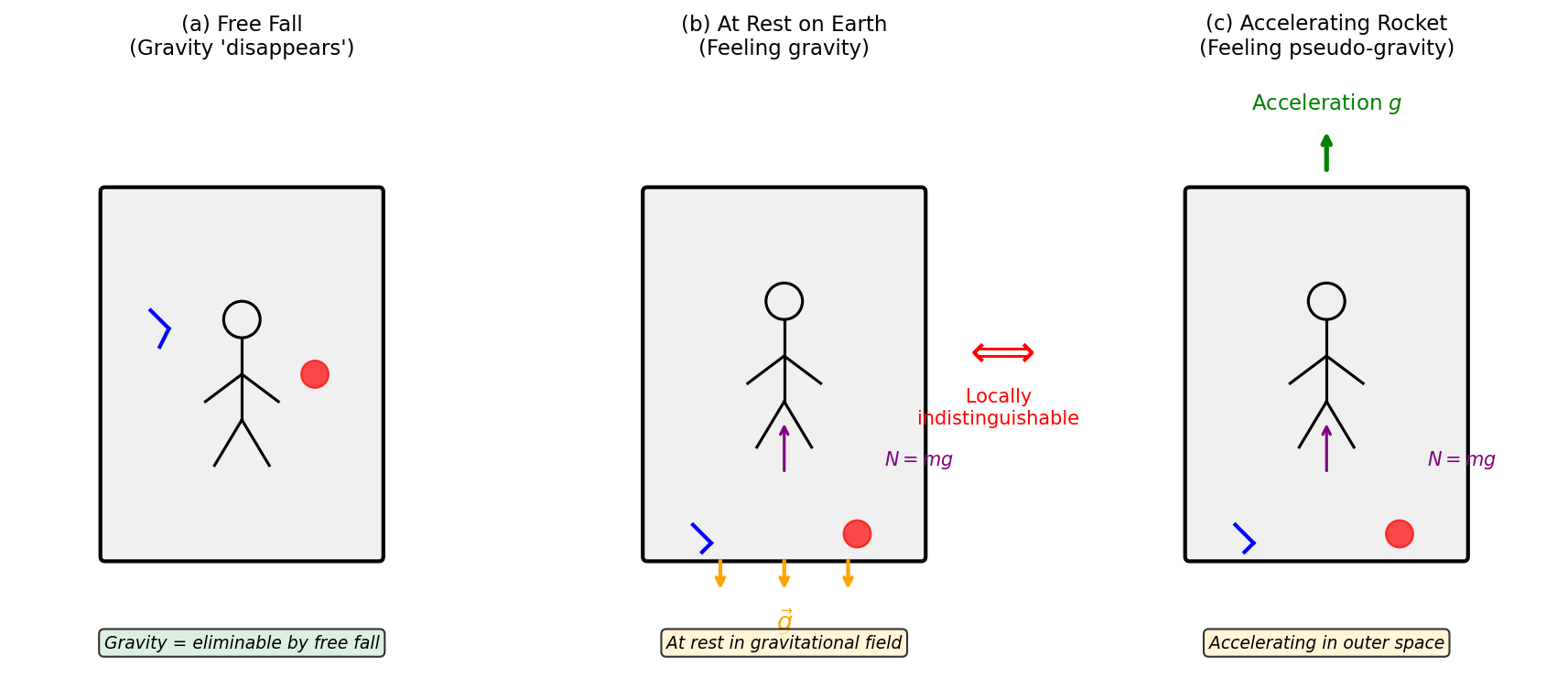
Fig. 5.2: The elevator thought experiment. (a) In free fall — everything floats and gravity appears to "vanish." (b) Stationary on the ground — gravity is felt. (c) Accelerating rocket in space — pseudo-gravity is felt. By the equivalence principle, (b) and (c) are locally indistinguishable.
⚪ Mei: Whether you drop a ball, measure with a spring scale, or observe a water surface, both situations give the same results. Locally, they are indistinguishable.
🟡 Lina: This is the core of the equivalence principle.
Equivalence Principle
A system at rest in a uniform gravitational field (a gravitational field with the same strength and direction everywhere) and a system uniformly accelerating in gravity-free space are locally physically indistinguishable.
Equivalently stated: A freely falling system is locally equivalent to an inertial frame.
🔵 Kai: What does "locally" mean? Why not "completely"?
🟡 Lina: Good question. Gravitational fields generally vary in strength and direction from place to place. Earth's gravity points toward Earth's center, so the direction is different in Tokyo versus Brazil, and it's weaker at higher altitudes. "Locally" means that within a sufficiently small region and short time, the gravitational field appears "uniform" (same strength and direction everywhere), so it's indistinguishable from acceleration.
⚪ Mei: Conversely, over a large region the non-uniformity of the gravitational field becomes visible, and it becomes distinguishable from acceleration.
🟡 Lina: Exactly. That "difference visible over large regions" is tidal force, which we'll address in detail in a later section. For now, just remember that "the equivalence principle applies only in a small region."
Canceling Gravity by Coordinate Transformation — Verification with Equations
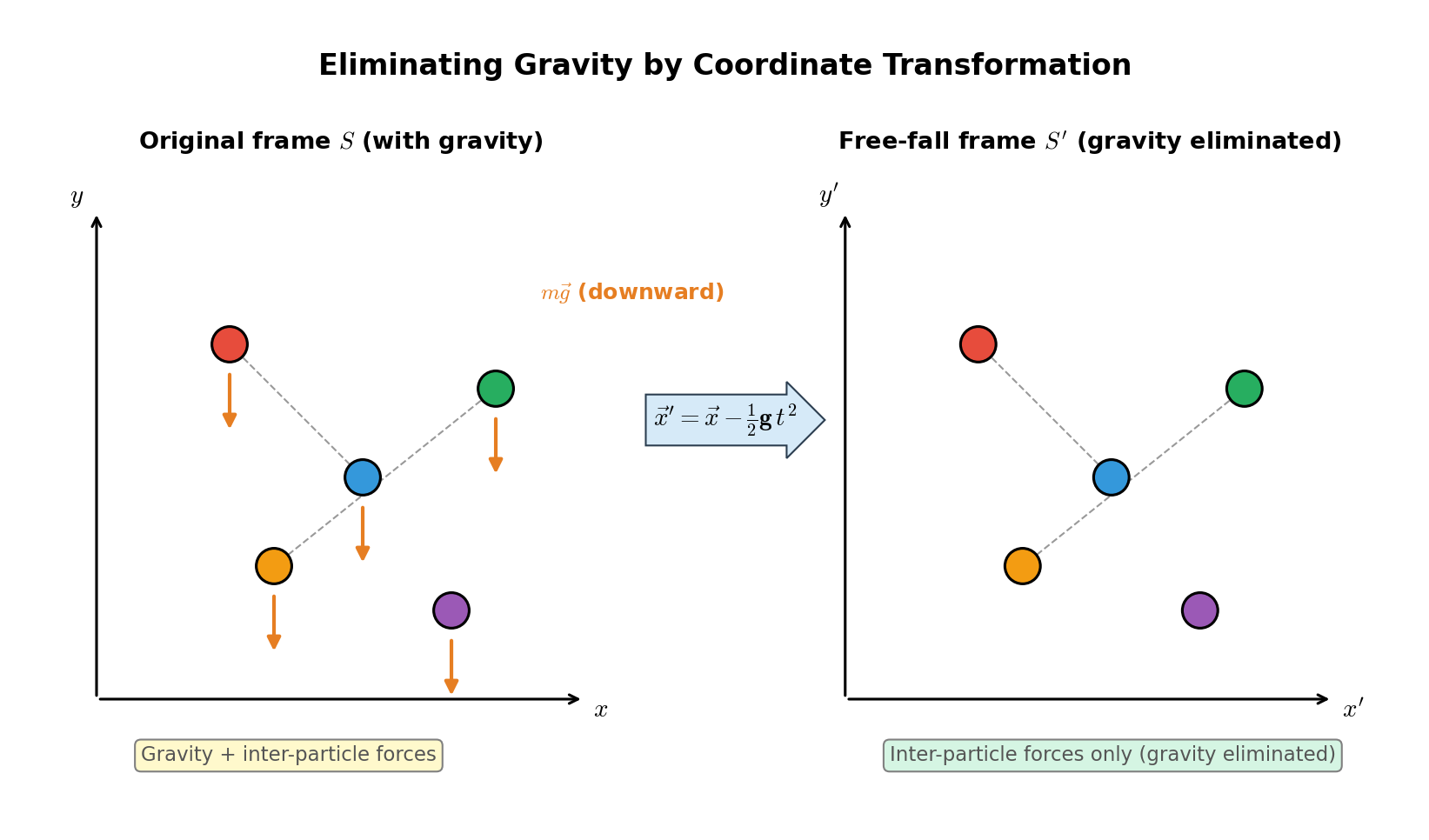
Fig. 5.3: Canceling gravity in a free-fall coordinate system. Left — particles in a uniform gravitational field \(\vec{g}\) (vertically downward, \(-y\) direction). Each particle experiences gravity (orange arrows, all downward) and inter-particle forces (dashed lines). Right — switching to the free-fall coordinate system \(S'\) cancels gravity, leaving only inter-particle forces.
🔵 Kai: Can the equivalence principle be verified with equations too?
🟡 Lina: Good question. Let's actually verify it. As in Fig. 5.3 "Canceling gravity in a free-fall coordinate system. Left", consider particles in a uniform gravitational field, and see whether gravity really disappears when we switch to a free-fall coordinate system. On the left side, gravity acts downward on each particle (shown by orange arrows), and there are also other forces between particles (shown by dashed lines, such as electric or spring forces). The right side shows what things look like after switching to the free-fall frame.
🔵 Kai: The left side is "the world as seen by someone standing on the ground," and the right side is "the world as seen by someone falling along with them."
🟡 Lina: Exactly. Remember that the equivalence principle holds "locally." So we consider a sufficiently small region where the gravitational field can be treated as uniform (the same \(\mathbf{g}\) everywhere). Suppose \(N\) particles are in this uniform gravitational field \(\mathbf{g}\). We focus on one particle (the particle of interest) and write its equation of motion. Let the position of the particle of interest be \(\vec{x}\), and the positions of the remaining \(N-1\) particles be \(\vec{x}_1, \vec{x}_2, \ldots, \vec{x}_{N-1}\). The summation index \(p\) runs from \(1\) to \(N-1\).
⚪ Mei: Since \(m_G = m_I\) has been confirmed, we can write both as the same \(m\).
🟡 Lina: Right. The \(m\) on the left side is inertial mass, and the \(m\) in \(m\mathbf{g}\) on the right is gravitational mass, but since they're equal we use the same symbol. The equation of motion is:
The right side consists of two parts. The first term \(m\mathbf{g}\) is the force from the uniform gravitational field (an external field like Earth's gravity), common to all particles. Gravity also acts between the particles themselves, but if the particle masses are small, it's overwhelmingly weak compared to the external field \(\mathbf{g}\), so we neglect it here. Therefore the second term \(\vec{F}(\vec{x} - \vec{x}_p)\) does not include gravity and represents the total non-gravitational forces (electric forces, spring forces, etc.) from the other particles. For simplicity, we assume \(\vec{F}\) depends only on the relative position \(\vec{x} - \vec{x}_p\). For example, the Coulomb force has the form \(\vec{F} \propto (\vec{x} - \vec{x}_p)/|\vec{x} - \vec{x}_p|^3\). In other words, all gravitational effects are in \(m\mathbf{g}\), and \(\vec{F}\) contains none.
🟡 Lina: Let's switch to a freely falling coordinate system. The coordinate transformation is:
🔵 Kai: Ah, \(\frac{1}{2}\mathbf{g}\,t^2\) is the high school formula for uniformly accelerated motion \(x = \frac{1}{2}gt^2\)!
⚪ Mei: So \(\vec{x}'\) is "the position as seen by a freely falling observer."
🔵 Kai: I see. But a coordinate transformation just changes each particle's position \(\vec{x}\) to \(\vec{x}'\), right? Does the form of the inter-particle force \(\vec{F}(\vec{x} - \vec{x}_p)\) change?
🟡 Lina: Actually, that's the key point. Let's compute the acceleration in the new coordinates. Differentiating both sides of \(\vec{x}' = \vec{x} - \frac{1}{2}\mathbf{g}\,t^2\) once with respect to \(t\) gives \(\frac{d\vec{x}'}{dt} = \frac{d\vec{x}}{dt} - \mathbf{g}\,t\), and differentiating once more (since \(\mathbf{g}\) is constant):
Since \(t' = t\), we have \(dt' = dt\), so the differentiation variable doesn't change.
That is, \(\frac{d^2\vec{x}}{dt^2} = \frac{d^2\vec{x}'}{dt'^2} + \mathbf{g}\). Substituting this into the left side \(m\frac{d^2\vec{x}}{dt^2}\) of the original equation of motion:
🔵 Kai: The argument of the force on the right side is still \(\vec{x} - \vec{x}_p\) — don't we need to rewrite it in the new coordinates \(\vec{x}'\)?
🟡 Lina: Good question. Actually, \(\vec{x}' - \vec{x}'_p = (\vec{x} - \tfrac{1}{2}\mathbf{g}t^2) - (\vec{x}_p - \tfrac{1}{2}\mathbf{g}t^2) = \vec{x} - \vec{x}_p\), so the relative position between particles doesn't change under the coordinate transformation. We're just subtracting the same \(\tfrac{1}{2}\mathbf{g}t^2\) from all particles. So we can write \(\vec{F}(\vec{x} - \vec{x}_p) = \vec{F}(\vec{x}' - \vec{x}'_p)\). Then the \(m\,\mathbf{g}\) on the left and the \(m\,\mathbf{g}\) on the right cancel:
🔵 Kai: The gravity term cancelled cleanly!
⚪ Mei: So just by switching to a freely falling coordinate system, it takes exactly the same form as the equation of motion in gravity-free space.
🟡 Lina: Exactly. In the freely falling coordinate system, gravity completely disappears, and only inter-particle forces remain.
🔵 Kai: But wait. Does this coordinate transformation cancel gravity for all particles simultaneously? Even though the particles have different masses.
🟡 Lina: Good question. Look back at the calculation. The \(m\mathbf{g}\) cancelled because the \(m\) on the left (inertial mass) equals the \(m\) on the right (gravitational mass). The value of mass \(m\) itself cancels out in the division, so gravity disappears for every particle with the same coordinate transformation. Conversely, if \(m_G \neq m_I\), each particle would have a different falling acceleration, so a single coordinate transformation couldn't cancel gravity for all particles simultaneously — the validity of the equivalence principle depends entirely on \(m_G = m_I\).
⚪ Mei: So the equivalence principle and \(m_G = m_I\) come as a package. If one breaks down, so does the other.
🟡 Lina: Exactly.
✅ Comprehension Check: State the equivalence principle in one sentence.
Answer
A system at rest in a uniform gravitational field and a system uniformly accelerating in gravity-free space are locally physically indistinguishable. Equivalently, a freely falling system is locally equivalent to an inertial frame.
📝 Exercises:
- Free-fall coordinate transformation and mathematical verification of the equivalence principle → Problem B-4. Velocity and Acceleration under Transformation to Free-Fall Coordinates, Problem B-5. Free-Fall Coordinate Transformation When \(m_I \neq m_G\), Problem M-2. Equivalence Principle for a Multi-Particle System
5.4 Tidal Forces — The Limits of the Equivalence Principle
🔵 Kai: So if you free-fall, gravity completely disappears? That sounds too good to be true...
🟡 Lina: Good intuition. The equivalence principle actually has an important limitation. What reveals it is the tidal force.
🟡 Lina: Consider two balls in free fall toward Earth. Suppose we drop them side by side horizontally. Earth's gravity pulls both toward Earth's center. But since the two balls are at horizontally displaced positions, their gravity vectors point toward Earth's center — meaning they're not perfectly parallel but point slightly toward each other (look at (b) in Fig. 5.4 "Tidal force in uniform and non-uniform fields" — you can see the two arrows converging toward the center). So over time, the two balls approach each other.
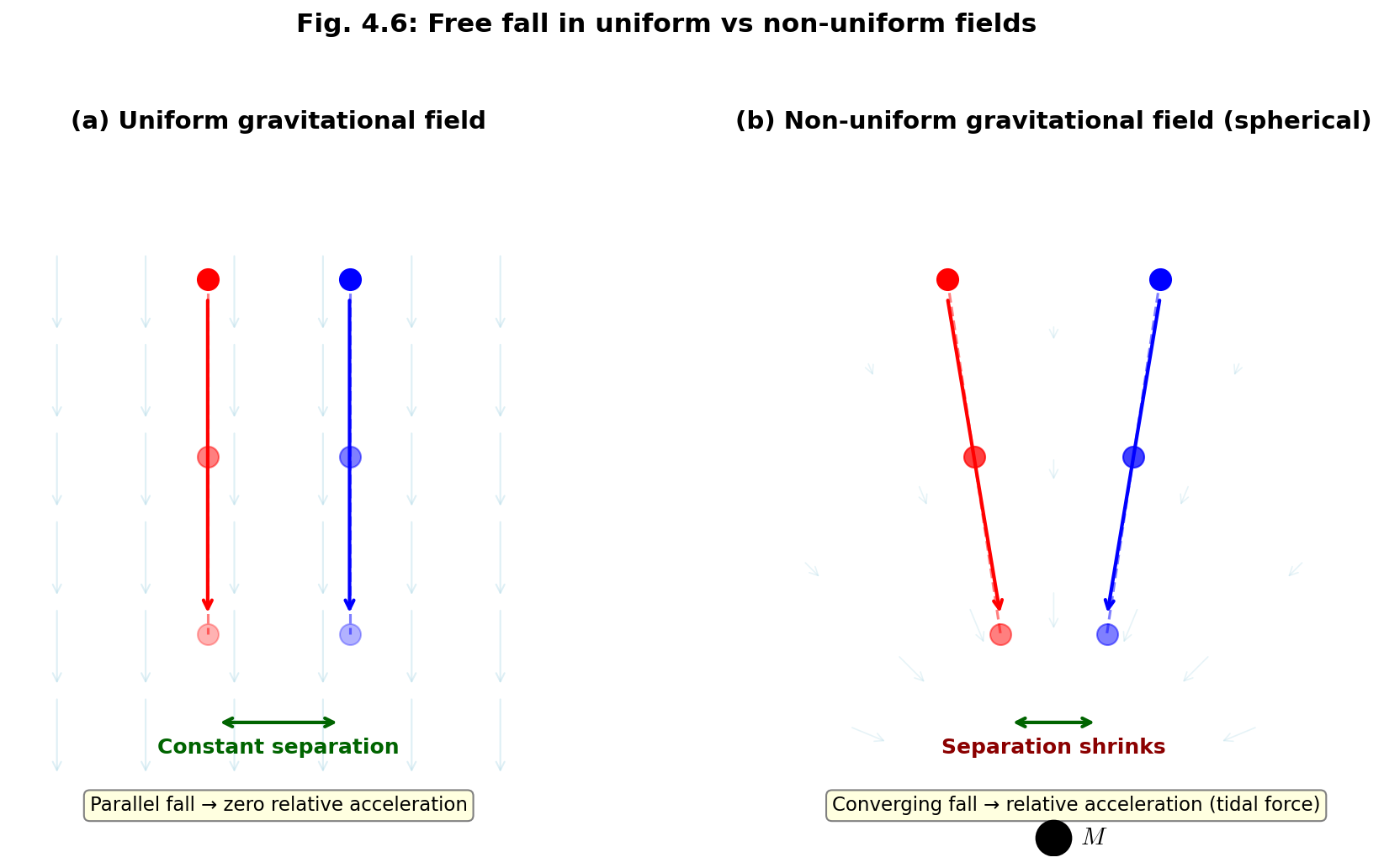
Fig. 5.4: Tidal force in uniform and non-uniform fields. (a) In a uniform gravitational field, two particles fall in parallel with zero relative acceleration. (b) In a non-uniform field (spherically symmetric), particles converge toward the center, producing relative acceleration. This is tidal force.
🔵 Kai: So they approach each other when side by side. What happens if we drop them one above the other?
🟡 Lina: If you drop two balls one above the other, the lower ball is closer to Earth and experiences slightly stronger gravity, while the upper ball experiences slightly weaker gravity. Since Newton's gravitational force is inversely proportional to the square of the distance, the acceleration is greater closer to Earth's center. So the lower ball falls faster, and over time the two move apart from each other.
⚪ Mei: So horizontally they "converge," and vertically they "diverge."
🟡 Lina: Fig. 5.4 "Tidal force in uniform and non-uniform fields" shows exactly this contrast. In (a) with a uniform field, particles fall in parallel with zero relative acceleration — this is the component that can be eliminated by the equivalence principle. In (b) with a non-uniform field (spherically symmetric), you can see horizontally separated particles converging toward the center. This is the component that cannot be eliminated — the tidal force.
🟡 Lina: The non-uniformity of the gravitational field producing different effects in different directions — that's the essence of tidal force.
🔵 Kai: Even though they're in free fall, the distance between the balls changes... you can't say "gravity has disappeared" in that case, can you?
🟡 Lina: Right. Ocean tides work on the same principle (Fig. 5.5 "The Moon's gravitational non-uniformity and ocean tides. (a) The Moon's gravity is inversely proportional to the square of distance, so it acts more strongly on the side closer to the Moon (blue arrows). (b) Subtracting the gravity at Earth's center leaves the residual (red arrows)"). Because the Moon's gravitational strength differs between the near side and far side, the ocean surface is stretched in the direction of the Moon.
🔵 Kai: I understand the near side being pulled, but why does the opposite side also bulge?
🟡 Lina: Good question. Remember what we learned from the equivalence principle — in a freely falling system, gravity disappears. The entire Earth is being accelerated toward the Moon by the Moon's gravity — meaning Earth's center is in free fall toward the Moon. Even though we say "falling," it has sideways velocity so it doesn't crash into the Moon but keeps orbiting — orbital motion is also a form of free fall (just like the ISS). So if you ride along with the Earth (in the Earth-center frame), by the same elevator logic, the Moon's gravity at Earth's center is exactly cancelled as the "free-fall acceleration."
🔵 Kai: Because Earth's center is in free fall, the Moon's gravity vanishes there... but since Earth is large, at places far from the center it doesn't completely cancel?
🟡 Lina: Exactly. It only cancels at Earth's center. What remains is the difference between "the Moon's gravity at that location" and "the Moon's gravity at Earth's center" — and that's the tidal force.
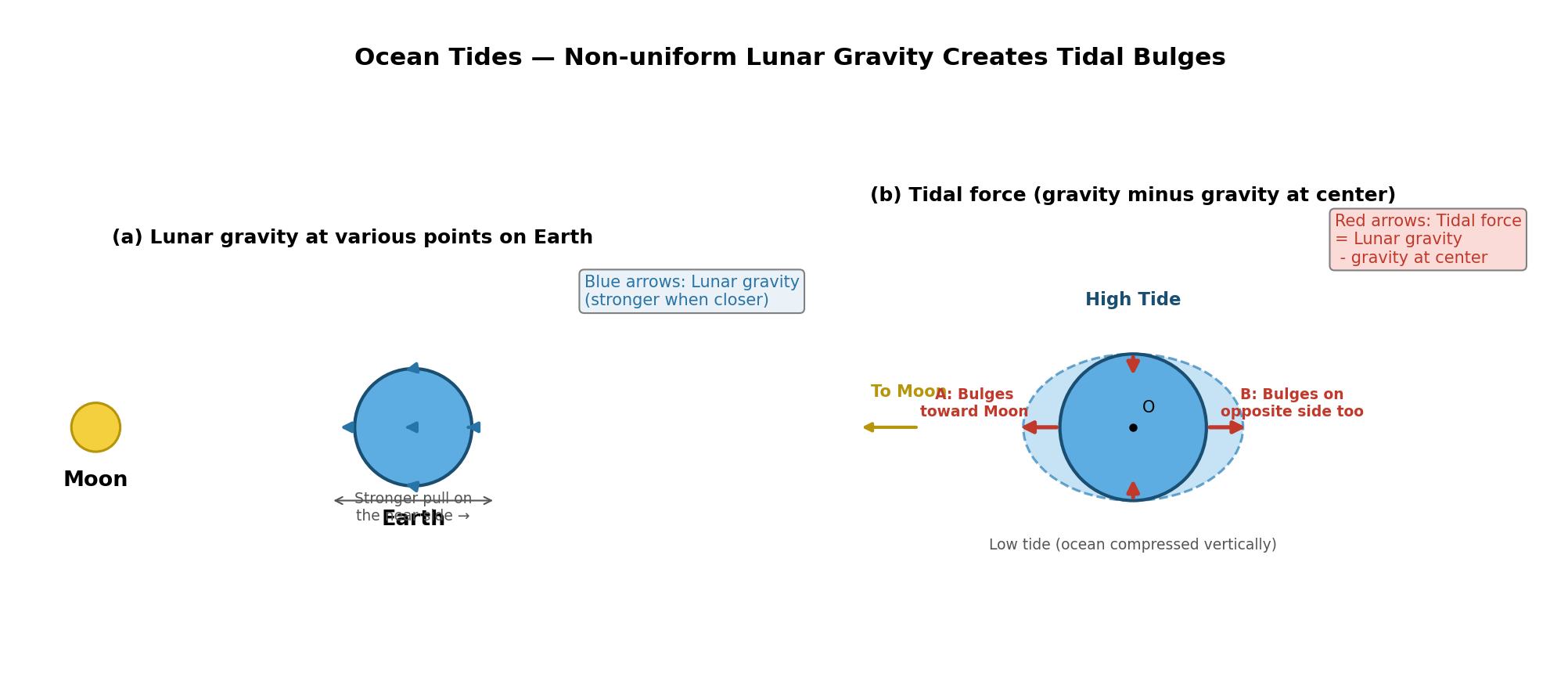
Fig. 5.5: The Moon's gravitational non-uniformity and ocean tides. (a) The Moon's gravity is inversely proportional to the square of distance, so it acts more strongly on the side closer to the Moon (blue arrows). (b) Subtracting the gravity at Earth's center leaves the residual (red arrows) — the tidal force — which points outward on both the Moon-facing and opposite sides, causing the ocean surface to bulge into an elliptical shape elongated toward the Moon. As Earth rotates, this produces approximately two high tides and two low tides per day.
🟡 Lina: Look at (a) in Fig. 5.5 "The Moon's gravitational non-uniformity and ocean tides. (a) The Moon's gravity is inversely proportional to the square of distance, so it acts more strongly on the side closer to the Moon (blue arrows). (b) Subtracting the gravity at Earth's center leaves the residual (red arrows)" — the Moon's gravity (blue arrows) is stronger on the side closer to the Moon. In (b), the residual after subtracting the gravity at Earth's center (red arrows) is shown. On the near side, the Moon's gravity is stronger than at Earth's center, so the difference points toward the Moon (outward). On the far side, the Moon's gravity is weaker than at Earth's center, so the difference points away from the Moon — which is also outward.
⚪ Mei: So both the Moon-facing side and the opposite side bulge outward, creating the elliptical shape.
🟡 Lina: Right. As Earth rotates beneath this ellipse, we get approximately two high tides and two low tides per day.
🔵 Kai: Ah, so you think in terms of "differences." The opposite side has weaker-than-average Moon gravity, so when you subtract, it points away from the Moon — that's why the opposite side also bulges outward. But wait, tidal force isn't "gravity itself" but rather "the variation of gravity from place to place" is the essential thing? Does that mean in a uniform gravitational field, tidal force would be zero?
🟡 Lina: Exactly right. In a uniform gravitational field, the force is the same everywhere, so the difference is zero — no tidal force arises. The (a) panel of Fig. 5.4 "Tidal force in uniform and non-uniform fields" is precisely that situation.
🟡 Lina: What the equivalence principle can eliminate is only the locally uniform component of the gravitational field. The tidal force arising from the non-uniformity of the gravitational field — the variation in strength and direction from place to place — cannot be eliminated even in free fall.
⚪ Mei: So the equivalence principle holds only in a sufficiently small region and for a sufficiently short time.
🟡 Lina: Yes. Such a system is called a local inertial frame. In Ch. 2, we introduced "inertial frame" as "a coordinate system with no acceleration or rotation." The local inertial frame is an extension of that: even when there's a gravitational field, if you take a freely falling coordinate system in the neighborhood of any point in spacetime, then within that small region special relativity holds — it becomes locally "a coordinate system with no acceleration or rotation." Using the ISS example from before, a small laboratory inside the ISS is a local inertial frame. However, a single inertial frame covering all of spacetime generally does not exist.
🔵 Kai: How small is "sufficiently small"?
🟡 Lina: It depends on the situation. In a weak gravitational field like Earth's surface, the equivalence principle is a good approximation over a fairly large region. But near a black hole where the gravitational field changes rapidly, it holds only in very small regions.
✅ Comprehension Check: Which component of the gravitational field can be eliminated by the equivalence principle? What cannot be eliminated?
Answer
What can be eliminated is the locally uniform component of the gravitational field. What cannot be eliminated is the tidal force arising from the non-uniformity of the gravitational field (differences in strength and direction from place to place).
📝 Exercises:
- Tidal forces and the limits of the equivalence principle → Problem M-3. Tidal Force and Locality of the Equivalence Principle
5.5 Gravitational Redshift — A Quantitative Consequence of the Equivalence Principle
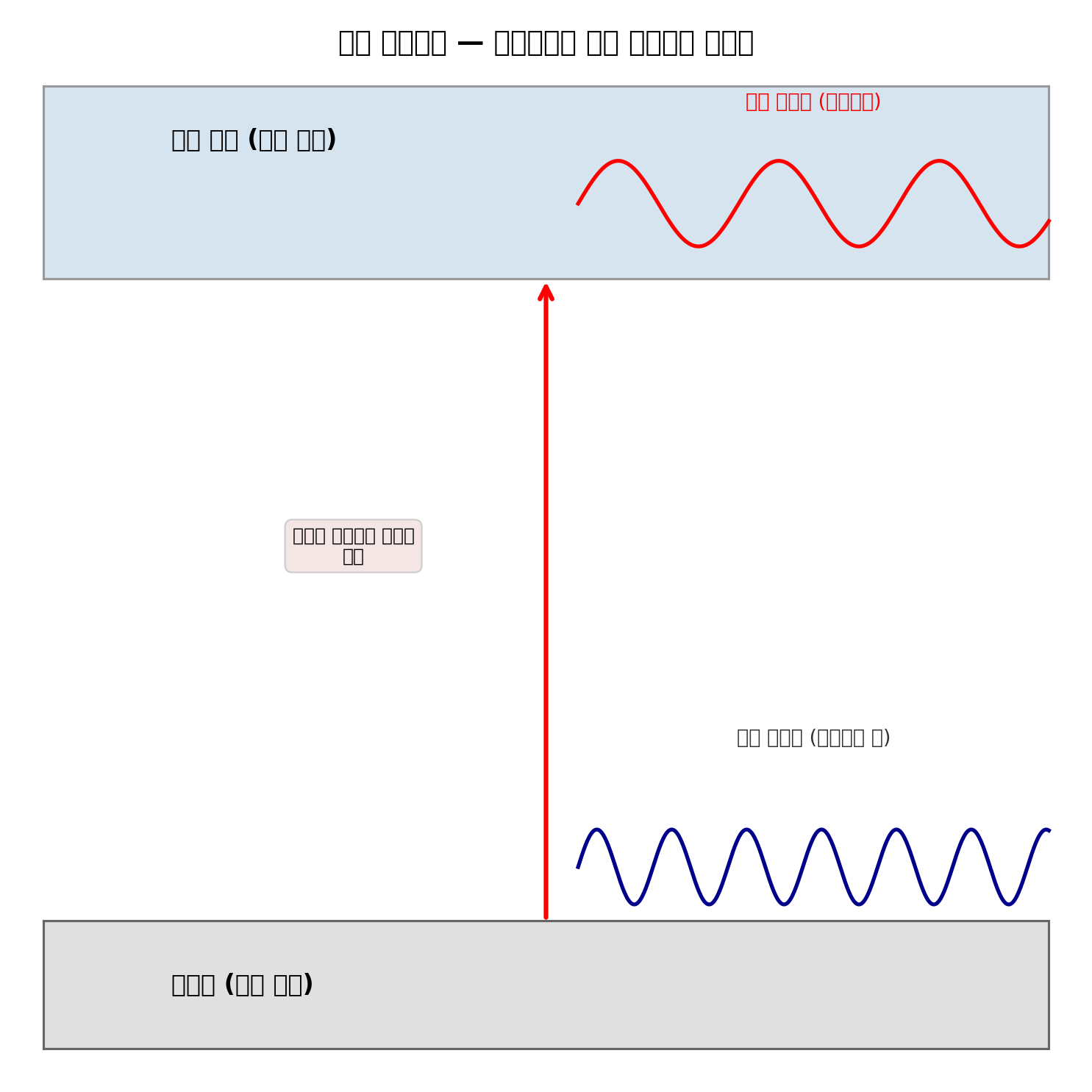
Fig. 5.6: Gravitational redshift. Light traveling upward in a gravitational field decreases in frequency (redshift).
🟡 Lina: Let me show you that the equivalence principle is not merely a philosophical statement but produces quantitative predictions. I've shown the conclusion we'll derive in Fig. 5.6 "Gravitational redshift" — light traveling upward in a gravitational field decreases in frequency (is redshifted). Let me now derive step by step why this happens, as the gravitational redshift.
Setting Up the Thought Experiment
🟡 Lina: A tower of height \(H\) stands on Earth's surface. Light is emitted from the ground upward toward the top of the tower. We'll consider how the frequency of this light changes.
🔵 Kai: The frequency of light changes? But the speed of light is constant, isn't it?
🟡 Lina: The locally measured speed of light is constant at \(c\) everywhere, but recall the fundamental wave equation \(c = \lambda\nu\) (speed of light = wavelength × frequency). Since the speed of light \(c\) is fixed as constant, if the frequency \(\nu\) decreases, the wavelength \(\lambda\) must increase — the speed of light itself doesn't change. As an analogy with sound, when an ambulance moves away, the speed of sound doesn't change but the siren sounds lower, right? Similarly, even with constant wave speed, the frequency alone can change. However, the Doppler effect mechanism differs between sound and light (sound has a medium but light doesn't), so this analogy applies only to the point that "frequency can change even with constant speed." The answer to "why does it change" is actually deep, ultimately coming down to "clocks run at different rates at different locations," which I'll explain again at the end of this section. First, let's use the equivalence principle to quantitatively derive how much the frequency changes.
Derivation from the Equivalence Principle
🟡 Lina: According to the equivalence principle, a freely falling system is locally equivalent to an inertial frame. So within a freely falling system, special relativity applies directly. We want to derive gravitational redshift, but calculating directly within a gravitational field is difficult. So the strategy is: use the equivalence principle to replace the "gravitational field problem" with an "accelerating frame problem," and solve it using the familiar special relativity tool (Doppler effect) in an inertial frame.
🟡 Lina: Here's the setup. At the instant the light is emitted, consider an observer who begins free fall right next to the light source — imagine jumping off the ground at that moment. The key is "at the instant the light is emitted." Why? Because at that instant, this observer and the light source are at the same location with the same velocity (zero), so free fall begins at rest relative to the light source at the moment of emission. If the start of free fall were too early or too late, there would be relative velocity between the observer and light source at the moment of emission, introducing an extraneous Doppler effect. Now, as confirmed in the previous section, gravity disappears in a freely falling system. A system where gravity has disappeared is "a system with no forces acting," so it's precisely an inertial frame. That is, by the equivalence principle, this freely falling observer is in a local inertial frame. Being in an inertial frame means special relativity applies. Then, from the freely falling observer's perspective, the receiver at the top of the tower appears to be accelerating upward, moving away from them. From the free-fall frame, the ground and tower together accelerate upward.
⚪ Mei: So at the instant of emission, the free-fall frame and the ground have the same velocity, but during the time light takes to reach the top, the entire tower accelerates, so the receiver acquires a velocity away from the source.
🔵 Kai: Ah, if the receiver is moving away, then just like an ambulance siren sounds lower as it moves away, the Doppler effect should decrease the frequency!
🟡 Lina: Exactly. The time for light to travel from the ground to the top of the tower is \(\Delta t \approx H/c\).
🔵 Kai: Why "\(\approx\)"? Isn't it exactly \(H/c\)?
🟡 Lina: From the free-fall frame's perspective, the receiver is accelerating, so during the time from emission to reception, the receiver's position shifts slightly. But that shift is on the order of \(\frac{1}{2}g(H/c)^2\), and its ratio to \(H\) is
(for \(H = 22.5\,\mathrm{m}\)), which is overwhelmingly small. So \(\Delta t = H/c\) is perfectly fine (the rigorous argument will be given in Ch. 6).
🟡 Lina: From the perspective of the observer who began free fall at the instant of emission, during this time the receiver at the top continues accelerating upward. What matters for the Doppler effect is the receiver's velocity at the moment the light is received, so we need to find the receiver's velocity after \(\Delta t \approx H/c\). Since it's uniformly accelerated motion:
This is the velocity the receiver has in the direction away from the source at the moment of reception.
🔵 Kai: Ah, the receiver is moving away from the source, so the Doppler effect decreases the frequency!
🟡 Lina: Exactly. Here we use the special relativistic Doppler effect. When a source and receiver are moving apart at constant velocity \(v\) (\(v > 0\)), the frequency received is given by a formula I'll show first and then derive step by step:
Don't worry, I'll derive it step by step now.
🔵 Kai: Please do! How is it derived?
🟡 Lina: It's cleanest to work in the receiver's rest frame (an inertial frame). The reason is that in the receiver's frame, the "interval between wave crest arrivals" directly gives the period measured by the receiver, with no need for a coordinate transformation at the end. Let's begin. In the receiver's frame, the source is receding at velocity \(v\). In the source's own rest frame, the source emits wave crests with period \(T_0 = 1/\nu_{\text{emitted}}\) (\(\nu_{\text{emitted}}\) is the frequency measured in the source's rest frame). But from the receiver's frame, the source's clock runs slower by a factor of \(1/\gamma\) (time dilation), so in the receiver's frame's coordinate time, wave crests are emitted every \(\gamma T_0\).
🔵 Kai: Because the moving source's clock runs slowly, the interval between crests becomes longer.
🟡 Lina: Right. Furthermore, since the source is moving away from the receiver, the position where the next crest is emitted is \(v \cdot \gamma T_0\) farther away than the previous one. This extra distance takes an additional \(v\gamma T_0/c\) for light traveling at speed \(c\). So the arrival interval measured by the receiver is:
⚪ Mei: Since we're calculating in the receiver's frame, this directly gives the arrival interval in the receiver's proper time. No coordinate transformation needed.
🟡 Lina: Exactly. Frequency is the reciprocal of period:
Now substitute \(\gamma = 1/\sqrt{1-v^2/c^2}\). Since \(1-v^2/c^2 = (1-v/c)(1+v/c)\), we have \(\gamma = 1/\sqrt{(1-v/c)(1+v/c)}\). Therefore:
Since \(\frac{\sqrt{1+v/c}}{1+v/c} = \frac{\sqrt{1+v/c}}{(\sqrt{1+v/c})^2} = \frac{1}{\sqrt{1+v/c}}\):
🔵 Kai: Great, it came out cleanly! Calculating from the start in the receiver's frame avoids the hassle of coordinate transformations.
⚪ Mei: The key point is "if you calculate in the receiver's frame, the arrival interval directly gives the value in the receiver's proper time." If you try to calculate in the source's frame and then transform, it's easy to get confused about which time interval to transform and how.
🟡 Lina: Now let's apply this constant-velocity Doppler formula to our problem. You might wonder "the receiver is accelerating — is it okay to use a constant-velocity formula?" But measuring frequency means "counting how many wave crests arrive." During one crest arrival (a time of \(\Delta t_{\text{wave}} \sim 1/\nu\)), if the receiver's velocity barely changes, then that single crest reception can be treated as a constant-velocity situation. In other words, the Doppler effect determines the frequency based solely on the receiver's velocity at the moment of reception. The acceleration matters only in how much the receiver's velocity changes during \(\Delta t_{\text{wave}}\). That velocity change is \(g \cdot \Delta t_{\text{wave}} = g/\nu\), and its ratio to the reception velocity \(v = gH/c\) is \(\frac{g/\nu}{v} = \frac{g}{\nu \cdot gH/c} = \frac{c}{\nu H}\). For gamma rays (\(\nu \sim 10^{18}\,\mathrm{Hz}\)) with \(H = 22.5\,\mathrm{m}\), this is \(\sim 10^{-11}\), overwhelmingly small compared to \(1\). So the receiver's velocity barely changes during one wavelength of light arrival, and applying the constant-velocity Doppler formula is perfectly valid.
🟡 Lina: In our problem, \(v/c = gH/c^2\) is a very small quantity (as we'll see shortly, \(\sim 10^{-15}\)). So we can use the \(v/c \ll 1\) approximation to simplify. Let's first confirm the basic approximation formula.
This follows from \((1 + \epsilon/2)^2 = 1 + \epsilon + \epsilon^2/4 \approx 1 + \epsilon\).
🔵 Kai: When \(\epsilon\) is small, \(\epsilon^2/4\) is negligible, so it holds.
🟡 Lina: Right. Next, let's approximate \(\sqrt{(1-x)/(1+x)}\) when \(x \ll 1\). I'll break it into three steps.
Step 1: \(1/(1+x) \approx 1 - x\). This comes from \((1+x)(1-x) = 1 - x^2 \approx 1\) (neglecting \(x^2\)), so dividing both sides by \((1+x)\) gives \(1-x \approx 1/(1+x)\).
Step 2: \(\frac{1-x}{1+x} = (1-x) \cdot \frac{1}{1+x} \approx (1-x)(1-x) = (1-x)^2 = 1 - 2x + x^2 \approx 1 - 2x\). We neglected \(x^2\) since \(x \ll 1\).
Step 3: Take the square root. Setting \(\epsilon = -2x\) and using \(\sqrt{1+\epsilon} \approx 1 + \epsilon/2\):
⚪ Mei: So in three steps we get \(\sqrt{(1-x)/(1+x)} \approx 1 - x\). And \(1/(1+x) \approx 1-x\) is the starting point for everything.
🔵 Kai: I see, everything reduces to \(\sqrt{1+\epsilon} \approx 1 + \epsilon/2\). But how much does this approximation deviate when \(v/c\) gets larger? For this problem it's \(10^{-15}\) so it's clearly fine.
🟡 Lina: Exactly. Substituting back \(x = v/c\):
Intuitively, since the receiver is receding from the source, the interval between wave crest arrivals becomes longer — the same mechanism as the Doppler effect for sound. Substituting \(v = gH/c\), the relationship between the frequency received at the top \(\nu_{\text{top}}\) and the frequency emitted at the ground \(\nu_{\text{ground}}\) is:
⚪ Mei: So \(\nu_{\text{top}} < \nu_{\text{ground}}\). The frequency of light received at the top is lower than when emitted at the ground. Lower frequency means longer wavelength — shifted toward the red.
🟡 Lina: Exactly. Longer wavelength = shifted toward red, so this is called redshift. Writing the relative change in frequency:
The minus sign means the frequency decreases. Look again at Fig. 5.6 "Gravitational redshift" — the red wave (top side) showing the frequency decrease is exactly what this formula expresses.
The Energy Conservation Viewpoint — Another Perspective
🔵 Kai: Light has energy too, so it should be affected by gravity. But the speed of light is constant, so it doesn't slow down. So where does the light's energy go?
🟡 Lina: Good question. According to quantum theory, the energy of a single photon is proportional to its frequency \(\nu\). The proportionality constant is written as Planck's constant \(h\). \(h \approx 6.63 \times 10^{-34}\,\mathrm{J{\cdot}s}\) is a very small value, and the unit \(\mathrm{J{\cdot}s}\) (joule-seconds) is a constant with dimensions of "energy × time."
This is the formula that appears in high school physics in the context of the photoelectric effect. The photoelectric effect experiment confirmed that "the higher the frequency of light, the greater the energy of the ejected electrons," and the proportionality constant is precisely \(h\). This textbook won't fully treat quantum theory until later, but here we'll only use the experimental fact that "the energy of light is proportional to frequency." That is, if frequency decreases, the photon's energy also decreases.
🔵 Kai: Ah, so decreasing frequency = decreasing energy! Light can't slow down, so instead it loses energy by decreasing its frequency.
🟡 Lina: Here, extending the idea of mass-energy equivalence \(E = mc^2\) that we learned in Ch. 4, let's formally assign an "effective mass" \(m_{\text{eff}} = E/c^2 = h\nu/c^2\) to a photon with energy \(E\).
🔵 Kai: Wait, photons have zero mass, right? Is it okay to assign them a mass?
🟡 Lina: Good point. The rest mass of a photon is zero, so this isn't "mass" in the strict sense. However, recall the equivalence principle — since a system at rest in a gravitational field is indistinguishable from an accelerating system, if a photon's energy changes in an accelerating frame (and it actually does via the Doppler effect), then it must change by the same amount in a gravitational field. That is, photons are affected by gravitational potential. To express this effect in Newtonian terms, we can treat \(E/c^2 = h\nu/c^2\) as a "gravitational weight." This is not a rigorous derivation but rather a convenient reinterpretation of the result already obtained via the equivalence principle in the language of "energy conservation." Think of it as "an intuitive confirmation that the same answer emerges." With this "treatment," let's consider the photon losing energy by an amount corresponding to the gravitational potential difference \(gH\).
🟡 Lina: In Newtonian terms, when a photon climbs a height \(H\) (positive value), gravity pulls it downward with force \(m_{\text{eff}}\,g\), so moving upward by \(H\) gives work \(-m_{\text{eff}}\,g\,H\) (negative because force and displacement are in opposite directions). That is, the change in energy is
It's negative, meaning energy decreases — the photon loses energy as it climbs through the gravitational potential. Here we use the ground frequency for \(\nu\) in \(m_{\text{eff}} = h\nu/c^2\). Strictly speaking, the frequency changes during the climb so \(m_{\text{eff}}\) changes too, but that change is on the order of \(gH/c^2 \sim 10^{-15}\). The correction entering the \(\Delta E\) calculation is of order \((gH/c^2)^2 \sim 10^{-30}\), completely negligible.
🔵 Kai: I see, so the effect of frequency changing during the climb is negligibly small.
🟡 Lina: Since \(E = h\nu\) with \(h\) constant, if the frequency changes from \(\nu\) to \(\nu + \Delta\nu\), the energy becomes \(E + \Delta E = h(\nu + \Delta\nu)\). Subtracting the original \(E = h\nu\) gives \(\Delta E = h\,\Delta\nu\). Dividing both sides by \(E = h\nu\)?
🔵 Kai: Let's see, \(\Delta E / E = h\,\Delta\nu / (h\nu)\), and the \(h\) cancels...
⚪ Mei: \(\Delta E / E = \Delta\nu/\nu\). The fractional change in energy equals the fractional change in frequency.
🟡 Lina: Right. So the energy \(\Delta E = -(h\nu/c^2)\,gH\) that the photon loses climbing height \(H\) corresponds directly to the frequency change \(\Delta\nu = \Delta E / h\). Here \(\nu\) is the frequency at emission on the ground, and \(\Delta\nu = \nu_{\text{top}} - \nu_{\text{ground}}\) is the change in frequency (negative since it decreases at the top). Dividing \(\Delta E = -(h\nu/c^2)\,gH\) by \(E = h\nu\):
🔵 Kai: Wait, this is exactly the same formula we derived from the equivalence principle! Is this a coincidence? It's strange to get the same answer from completely different approaches...
🟡 Lina: It's not a coincidence. This means we're viewing the same phenomenon from two perspectives. The equivalence principle (Doppler effect in a free-fall frame) and energy conservation (photon energy changing with gravitational potential) both point to the same conclusion of gravitational redshift.
🔵 Kai: So the two derivations agreeing means "if the equivalence principle is correct, then energy conservation must take this form." It serves as a consistency check.
Caution about the picture of 'photons accelerating due to gravity'
This energy conservation argument is useful as a convenient mnemonic, but strictly speaking:
- Photons have zero mass. "A photon experiencing gravitational acceleration" is merely a classical particle analogy
- The correct picture in general relativity is "gravity is not a force but spacetime curvature," and photons simply travel along geodesics (null geodesics) in curved spacetime
- The essence of redshift is "clocks run at different rates at different locations." Since frequency is the number of oscillations per unit time, differences in clock rates directly manifest as differences in frequency
Frequency decrease, energy decrease, and time dilation — these are the same single phenomenon (spacetime geometry) expressed in different words. We'll deepen this perspective later in this chapter and from Ch. 6 onward.
🔵 Kai: So conversely, if we send light from the top of the tower down to the ground?
🟡 Lina: By symmetry, the frequency increases in that case (blueshift). In general, sending light from a location with lower gravitational potential (ground) to higher potential (top) produces a redshift, and the reverse produces a blueshift.
🟡 Lina: This is the phenomenon called gravitational redshift.
Experimental Verification
🔵 Kai: Can this effect actually be measured?
🟡 Lina: Yes. In 1960, Pound and Rebka successfully measured it using the tower of Harvard University's physics building (height about 22.5 m). The key was the Mössbauer effect — a phenomenon where atomic nuclei in a crystal emit and absorb gamma rays without recoil. Using this, one can produce gamma rays with extremely sharp frequencies. Because the frequency is so sharp, frequency changes at the \(10^{-15}\) level could be detected.
🔵 Kai: How large an effect is \(10^{-15}\) concretely?
🟡 Lina: Let's calculate using our formula. With \(g \approx 10\,\mathrm{m/s^2}\), \(H = 22.5\,\mathrm{m}\): \(gH/c^2 \approx 10 \times 22.5 \,/\, (3 \times 10^8)^2 \approx 2.5 \times 10^{-15}\). That's 2.5 parts in a quadrillion — an incredibly tiny effect.
⚪ Mei: And measuring it was possible because the Mössbauer effect provides gamma rays with extremely sharp frequencies.
🟡 Lina: Right. The Pound-Rebka experimental result agreed with the theoretical prediction to about 10% precision, and the subsequent improved experiment (Pound-Snider, 1965) confirmed it to within 1%.
What Gravitational Redshift Means — Different Clock Rates
🟡 Lina: Gravitational redshift has an even deeper meaning. The frequency of light is "how many times it oscillates per second," so it can be viewed as a kind of clock. If the frequency changes, it means clocks run at different rates at different locations.
🔵 Kai: What? Time passes at different rates depending on location? But this is different from "moving clocks run slowly" that we learned in Ch. 3, right? That was due to velocity, but here nothing is moving...
🟡 Lina: Good distinction. The time dilation of special relativity is caused by relative velocity, but what we're discussing now is caused by differences in gravitational potential. A clock at a higher gravitational potential (top of the tower) runs faster than a clock at a lower potential (ground). This is gravitational time dilation, which exists independently of the special relativistic effect.
🟡 Lina: For a practical application, this effect is built into GPS satellite clock corrections. Satellites are at higher gravitational potential than the ground, so their clocks run faster than ground clocks. In practice, there's also the special relativistic time dilation from the satellite's orbital velocity (an opposite effect), but the gravitational effect is larger. Without correcting for both, position measurements would accumulate errors of several kilometers per day. You can calculate this in detail in the exercises.
⚪ Mei: So gravitational redshift is directly relevant to everyday technology.
✅ Comprehension Check: What is gravitational redshift? And how does it relate to "the rate of time"?
Answer
It is the phenomenon where light sent from a location with lower gravitational potential to higher gravitational potential decreases in frequency (redshifts). \(\Delta\nu/\nu \approx -gH/c^2\). Conversely, light sent from high to low potential increases in frequency (blueshifts). Since the frequency of light can be viewed as a kind of clock, this means that clocks run at different rates depending on location. Clocks at higher gravitational potential (e.g., the top of a tower or GPS satellites) run faster than clocks at lower potential (ground).
📝 Exercises:
- Derivation of gravitational redshift and GPS satellite clock corrections → Problem B-6. Light Travel Time and Velocity Acquired by Ground Apparatus, Problem B-7. Frequency of Light from the Doppler Effect, Problem B-8. Gravitational Redshift Formula in Potential Form, Problem M-4. Derivation of Gravitational Redshift from the Equivalence Principle, Problem M-5. Time Dilation at Tokyo Skytree, Problem A-1. Metric Correction Derived from Gravitational Redshift, Problem A-2. Relativistic Corrections for GPS Satellites
5.6 Gravity Is Not a Force but a Property of Spacetime — The Great Conceptual Shift
No Global Lorentz Frame Exists
🟡 Lina: The existence of gravitational redshift actually poses a very deep problem.
🟡 Lina: In the Lorentz frame we learned about in Ch. 3 — a coordinate system where the metric takes the form \(ds^2 = -c^2 dt^2 + dx^2 + dy^2 + dz^2\) — two clocks at rest at the same location should tick at the same rate. But gravitational redshift shows that a clock at the top of the tower and a clock on the ground tick at different rates.
🔵 Kai: Wait, isn't that a contradiction? In a Lorentz frame, stationary clocks should all run at the same rate, but the top and ground differ... isn't that inconsistent?
🟡 Lina: Exactly, it's a contradiction (Fig. 5.7 "Why no global Lorentz frame exists"). In the Lorentz frame metric \(ds^2 = -c^2 dt^2 + dx^2 + dy^2 + dz^2\), consider a stationary clock (\(dx = dy = dz = 0\)).
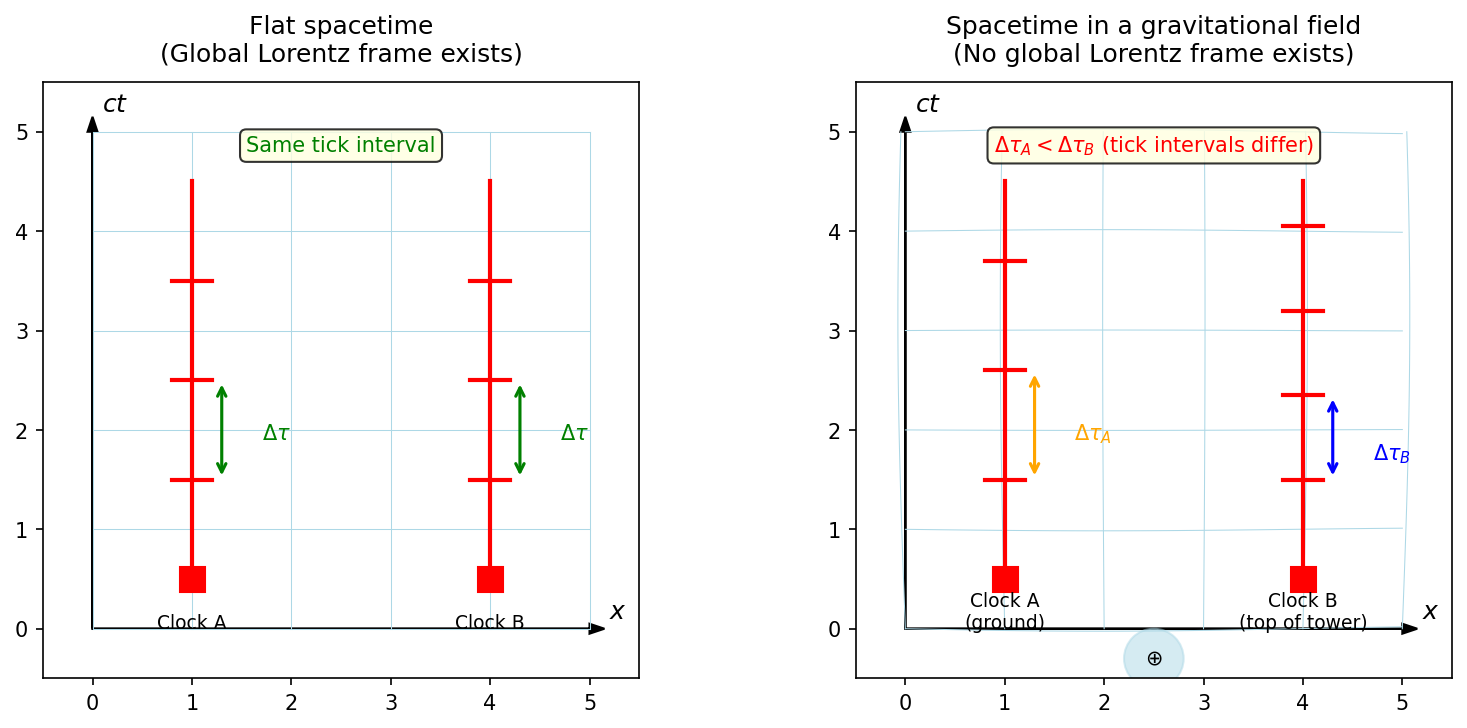
Fig. 5.7: Why no global Lorentz frame exists. Left: In flat spacetime, two clocks at rest at different locations tick at the same rate (a global Lorentz frame exists). Right: In a gravitational field, a clock on the ground (lower potential) runs slower than a clock at the top of the tower. This difference in clock rates means no single Lorentz frame covering all of spacetime exists.
🟡 Lina: As we learned in Ch. 4, proper time \(d\tau\) (the time ticked by the clock itself) is defined from the spacetime interval. In Ch. 4 we used natural units with \(c = 1\), writing \(d\tau^2 = -ds^2\). In this chapter with SI units where \(c\) is explicit, we match dimensions by writing \(c^2 d\tau^2 = -ds^2\) (just multiplying the left side by \(c^2\) to get dimensions of length squared). Let's verify for a stationary clock (\(dx = dy = dz = 0\)). \(ds^2 = -c^2 dt^2\) gives \(-ds^2 = c^2 dt^2\). So \(c^2 d\tau^2 = c^2 dt^2\), meaning \(d\tau = dt\).
🔵 Kai: So in a Lorentz frame, a stationary clock advances at the same rate as coordinate time \(t\) regardless of location.
🟡 Lina: Right. But now recall the gravitational redshift we just derived. The frequency of light differs between the top and ground of the tower. Consider using light oscillations as a "clock" — for example, making a clock that "advances one tick for every oscillation of light." If the frequency of light emitted at the ground is \(\nu_{\text{ground}}\), the ground clock ticks \(\nu_{\text{ground}}\) times per second. When the same light arrives at the top, its frequency has dropped to \(\nu_{\text{top}} < \nu_{\text{ground}}\). But if a person at the top makes a clock using the same type of light source at hand, its frequency should be the same value as \(\nu_{\text{ground}}\) (since the same physical laws produce the same light source). So the "local clock" at the top ticks faster than the light arriving from the ground — this means the clock at the top runs faster than the clock on the ground.
🔵 Kai: Ah, I see. The light arriving from the ground looks "slow" because the clock at the top is running faster.
🟡 Lina: Exactly. So the proper time \(d\tau\) ticked during the same coordinate time interval \(dt\) differs by location. But as we just saw, in a Lorentz frame \(d\tau = dt\) is the same everywhere. This is a contradiction. Therefore within a gravitational field, no global Lorentz frame covering the entire surface of the Earth exists. You cannot construct a single Lorentz frame that simultaneously covers both the top and bottom of the tower.
⚪ Mei: From the single observational fact of gravitational redshift, it logically follows that the framework of special relativity alone cannot handle gravity.
🔵 Kai: So is special relativity no longer usable?
🟡 Lina: Not globally. But locally it can be used. As the equivalence principle taught us, within a freely falling system — a local inertial frame — special relativity holds exactly in a sufficiently small region.
Analogy with a Curved Surface
🟡 Lina: Let me introduce a very important analogy. Think about Earth's surface.
🔵 Kai: A sphere.
🟡 Lina: A sphere is curved, but the ground at your feet looks flat, right? In a sufficiently small region, the sphere can be approximated as a plane. But you can't cover the entire Earth with a single plane — making a flat map always introduces distortions.
⚪ Mei: So just as a sphere cannot be covered by a single plane, spacetime with a gravitational field cannot be covered by a single Lorentz frame — but just as your feet see a flat approximation, locally special relativity works.
🟡 Lina: Precisely. Einstein took this analogy seriously. Spacetime with a gravitational field is "curved" like a sphere, and in sufficiently small regions it looks "flat" (Minkowski-like). But a single Lorentz frame cannot cover all of spacetime. And here is Einstein's genius leap.
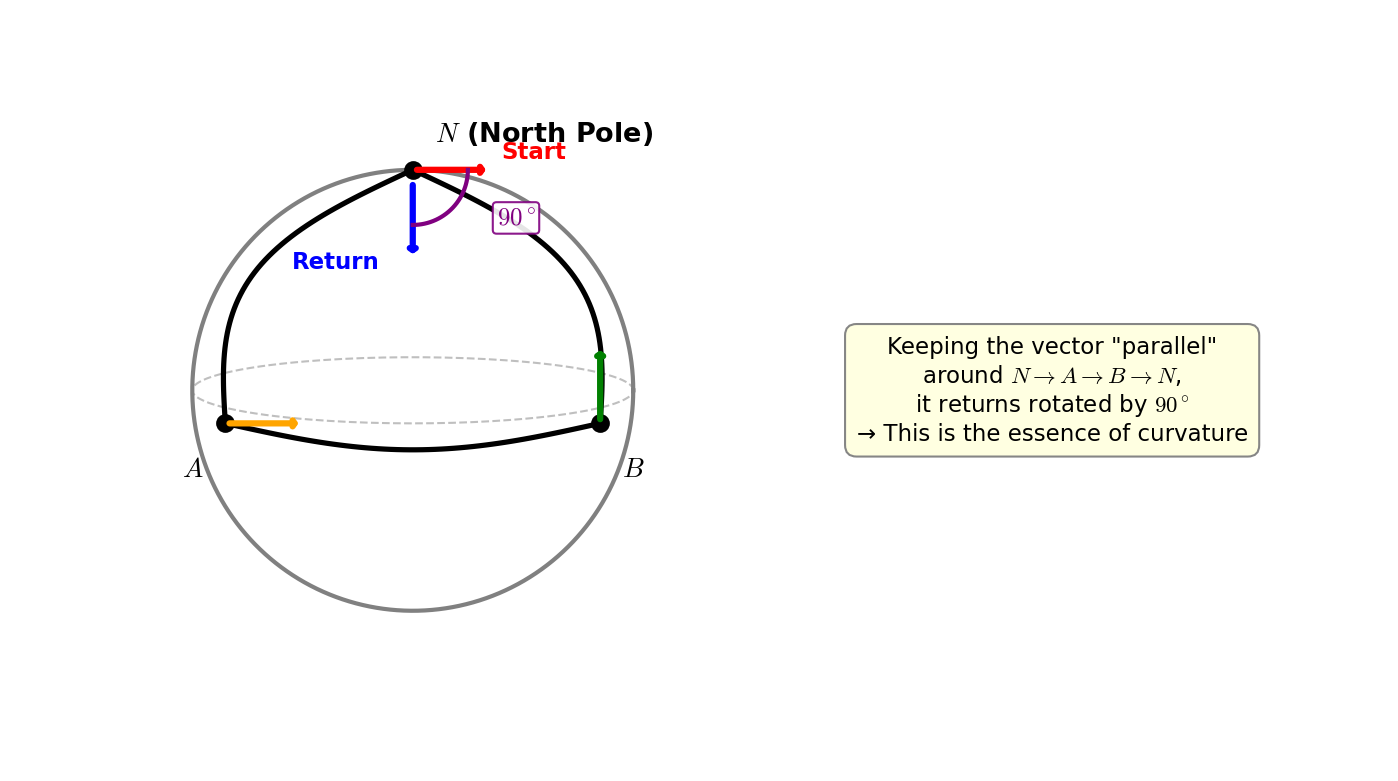
Fig. 5.8: Parallel transport and curvature on a sphere. When a vector is carried "parallel to itself" around the loop \(N \to A \to B \to N\) on a sphere, it returns rotated by \(90°\). In flat space it would not rotate. The rotation angle reflects the curvature.
🟡 Lina: Look at Fig. 5.8 "Parallel transport and curvature on a sphere". Imagine an arrow at the North Pole \(N\) pointing south. Carry this arrow "without changing its direction" straight down to a point \(A\) on the equator. Then carry it along the equator to point \(B\). Finally, carry it from \(B\) back to the North Pole \(N\). On a flat sheet of paper, the arrow should return to its original direction. But on a sphere, the arrow has rotated by \(90°\) when it returns.
🔵 Kai: What exactly does "carry without changing direction" mean?
🟡 Lina: Intuitively, it means "don't tilt it left or right relative to the direction of travel." Let's trace through concretely. An arrow pointing south at the North Pole is carried along a meridian to the equator — since we don't tilt it left or right relative to the direction of travel (south), the arrow keeps pointing south and arrives at the equator. Next, carry it \(90°\) eastward along the equator — now the direction of travel is east, so we don't tilt the arrow east-west. The south-pointing arrow is at right angles (\(90°\) to the right) of the direction of travel (east). Carrying without tilting, it stays \(90°\) to the right of the direction of travel, meaning it keeps pointing south. Finally, carry it from there along a meridian back to the North Pole — the direction of travel is north, so we don't tilt the arrow left or right. It's carried while maintaining "\(90°\) to the right of the direction of travel." The crucial point here is that when traveling north along a meridian, the cardinal directions themselves change with location. At the starting point on the equator, "north" was toward the pole, and "\(90°\) to the right" was south. But upon arriving at the North Pole, the meridian you walked along defines "south." That is, at the North Pole, your "direction of travel" is from the direction of the 90°E meridian. The right \(90°\) from that is... not "south" along the 0° meridian, but right from 90°E, which means pointing west. This might be confusing with words alone, so try tracing it with your finger on a globe. If you check the angle between the 0° meridian and the 90°E meridian at the North Pole, you'll feel how the arrow has rotated \(90°\). So upon returning to the North Pole, the arrow points west. It started pointing south but has rotated \(90°\)! On a flat surface, "parallel transport" is trivial and the arrow returns unchanged, but on a curved surface, the result depends on the path. This operation is called parallel transport. And the degree to which "the direction changes after going around" reflects the curvature of the surface. We'll formalize this mathematically in later chapters.
🔵 Kai: I see... "curvature" can be detected by someone on the surface without leaving it. Just check whether the direction changes after going around a loop.
🟡 Lina: Exactly. This is the idea of "intrinsic curvature." You can detect curvature using only operations on the surface, without looking at it from outside.
Correspondence Between Tidal Force and Curvature
🟡 Lina: We discussed tidal forces earlier. Two freely falling particles approach or separate due to the non-uniformity of the gravitational field.
🟡 Lina: In fact, exactly the same thing happens in the geometry of a curved surface. Imagine two people on a sphere who start at two points on the equator and walk "straight" northward.
🔵 Kai: What does "straight" mean on a sphere? The sphere itself is curved.
🟡 Lina: Good question. It means not turning left or right, following the shortest-distance path on the surface — this is called a geodesic. On a sphere, geodesics are great circles. A great circle is the circle formed when a plane passing through the center of the sphere intersects the sphere's surface — meridians and the equator on a globe are examples.
🔵 Kai: Why are great circles the shortest paths?
🟡 Lina: Think of a familiar example. When flying from Tokyo to New York, drawing a straight line on a flat map appears to cross the Pacific, but actual flights take a route through the Arctic region. If you stretch a string taut on a globe, you'll see the northerly route is shorter. The taut string traces an arc of a great circle. On a sphere, "straight" takes a different shape than a straight line on a flat surface.
🔵 Kai: Oh, so that's what "great circle routes" for airplanes mean.
🟡 Lina: Now consider two people walking along geodesics northward from two points on the equator. For example, one walking along the 0° meridian (through London) and another along the 90°E meridian (through Southeast Asia). On the equator, their separation is one-quarter of Earth's circumference, but as they head north, the spacing between meridians narrows, and at the North Pole all meridians converge to a single point. Check on a globe — meridians equally spaced at the equator all converge at the pole. Since meridians are geodesics (great circles), this is a concrete example of "parallel lines meeting on a curved surface." If you have a globe handy, trace two meridians with your fingers to feel it.
🔵 Kai: Ah, right! On a plane, parallel lines stay parallel forever, but on a sphere they meet.
⚪ Mei: That has the same structure as tidal force. Two freely falling particles approaching each other — two geodesics on a sphere converging toward the pole.
🟡 Lina: Einstein saw through this correspondence.
Table 5.3: Correspondence between gravitational phenomena and the geometry of curved spacetime
| World of gravity | Geometry of curved surfaces |
|---|---|
| Path of a freely falling particle | Geodesic in curved spacetime |
| Relative acceleration between particles due to tidal force | Convergence/divergence of geodesics due to curvature |
| Gravity can be locally eliminated (equivalence principle) | Locally looks flat |
| Cannot be eliminated globally (tidal force) | Cannot be covered globally by a plane |
🟡 Lina: So the effects of gravity can be described as curvature of spacetime.
✅ Comprehension Check: What does tidal force (relative acceleration between freely falling particles) correspond to in the geometry of curved spacetime?
Answer
It corresponds to the convergence/divergence of geodesics due to curvature. Just as two initially parallel geodesics (great circles) on a sphere converge toward the pole, in curved spacetime the paths of freely falling particles (geodesics) approach or separate from each other due to curvature.
The Great Conceptual Shift — Free Fall Is "Inertial Motion"
🟡 Lina: Let me clarify the difference in thinking between Newtonian mechanics and general relativity.
🟡 Lina: In Newtonian mechanics, a person stationary on Earth's surface is considered to be in an "inertial frame," and a falling apple is interpreted as having "a force called gravity acting on it."
🔵 Kai: That's the normal way of thinking, right?
🟡 Lina: But in general relativity, it's reversed. The falling apple is the one doing inertial motion, and the person standing on Earth's surface is being pushed upward by the ground and is accelerating. Let me summarize this shift in thinking in a table.
Table 5.4: Comparison of the interpretation of "gravity" in Newtonian mechanics and general relativity
| Newtonian mechanics | General relativity | |
|---|---|---|
| Nature of gravity | A "force" between objects | Spacetime curvature (geometric property) |
| Inertial motion | No forces, constant velocity straight-line motion | Free fall (motion along geodesics) |
| Falling apple | Being accelerated by the force of gravity | Doing inertial motion (no force acting) |
| Person standing on ground | In an inertial frame (forces balanced) | Being pushed by the ground and accelerating |
| Reading on a bathroom scale | Balance of gravity and normal force | Detection of deviation from geodesic (acceleration) |
🔵 Kai: What? Me standing on the ground right now is an "accelerating" state?
🟡 Lina: Yes. The ground is pushing your feet upward, so you're deviating from free fall (= inertial motion). What a bathroom scale shows is the degree to which you're deviating from inertial motion.
🔵 Kai: But if I'm accelerating, my velocity should keep changing, right? I've been in the same place the whole time...
🟡 Lina: Good question. First, think about bodily sensation. When you're sitting in a chair, you feel the force of the chair on your bottom, right?
🔵 Kai: Yes, I feel it.
🟡 Lina: If you were in free fall — inside the ISS — that force would be zero. So "feeling a force" itself is evidence that you're deviating from free fall (= inertial motion). In general relativity, this "whether you feel a force or not" is the criterion for determining acceleration.
🔵 Kai: I see... not "whether you're moving through space" but "whether you feel a force" determines acceleration. But "acceleration" normally means velocity is changing, right? Calling it "acceleration" when you just feel a force but velocity isn't changing — isn't that changing the meaning of the word?
🟡 Lina: Sharp observation. Actually, thinking "velocity isn't changing" refers to the spatial perspective. Recall the spacetime diagrams from Ch. 4 — even if you're spatially at rest, you're always moving forward in the time direction, right? On a spacetime diagram, even a stationary person traces a "path (world line) extending upward along the time axis."
🔵 Kai: Oh right. On a spacetime diagram, even "at rest" the world line extends upward. Whether that world line is "straight" is the question.
🟡 Lina: Exactly. A freely falling object's world line is a geodesic (the most natural straight path in curved spacetime), but a person standing on the ground is being pushed by the ground and continuously deviates from the geodesic. This "deviating from the geodesic" is the precise meaning of "acceleration" in general relativity. An accelerometer (bathroom scale) registers a value precisely because it's detecting this deviation.
🔵 Kai: Hmm... spatially not moving, but in spacetime continuously deviating from "the straight path." Honestly I still can't fully intuit this, but I understand the criterion "feeling a force = deviating from geodesic." Then conversely, a freely falling person "feels no force" and is on the geodesic — so an accelerometer reading zero is "evidence of inertial motion."
⚪ Mei: So in Newtonian mechanics the criterion was "static equilibrium = inertial frame," but in general relativity it becomes "feeling no force = inertial motion (geodesic)." A bathroom scale can be reinterpreted not as measuring "the magnitude of gravity" but "how much you deviate from a geodesic."
🟡 Lina: Exactly. The criterion for "what is natural motion" is reversed between Newtonian mechanics and general relativity.
✅ Comprehension Check: In Newtonian mechanics and general relativity, which is doing "inertial motion" — the person standing on the ground or the freely falling apple?
Answer
The freely falling apple is the one doing inertial motion (motion along a geodesic). The person standing on the ground is in a state of being pushed upward by the ground and accelerating (deviating from free fall).
🟡 Lina: In other words, gravity is not a "force" but a geometric property of spacetime. Objects simply follow the "straightest" paths in curved spacetime — geodesics — and are not being pulled by any "force." This was Einstein's revolutionary insight. Wheeler summarized it beautifully:
John Wheeler
Spacetime tells matter how to move; matter tells spacetime how to curve.
🔵 Kai: Gravity isn't a "force" but "curvature of spacetime"... honestly I'm still half-skeptical. Newton's \(F = mg\) worked for hundreds of years, and now it's all just "appearance"? But yes — the fact that you can cancel gravity with the equivalence principle, that tidal force corresponds to curvature, that no global Lorentz frame exists — it all connects to "gravity = spacetime curvature." But how do you measure "curvature" numerically? For a sphere, the radius determines the curvature, but spacetime doesn't have a "radius."
⚪ Mei: Indeed, if we say "it's curved," we need mathematics to express it quantitatively.
🟡 Lina: Good question. That's exactly the journey ahead. We'll learn the mathematics describing curved spacetime — Riemannian geometry — and ultimately arrive at Einstein's field equation. But before that, the next chapter prepares the mathematical tools for "how to describe curved space."
🔵 Kai: I'm looking forward to it. Once I understand "how to express curvature numerically," I think it'll click more.
✅ Comprehension Check: In general relativity, which is doing "inertial motion" — the person standing on the ground or the freely falling apple?
Answer
The freely falling apple is the one doing inertial motion (motion along a geodesic). The person standing on the ground is in a state of being pushed upward by the ground and deviating from free fall (accelerating).
📝 Exercises:
- Newton vs general relativity interpretation, geodesics → Problem M-6. Shift in Interpretation between Newtonian Mechanics and General Relativity
5.7 Summary of This Chapter
🟡 Lina: Let's organize what we learned today.
-
Contradiction between Newtonian gravity and special relativity: Newton's gravity assumes instantaneous action at a distance, incompatible with special relativity's prohibition of faster-than-light information transfer.
-
Inertial mass and gravitational mass: Logically separate concepts, but experimentally confirmed equal to better than \(10^{-15}\) precision (MICROSCOPE satellite, 2022). Thanks to this equivalence, all objects fall with the same acceleration.
-
The equivalence principle: A system at rest in a gravitational field and a system accelerating in gravity-free space are locally indistinguishable. A freely falling system is equivalent to a local inertial frame.
-
Gravitational redshift: From the equivalence principle, light sent from lower to higher gravitational potential decreases in frequency by \(\Delta\nu/\nu \approx -gH/c^2\). This means time passes at different rates at different locations.
-
Gravity is a property of spacetime: From the non-existence of a global Lorentz frame and the correspondence between tidal force and curvature, we conclude that gravity should be described not as a "force" but as "curvature of spacetime."
Preview of the Next Chapter
In this chapter, we arrived at the physical idea that "gravity is the curvature of spacetime." However, we don't yet have concrete mathematical tools for measuring "distance" and "angle" in curved space. In the next chapter, Ch. 6, starting from curvilinear coordinates such as polar and spherical coordinates, we'll introduce the metric tensor \(g_{\mu\nu}\). What does it mean for distance to remain unchanged even when the coordinate system changes — we'll take the first step toward Riemannian geometry.
References
- Hartle, J. B. (2003). Gravity: An Introduction to Einstein's General Relativity. Addison-Wesley. Chapter 6.
- Hobson, M. P., Efstathiou, G. P. & Lasenby, A. N. (2006). General Relativity: An Introduction for Physicists. Cambridge University Press.
- Schutz, B. F. (2022). A First Course in General Relativity, 3rd ed. Cambridge University Press. Chapter 5.
- 佐藤勝彦 (1996).『相対性理論』岩波書店. 第 3 章「特殊相対性論の限界と等価原理」.
- Tong, D. (2019). General Relativity. University of Cambridge Lecture Notes. Chapter 1.
- Rovelli, C. (2016). Reality Is Not What It Seems: The Journey to Quantum Gravity. Penguin. Chapter 5.
- Pound, R. V. & Rebka, G. A. (1960). "Apparent Weight of Photons." Physical Review Letters, 4(7), 337–341.
- Touboul, P. et al. [MICROSCOPE Collaboration] (2017). "MICROSCOPE Mission: First Results of a Space Test of the Equivalence Principle." Physical Review Letters, 119(23), 231101.
- Touboul, P. et al. [MICROSCOPE Collaboration] (2022). "MICROSCOPE Mission: Final Results of the Test of the Equivalence Principle." Physical Review Letters, 129(12), 121102.
Feedback on this page
Let us know if something was unclear, incorrect, or could be improved.