Prologue — Welcome to This Journey
A general relativity class scene: Lina, Kai, and Mei.
Before You Begin
If you haven't read it yet, please start with Introduction — Before the 4 Journeys. It shares the philosophy of science stance underlying this entire site (models are hypotheses / equations are tools for falsifiability) and provides a map of the 4 journeys.
Goals of This Prologue
Gain the motivation and overall map for the entire journey.
- Grasp Newton's limitations — Survey where the gravitational model hits a wall and why it contradicts special relativity
- See the question Einstein answered — Get a sense of what question general relativity answers as a model
- Grasp the big picture of the journey — Overview the structure of all 25 chapters across 9 Parts, and confirm the role of the equations we'll be following
We want to survey what questions the model called "general relativity"—which Einstein struggled with for 10 years and which repainted the landscape of 20th-century physics—answers, what phenomena it describes, and where we're headed on this long journey. We'll keep equations to a minimum; the full mathematical development begins in Ch. 1.
Why Study General Relativity?
🔵 Kai: Why do we need to learn "general relativity" in the first place? Isn't Newton's gravity good enough?
🟡 Lina: Great question. Newton's universal gravitation predicted celestial motion with astounding accuracy for centuries. The basic equation is:
where \(G \approx 6.67 \times 10^{-11}\ \mathrm{N\cdot m^2/kg^2}\) is the gravitational constant. The discovery of Neptune in 1846 "by calculation alone" was Newton's model at its finest.
🔵 Kai: Discovering a planet by calculation!?
🟡 Lina: But from the late 19th century into the early 20th century, phenomena that Newton's model couldn't explain were gradually being found. A subtle drift in Mercury's orbit, mysteries about the speed of light, and above all—Newton's model contradicts special relativity.
⚪ Mei: What do you mean by "contradicts," specifically?
🟡 Lina: Special relativity, published by Einstein in 1905, starts from the astonishing fact that "no matter how fast you're moving, the speed of light always measures the same value \(c \approx 3 \times 10^8\ \mathrm{m/s}\)." As a consequence, it asserts that "no signal can travel faster than the speed of light" (we'll derive why in Part II). But look at Newton's equation \(F = Gm_1 m_2/r^2\)—there's nowhere in this equation for "the time it takes to propagate," is there? That means if the Sun suddenly disappeared, Earth, 150 million km away, would feel it instantaneously. It propagates infinitely faster than light. The contradiction is visible the moment you write both side by side.
🔵 Kai: Wait a moment. If "the speed of light is constant," why does that mean "signals faster than light are forbidden"? Aren't those separate things…?
🟡 Lina: Good question. Intuitively, if the speed of light is the same for everyone, then no matter how much you accelerate, the speed of light as seen from your perspective remains \(c\)—meaning the gap between you and light never shrinks. Since there's an "unreachable wall," you can't leap over it either. We'll leave the rigorous derivation to Part II, but for now, just accept the conclusion that "special relativity forbids superluminal transmission."
🔵 Kai: Got it. So Newton's gravity propagates instantaneously, which creates a contradiction… how was it resolved?
🟡 Lina: In 1915, after 10 years of searching, Einstein arrived at a remarkable answer—
Gravity is not a "force." Gravity is the curvature of spacetime.
🔵 Kai: …Spacetime curves? But why does making it "the shape of spacetime" eliminate the instantaneous propagation problem?
🟡 Lina: Good question. In Newton's model, the contradiction arose because it assumed "force arrives instantaneously." Einstein redescribed gravity not as a "force" but as "the shape of spacetime itself." And because Einstein's equations are constructed to be consistent with special relativity, changes in the shape of spacetime—that is, changes in curvature—are automatically guaranteed to propagate as waves at or below the speed of light. That's why the instantaneous propagation problem disappears.
⚪ Mei: So by reframing it from "a force flying across" to "the shape of spacetime changing," the speed limit of light could be naturally built into the propagation speed.
🟡 Lina: Exactly. And the main theme of this journey is to express that idea precisely in equations.
✅ Comprehension Check: State in one sentence why Newton's gravitational model contradicts special relativity.
Answer
Newton's gravity propagates instantaneously (at infinite speed), but special relativity states that no signal can travel faster than the speed of light.
📝 Exercises:
- Calculating the magnitude of the Sun-Earth gravitational force → Problem B-1. Calculating the Gravitational Force Between the Sun and Earth
Four Fundamental Properties of Gravity
🟡 Lina: Before we dive into equations, let's organize the "personality" of gravity as a force. Every phenomenon in this universe can ultimately be explained by one of 4 fundamental forces.
Table 0.1: Comparison of the four fundamental forces of nature
| Force | Acts on | Range | Relative strength (strong force = 1) |
|---|---|---|---|
| Strong force | Quarks, atomic nuclei | \(\sim 10^{-15}\) m | \(1\) (reference) |
| Electromagnetic force | Charged particles | Infinite | \(\sim 10^{-2}\) |
| Weak force | Leptons, quarks | \(\sim 10^{-18}\) m | \(\sim 10^{-6}\) |
| Gravity | Everything with mass (energy) | Infinite | \(\sim 10^{-38}\) |
Terminology note: Quarks are particles that make up protons and neutrons; leptons are the collective name for particles like electrons and neutrinos (extremely light particles with no electric charge) that don't feel the strong force. The strong force is what binds protons and neutrons together inside atomic nuclei; the weak force causes radioactive decay (β decay (beta decay)—a process where a neutron inside a nucleus transforms into a proton, emitting an electron and a neutrino). The "relative strength" in the table is a rough ratio when comparing each force at the same distance between the same particles (an order-of-magnitude guide), which can vary by several orders depending on conditions. What matters here is the contrast that "only gravity acts on everything."
🔵 Kai: Gravity is overwhelmingly weak… \(10^{-38}\) means the reciprocal of 1 followed by 38 zeros, right? That's unimaginably small.
🟡 Lina: Right. To give you a sense of how weak it is: if you place two protons 1 m apart, the gravitational attraction is less than \(10^{36}\) times weaker than the electromagnetic repulsion. To grasp how enormous \(10^{36}\) is—it's a trillion (\(10^{12}\)) times a trillion times a trillion—a weakness utterly beyond everyday intuition. But gravity has 4 special properties that allow it to dominate the universe despite this weakness.
- Universality — It acts on all matter and energy (unlike electromagnetic force, it affects particles without electric charge too)
- Cannot be shielded — With electricity, you can cancel forces by combining + and − charges, but gravity has no "negative mass." It's always attractive
- Long-range force — Gravitational attraction diminishes as \(1/r^2\) but never reaches zero. It reaches everywhere
- Extremely weak — Comparing gravity to electromagnetic force between two protons: only \(\sim 10^{-36}\) times as strong
Note: The \(10^{-38}\) in the table uses the strong force as reference, while \(10^{-36}\) here uses the electromagnetic force as reference—the comparison targets differ, but both show that gravity is "overwhelmingly weak."
🔵 Kai: But even though it's this weak, they say gravity dominates at cosmic scales, right? Why?
🟡 Lina: Good question. The electromagnetic force has positive and negative charges that cancel each other out, so at large scales it gets neutralized. But gravity cannot be canceled—it can't be shielded, it's always attractive, and it reaches everywhere, so the more mass accumulates, the stronger it gets. At the scale of stars, galaxies, and the entire universe, gravity becomes the dominant force.
🔵 Kai: …So gravity is weak but "can't be canceled," which means it snowballs as mass accumulates? But conversely, if "negative mass" existed, would gravity cancel out and become weaker?
🟡 Lina: Theoretically, yes. But negative mass has never been observed. So gravity only ever accumulates.
🔵 Kai: Weak but never canceled, so it wins in the end… It's an understated but tenacious force.
🟡 Lina: Exactly. To summarize, three of the four properties—"universal, cannot be shielded, long-range"—combine to compensate for its weakness. Conversely, looking at the other forces: the electromagnetic force is "strong but positive and negative cancel out," and the strong and weak forces are "strong but have extremely short range as shown in the table"—each has a reason for becoming ineffective at large scales. Gravity alone has neither of these weaknesses—its only weakness is "being weak."
⚪ Mei: To organize: the electromagnetic force's weakness is "cancellation," the strong and weak forces' weakness is "limited range"—gravity's only weakness is "being weak." That's why at large scales, only gravity survives.
✅ Comprehension Check: Gravity is overwhelmingly the weakest of the 4 fundamental forces, yet it dominates at the largest cosmic scales. Why?
Answer
Gravity cannot be shielded (there's no negative mass), it's always attractive, and it reaches everywhere. The electromagnetic force has positive and negative charges that cancel at large scales, but gravity is never canceled and only accumulates.
📝 Exercises:
- Ratio of gravitational to electromagnetic force strength → Problem B-2. Ratio of Gravitational to Coulomb Force Between Protons
- Quantitative understanding of gravity's 4 properties → Problem M-1. Quantitative Evaluation of the Four Properties of Gravity
When Does General Relativity Become Necessary? — The Criterion \(GM/(Rc^2)\)
🔵 Kai: Specifically, when can't Newton's model explain things?
🟡 Lina: Using a celestial body's mass \(M\) and radius \(R\), we compute the quantity
This is a pure number with no units (a dimensionless quantity)—for example, just as "height ÷ arm length" gives a pure number when you divide quantities of the same dimension. Let's actually verify the dimensions: \(G\) has dimensions \(\mathrm{m^3/(kg \cdot s^2)}\), \(M\) is \(\mathrm{kg}\), \(R\) is \(\mathrm{m}\), and \(c^2\) is \(\mathrm{m^2/s^2}\), so
(In the numerator, \(\mathrm{kg}\) cancels to give \(\mathrm{m^3/s^2}\); in the denominator, \(\mathrm{m \times m^2 = m^3}\), so numerator and denominator match.)
The units cancel properly to give a dimensionless quantity. Roughly speaking, it's an indicator of "how much the gravitational effects at a body's surface encroach into the realm of light speed (the relativistic domain)." The closer this value gets to 1, the more general relativistic effects cannot be ignored. Let's look at specific values:
Table 0.2: Rough relativistic parameter for various celestial bodies
| Celestial body | Approximate \(GM/(Rc^2)\) |
|---|---|
| Earth | \(\sim 10^{-9}\) |
| Sun | \(\sim 10^{-6}\) |
| White dwarf | \(\sim 10^{-4}\) |
| Neutron star | \(\sim 0.1\) |
| Black hole | \(\sim 1\) |
🔵 Kai: Why does this quantity represent "the strength of gravity"? It just looks like combining \(G\), \(M\), \(R\), and \(c\)…
🟡 Lina: Intuitively, think of the minimum speed you'd need to launch a rocket from a body's surface so it never comes back—this is called the escape velocity. For a rocket to fly all the way to infinity, its initial kinetic energy \(\frac{1}{2}mv^2\) must be at least as large as the energy needed to move against gravity all the way to infinity.
🔵 Kai: How do you find "the energy needed to move against gravity all the way to infinity"? Since gravity changes with distance, you can't just do "force × distance," right?
🟡 Lina: Right, good catch. Since the force changes with distance, you technically need to "multiply the varying force by a tiny interval at each distance and add them all up."
For those who haven't learned integration yet: In mathematics, this operation is called "integration" and is denoted by the symbol \(\int\). Since gravity weakens with distance (decreasing as \(1/r^2\)), adding it all up to infinity still gives a finite total—just accept that the result is \(GMm/R\). The mathematical derivation below is a supplement for those who've studied Calculus, so feel free to skip ahead to "just barely escaping."
Written as an equation, it's \(\int_R^\infty \frac{GMm}{r^2}\,dr\)—the integral symbol \(\int\) means "sum up," and the image is adding up the gravity \(GMm/r^2\) at each point bit by bit from \(R\) to \(\infty\) (infinity).
Pulling the constant \(GMm\) outside the integral gives \(GMm\int_R^\infty r^{-2}\,dr\). Using the formula \(\int r^{-2}\,dr = -r^{-1}\) from calculus, we get \(GMm\,[-1/r]_R^\infty\). This notation means "substitute \(r = \infty\) into \(-1/r\), then subtract the value with \(r = R\) substituted." Since \(-1/r \to 0\) as \(r \to \infty\), we get \(0 - (-1/R) = 1/R\)—so the total converges to the finite value \(1/R\). Multiplying by \(GMm\) gives the result \(GMm/R\). In physics textbooks, the gravitational potential energy is defined as \(-GMm/r\) with infinity as the reference. The minus sign appears because an object attracted by gravity is in a lower energy state than at infinity (reference = 0)—it needs energy input to reach infinity. The potential energy at infinity is \(0\), and at radius \(R\) it's \(-GMm/R\), so the energy needed to go from radius \(R\) to infinity is the difference: \(0 - (-GMm/R) = GMm/R\). A careful derivation of the integral will be done in Ch. 1, so for now we'll just use the result.
"Just barely escaping" means arriving at infinity with exactly zero velocity—reaching it with no energy to spare. In this case, kinetic energy exactly equals the required energy, so \(\frac{1}{2}mv^2 = \frac{GMm}{R}\). Dividing both sides by \(m\) and solving for \(v\) gives \(v_{\mathrm{esc}} = \sqrt{2GM/R}\). Dividing by \(c\) and squaring:
So \(GM/(Rc^2)\) is exactly half of \((v_{\mathrm{esc}}/c)^2\)—an indicator measuring how close the escape velocity is to the speed of light. As this value approaches 1, the "escape velocity approaches the speed of light"—meaning gravity is so extreme that even light has difficulty escaping. The rigorous derivation is in Ch. 1, so for now just remember that "the closer to 1, the more Newton can't handle it."
🔵 Kai: I see, if it's the ratio of escape velocity to the speed of light, you can intuitively grasp "how extreme the gravity is." I'll follow the integral calculation in Ch. 1, but I'll remember the result \(v_{\mathrm{esc}} = \sqrt{2GM/R}\) for now. But for Earth it's \(10^{-9}\), right—what does that translate to in terms of escape velocity?
🟡 Lina: \((v_{\mathrm{esc}}/c)^2 = 2GM/(Rc^2) \approx 2 \times 10^{-9}\) (twice the table's \(GM/(Rc^2) \sim 10^{-9}\)), so \(v_{\mathrm{esc}}/c \approx \sqrt{2 \times 10^{-9}} \approx 4.5 \times 10^{-5}\)—about 1/22,000th of the speed of light. Well within the regime where Newton suffices.
🔵 Kai: 1/22,000th of the speed of light. No wonder we don't need relativity in everyday life. But conversely, for a neutron star at \(0.1\), the escape velocity is… let's see, \(\sqrt{0.2} \approx 0.45\), so nearly half the speed of light? At that point Newton definitely won't work.
⚪ Mei: Looking at the table, there's an 8 order-of-magnitude change from Earth to neutron stars. What creates this difference?
🟡 Lina: Good observation. Looking at the formula \(GM/(Rc^2)\), the larger the mass \(M\) and the smaller the radius \(R\), the larger the value. In other words, this indicator measures how compactly a body is compressed. In physics, it's also called "compactness." Even for bodies of similar mass, the more tightly compressed one has a larger value—think of it as a density-like indicator of "mass ÷ size."
⚪ Mei: I see. So a neutron star has roughly the same order of mass as the Sun, but because its radius is so much smaller, the value jumps dramatically.
🟡 Lina: Exactly. In fact, a neutron star has 1–2 solar masses but a radius of only about 10 km—compared to the Sun's radius of 700,000 km, it's dramatically smaller, so the value jumps by 5 orders of magnitude. In everyday life Newton suffices, but for precision technology like GPS, even Earth's \(10^{-9}\) requires corrections. Conversely, for neutron stars and black holes, Newton's model can't tell us anything.
✅ Comprehension Check: Give one example of a celestial body for which the dimensionless quantity \(GM/(Rc^2)\) is close to 1.
Answer
A black hole (\(GM/(Rc^2) \sim 1\)). Neutron stars (\(\sim 0.1\)) also have large general relativistic effects.
📝 Exercises:
- Computing \(GM/(Rc^2)\) → Problem B-4. Relativistic Parameter for Various Celestial Bodies
- Deriving the Schwarzschild radius → Problem B-5. Derivation of the Schwarzschild Radius
- \(GM/(Rc^2)\) at the Schwarzschild radius → Problem B-6. Criterion at the Schwarzschild Radius
- Correspondence between \(GM/(Rc^2)\) and observed phenomena → Problem M-2. Stages of the Transition from Newton to GR
The World Described by General Relativity
🟡 Lina: General relativity describes a surprisingly wide range of phenomena with a single equation. Let's look at 4 concrete examples.
GPS — Relativity Embedded in Our Daily Lives
The map app on your smartphone calculates your position using signals from GPS satellites orbiting Earth. The atomic clocks on these satellites require nanosecond-level precision. According to general relativity, clocks in stronger gravity tick slower than clocks in weaker gravity (we'll learn why in Part IV)—since satellites orbit at higher altitudes where Earth's gravity is weaker, their clocks tick faster than clocks on the ground. Additionally, the special relativistic effect (time dilation due to the satellite's high speed) also plays a role, and the net combined effect is that satellite clocks run about 38 microseconds faster per day than ground clocks.
Breakdown (reference): The gravitational effect alone makes clocks run about +45 microseconds faster, while the special relativistic effect (time dilation from the satellite's high speed—we'll learn why in Part II) contributes about \(-7\) microseconds, partially canceling it. The net effect is about +38 microseconds. Without correction, position errors would accumulate to about 11 km per day (GPS calculates distance from the arrival time of radio waves from satellites, so a 38-microsecond clock offset translates to a "distance reading" error. Radio waves travel at the speed of light, covering about 300 m per microsecond, so a 38-microsecond offset corresponds to roughly \(38 \times 300\ \mathrm{m} \approx 11\ \mathrm{km}\)). General relativity is already embedded in our daily lives.
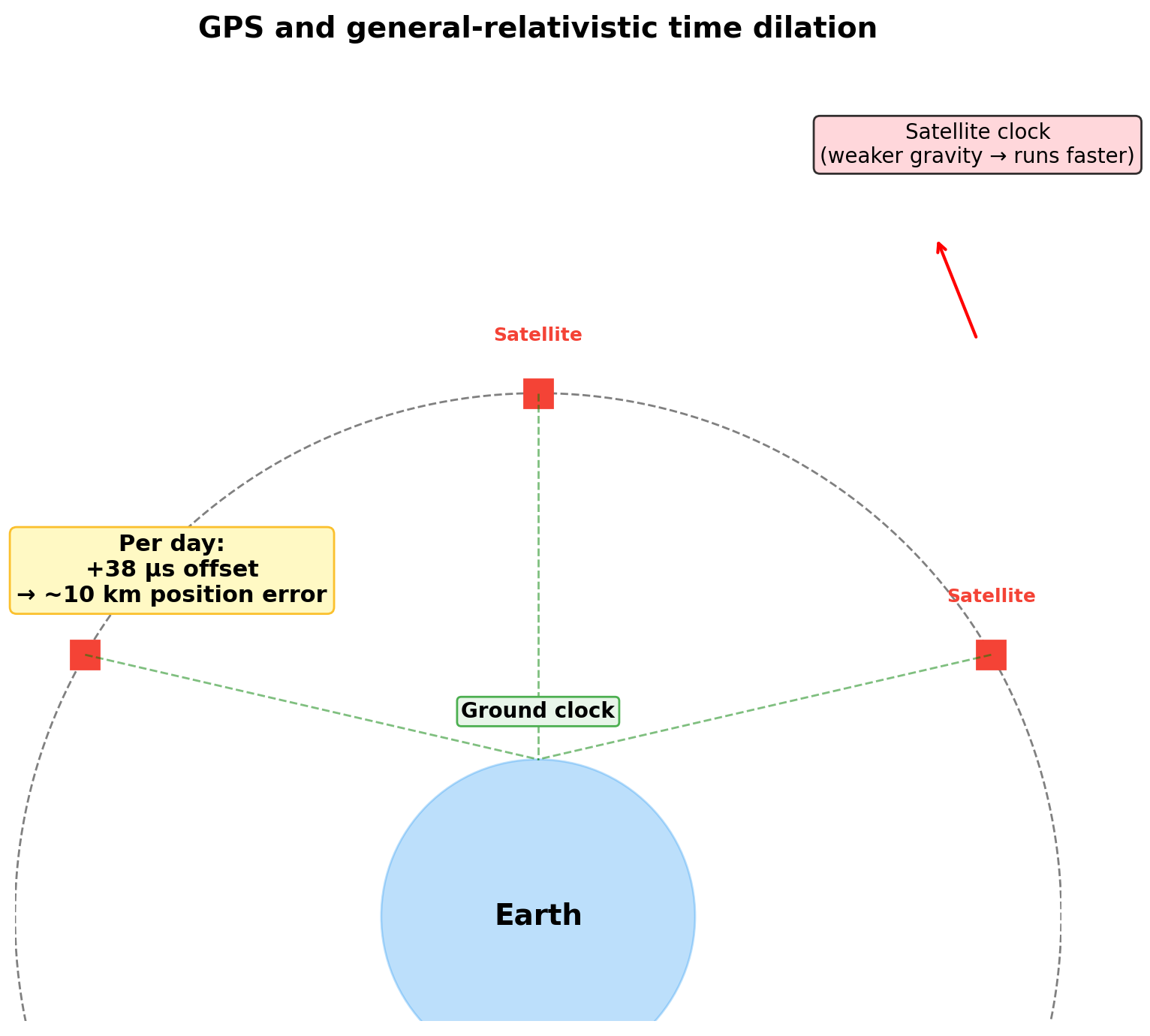
Fig. 0.1: Relativistic time offset between GPS satellite and ground clocks. Without relativistic corrections, position errors accumulate rapidly.
🔵 Kai: An 11 km drift per day without correction—relativity really does affect daily life… Looking at the figure (Fig. 0.1 "Relativistic time offset between GPS satellite and ground clocks"), you can clearly see how errors keep accumulating. But why do the gravitational +45 microseconds (faster) and the velocity \(-7\) microseconds (slower) go in opposite directions?
🟡 Lina: Good question. Let's consider the two effects separately. First, the velocity effect—"a moving clock runs slower than a stationary clock" is a consequence of special relativity. In a nutshell, because the speed of light is constant, "one second for a moving person" and "one second for a stationary person" are no longer the same length—we'll carefully work through the mechanism in Part II. GPS satellites fly at about 4 km/s, so their clocks are slowed by that amount. That's the \(-7\) microseconds.
🔵 Kai: I see, moving fast slows the clock. What about the gravity part?
🟡 Lina: Clocks in stronger gravity tick slower. As a rough image, when you throw a ball upward, gravity pulls it back and slows it down, right? Light similarly "loses energy" when it "climbs" from a strong gravitational region to a weaker one. Light that has lost energy appears to have a lower frequency—this is called gravitational redshift.
🔵 Kai: Light loses energy…? But the speed of light doesn't change, right? A ball slows down, but light doesn't slow down—isn't it strange that only its energy decreases?
🟡 Lina: Right, the speed of light doesn't change. Rigorously understanding "why light loses energy in gravity" requires the tools of general relativity, which we'll carefully derive in Part IV. But at this stage, you can be satisfied from an energy conservation perspective—when you throw a ball upward, kinetic energy converts to potential energy and the speed drops, right? Since light is also "climbing" against gravity, it must sacrifice something. Light can't change its speed, so instead it lowers its frequency to release energy. As you learn in high school physics with \(E = h\nu\), light with higher frequency \(\nu\) (faster oscillation) has more energy. So when climbing against gravity, the frequency drops—meaning the number of oscillations per second decreases. This is where atomic clocks come in. Atomic clocks count the oscillations of electromagnetic waves emitted by specific atoms and define "one second" as a certain number of oscillations.
🔵 Kai: Ah, so an atomic clock in a strong gravitational field has its atom's oscillations themselves—as seen from far away—running slower?
🟡 Lina: Exactly. Gravitational redshift is the statement that "when light is sent from a region of strong gravity to a region of weak gravity, the receiver sees a lower frequency"—but this is just the flip side of saying "the oscillations of atoms in a strong gravitational field are themselves slower when viewed from far away."
🔵 Kai: Wait, why does "the frequency appears lower" translate to "time runs slower"?
🟡 Lina: If the sender's atom is oscillating at the same pace but the receiver sees a lower frequency, that means the sender's "one oscillation" takes longer when measured in the receiver's time—which can only be interpreted as the sender's time flowing more slowly. Therefore, an atomic clock in a strong gravitational field takes longer (compared to a distant clock) to count the same number of oscillations—its ticks are slower.
⚪ Mei: To organize: "frequency appears lower = sender's one oscillation takes longer = sender's time runs slower."
🟡 Lina: Right. Since the satellite is in a weaker gravitational field than the ground, its clock runs faster—that's the +45 microseconds. The rigorous argument comes in Part IV. Combining both: \(+45 - 7 = +38\) microseconds. For now, just remember the fact that "velocity causes slowing, weaker gravity causes speeding up"—two effects working in opposite directions.
Black Holes — Objects from Which Even Light Cannot Escape
When gravity reaches its extreme, we get a black hole. The boundary from which even light cannot escape is called the event horizon. In 2019, the Event Horizon Telescope captured the "shadow" of a supermassive black hole at the center of galaxy M87. The size of the shadow predicted by general relativity matched the observation to within 10%.
Gravitational Waves — Ripples in Spacetime
In Newton's model, gravity propagates instantaneously, so the concept of "gravitational waves" never arises. But general relativity predicts that curvature of spacetime propagates as waves at the speed of light. Imagine massive objects moving violently, causing the surrounding spacetime to "wobble," with that wobble spreading in all directions at the speed of light—just like ripples when you throw a stone into water. In 2015, LIGO directly detected these gravitational waves for the first time—ripples in spacetime generated when two black holes merged 1.3 billion light-years away. The spatial stretching and squeezing detected was less than 1/1000th the diameter of a single proton.
🔵 Kai: Less than 1/1000th of a proton… can you really measure something like that?
🟡 Lina: Laser light is split in two directions and sent back and forth, and when a gravitational wave passes, the tiny path-length difference is read as changes in interference fringes. LIGO's arms are 4 km long, so even extremely tiny stretching can be detected. We'll cover the detailed mechanism in Part VII.
✅ Comprehension Check: Why does the concept of "gravitational waves" not arise in Newton's model?
Answer
In Newton's model, gravity propagates instantaneously (at infinite speed), so the concept of "waves" that take a finite time to propagate doesn't hold. In general relativity, spacetime curvature propagates at the speed of light, making gravitational waves possible.
Cosmology — The Fate of the Entire Universe
The expansion of the universe, the Big Bang, the future of the cosmos. A model that treats the entire universe as a subject of physics cannot be written without general relativity—because only Einstein's model can describe the global shape of spacetime.
🔵 Kai: "The shape of the entire universe"—do you mean like whether the universe is round or flat?
🟡 Lina: Yes. Whether space as a whole is closed or extends infinitely—and how that shape changes over time (whether it's expanding, or will eventually contract)—that's what cosmology describes. Newton's model has no framework for dealing with "the shape of all space," so it can't answer such questions. Details in Part VIII.
✅ Comprehension Check: If general relativistic corrections were not applied to GPS satellite clocks, approximately how many km of position error would accumulate per day?
Answer
About 11 km. Because satellites are at higher altitudes where Earth's gravity is weaker, their clocks run about 38 microseconds faster per day (this 38 microseconds is the net value of gravitational and special relativistic effects; the gravitational effect alone is about +45 microseconds). Neglecting this correction causes position errors to accumulate. Light travels about 300 m per microsecond, so 38 microseconds gives approximately 11 km of error.
📝 Exercises:
- Quantitative evaluation of GPS relativistic corrections → Problem A-1. Gravitational Time Dilation of GPS Satellites
The Big Picture — What Lies Ahead
🟡 Lina: This journey is structured in 9 Parts and 25 chapters. Let's get a full overview now.
Table 0.3: Overall structure and themes of each Part
| Part | Chapters | Theme |
|---|---|---|
| Part I | Ch. 1–2 | Starting Point — Limits of Newton's gravity and the journey's blueprint |
| Part II | Ch. 3–4 | Special Relativity — Lorentz transformations and Minkowski spacetime |
| Part III | Ch. 5–8 | Gathering the Tools — Equivalence principle, metric, geodesics, Schwarzschild spacetime |
| Part IV | Ch. 9–11 | Testing Ahead — The solar system and GPS |
| Part V | Ch. 12–15 | The Heart of the Theory — Curvature and Einstein's equations |
| Part VI | Ch. 16–18 | Applications 1 — Black holes |
| Part VII | Ch. 19–20 | Applications 2 — Gravitational waves |
| Part VIII | Ch. 21–23 | Applications 3 — Cosmology |
| Part IX | Ch. 24–25 | Beyond — Differential forms and quantum gravity |
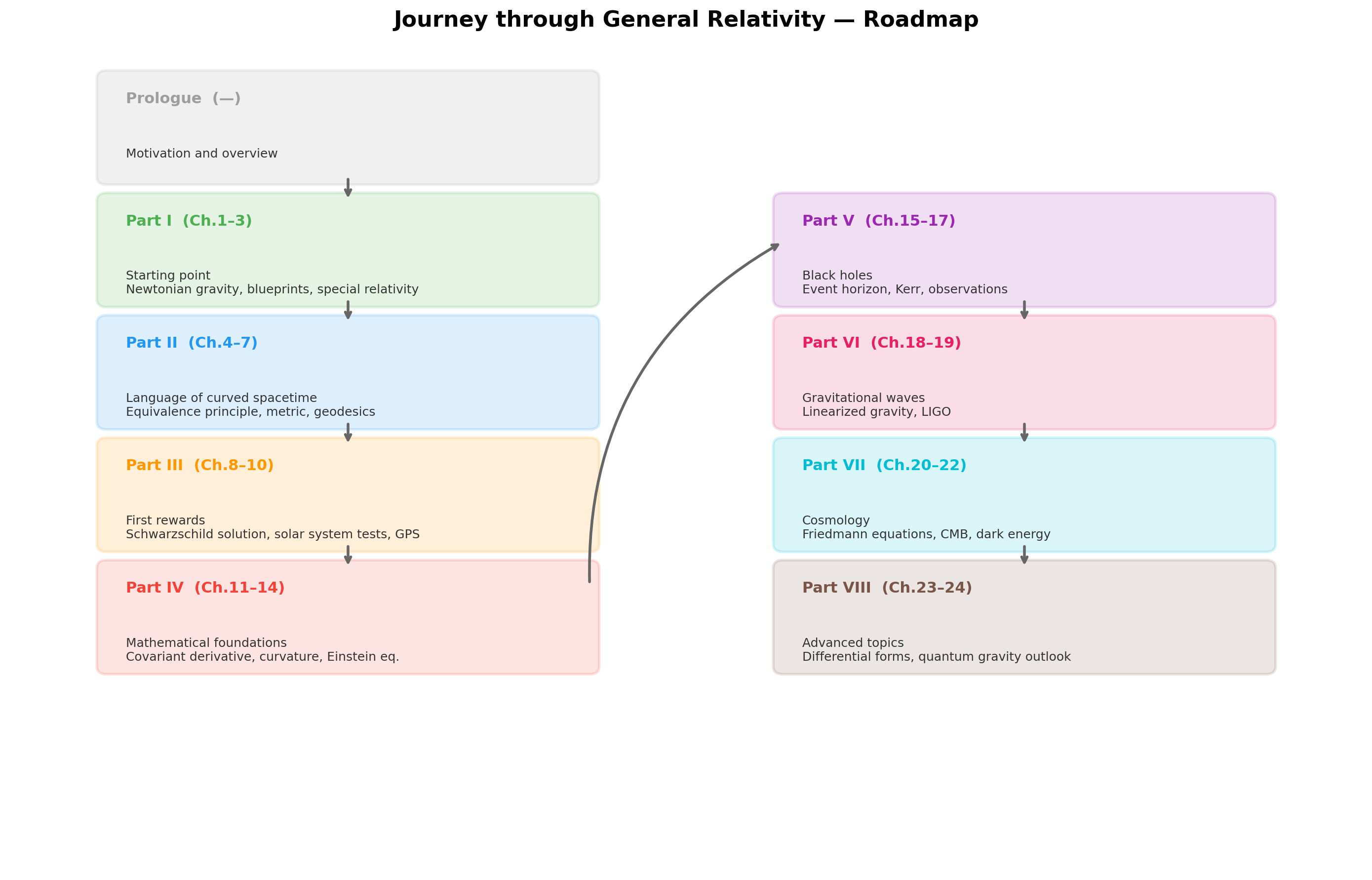
Fig. 0.2: Full roadmap of the 25-chapter journey. Through 9 Parts, we trace the path step by step from the limits of Newton's gravity to the prospects of quantum gravity.
🔵 Kai: That's a long journey… 25 chapters?
🟡 Lina: But if you grasp the flow as a single thread, you won't get lost (Fig. 0.2 "Full roadmap of the 25-chapter journey"). First, Part I confirms why Newton's gravity hits its limits, then Part II establishes the key to the solution—special relativity with Lorentz transformations and Minkowski spacetime.
⚪ Mei: Looking at the table, the next one, Part III, is "Gathering the Tools." "Equivalence principle, metric, geodesics, Schwarzschild spacetime"—these are all words I've never heard, but will they be defined in Part III?
🟡 Lina: Yes, they're all tools for dealing with curved spacetime. When we get to Part III, we'll carefully define each one starting from its motivation, so don't worry.
🔵 Kai: Metric, geodesics… the names alone sound difficult, but I just need to wait until Part III, right?
🟡 Lina: Right. And here's the interesting part: at the end of Part III, we receive the "answer" in the form of Schwarzschild spacetime. We get the most basic solution of general relativity—accepting its form first, leaving the derivation for later.
🔵 Kai: Wait, is it okay to use the answer before deriving it?
🟡 Lina: That's the idea behind Part IV, "Testing Ahead." Using Schwarzschild spacetime, even without knowing Einstein's equations yet—you can calculate the representative predictions of general relativity with your own hands: Mercury's perihelion precession, the bending of light, GPS time corrections. Without waiting for the mathematics to be complete, we first check: "Does this model actually explain reality?"
⚪ Mei: So the order is: use the answer first to test it, then go back to the heart of the theory in Part V.
🟡 Lina: Yes. In Part V, we encounter Riemann curvature tensor, energy-momentum tensor, variational principle—unfamiliar names, I know. A "tensor" is an extension of a vector (an arrow)—think of it as a "table of numbers" that organizes components in each direction. We'll define everything from scratch in Part V, so for now just remember the names. What we ultimately arrive at is this equation:
This is called the Einstein equation. Roughly speaking, "the left side \(G_{\mu\nu}\) represents how spacetime is curved, and the right side \(T_{\mu\nu}\) represents the distribution of matter and energy there (this is the 'energy-momentum tensor')"—they're connected by an equals sign, expressing the relationship that matter curves spacetime, and curved spacetime determines how matter moves.
🔵 Kai: Matter curves spacetime, and curved spacetime moves matter… they influence each other. But what's this \(\mu\nu\)?
🟡 Lina: The subscripts \(\mu\nu\) are labels representing spacetime directions (each component of time and space). For example, \(\mu = 0\) for time, \(\mu = 1, 2, 3\) for the 3 spatial directions—a numbering notation. Since \(\mu\) and \(\nu\) each take values from 0 to 3, this single line actually summarizes up to \(4 \times 4 = 16\) relations (due to symmetry, only 10 are independent—details in Part V).
🔵 Kai: 16 equations in one line…! Also, the \(G_{\mu\nu}\) on the left and the \(G\) on the right are the same letter—are they different things?
🟡 Lina: Good catch. The left-side \(G_{\mu\nu}\) is the "Einstein tensor," and the right-side \(G\) is the gravitational constant we saw earlier—same letter but different objects. We'll derive why the coefficient \(8\pi G/c^4\) appears in Part V.
🟡 Lina: The way to tell them apart is simple—if \(G_{\mu\nu}\) has subscripts, it's the Einstein tensor; if \(G\) appears bare, it's the gravitational constant. In the equation above, the left-side \(G_{\mu\nu}\) is the Einstein tensor and the right-side \(G\) is the gravitational constant—both appear in the same equation, but you can distinguish them by whether subscripts are present. The meaning of the subscripts and the idea of "summarizing 16 equations" will all be carefully covered from scratch in Part V—for now, it's enough to understand that "it looks like one line but is actually multiple equations written together."
🟡 Lina: Once we get that far, it's application time. Part VI covers the internal structure of black holes—what happens "beyond" the event horizon, and even rotating black holes (the Kerr solution). Part VII derives gravitational waves from the weak-field limit of Einstein's equations and connects to LIGO's detection.
🔵 Kai: Causal structure, Kerr solution—the names alone are scary… but do they all come from Einstein's equation?
🟡 Lina: Yes, from a single equation. Part VIII treats the entire universe as a single solution—cosmology, from the Friedmann equations to accelerating expansion and inflation.
🔵 Kai: What about the final Part IX?
🟡 Lina: "Beyond." We rewrite general relativity using the modern formulation of differential forms, and close the journey with prospects toward the Planck scale and quantum gravity—the next model, still incomplete.
🔵 Kai: Quantum gravity is still incomplete?
🟡 Lina: Yes. A theory unifying general relativity and quantum mechanics remains unfinished even now in the 21st century. That's precisely why the chapter is titled "Beyond."
🔵 Kai: Ending the journey with an incomplete theory… that's kind of romantic.
⚪ Mei: …Organizing the whole thing: "Confirm the starting point → Establish special relativity → Gather tools → Use the answer first to test it → Return to the heart of the theory to derive it → Apply it → Look ahead to what's beyond."
🟡 Lina: Yes. And throughout each chapter, don't lose sight of "why this mathematics is necessary." Even if the names sound scary, when you encounter them at the moment they're needed, you'll think "Ah, so that's what it is"—as long as you understand the motivation, the equations aren't scary.
🔵 Kai: A long journey, but the structure of "test with the answer first, then go back to the theory" is interesting. I always imagined you'd complete the theory first and then do applications, but it's the reverse. But one thing I'm wondering—in Part IV when we "use the answer" to test, what if that answer is wrong? Is it okay to trust it without having derived it?
🟡 Lina: A very important question. In Part IV, we use Schwarzschild spacetime "assuming it's correct" and compare the predictions it yields—Mercury's orbital drift, the bending of light—against observations. If predictions and observations don't match, the model gets rejected. In reality they match beautifully, so we can confidently derive "why this solution emerges" in Part V—it's essentially confirming trust through experiment first, then delving into the theory's internal structure.
🔵 Kai: I see, you verify "it's trustworthy" through experiment first, then open up the internals. It's like a mystery novel where you identify the culprit first and then figure out the trick. Since you know the culprit is right, you can follow the trick's mechanism with confidence.
⚪ Mei: But that trick-solving Part V, with "curvature tensor" and "variational principle"—just the names are honestly intimidating.
🟡 Lina: I understand that feeling. But for example, the "curvature tensor" is motivated in Part III through the story of walking on a curved surface, then formally defined in Part V. The "variational principle" is also introduced after being motivated as "a method for finding the shortest path." The names are scary when heard in advance, but when you encounter them at the moment of need, you should think "Ah, so that's what it is."
🔵 Kai: As long as motivation comes first, it's not scary. …Alright, let's go! Starting with seeing Newton's limits in equations.
🟡 Lina: Yes. In the next chapter, Ch. 1, we'll begin the journey by examining precisely in equations how far Newton's gravitational model is correct—and where its limits lie.
Next Chapter Preview
Ch. 1 How Far Is Newton's Gravity Correct? — We formulate Newton's universal gravitation as a "field theory" (gravitational field, gravitational potential, Poisson equation), confirm its spectacular successes (the discovery of Neptune), and then precisely analyze two limitations at the equation level—Mercury's perihelion precession and the instantaneous propagation of gravity.
References
- Hartle, J. B. (2003). Gravity: An Introduction to Einstein's General Relativity. Addison-Wesley. Chapter 1.
- Rovelli, C. (2017). Reality Is Not What It Seems: The Journey to Quantum Gravity. Riverhead Books. Chapters 3, 5.
- Tong, D. (2019). General Relativity. University of Cambridge Part II Mathematical Tripos. Chapter 1.
Feedback on this page
Let us know if something was unclear, incorrect, or could be improved.