Introduction — Before the Four Journeys
Goal of this chapter: This site contains four independent journeys (General Relativity, Quantum Mechanics, Quantum Field Theory, and The Challenge of Quantum Gravity). Before entering any of them, we want to share a set of "common principles." Specifically:
- All descriptions in physics are "models (= falsifiable hypotheses)," and writing them in mathematical equations is precisely what makes quantitative verification possible
- The categories of physics are organizational shelves made by humans, and they have historically been unified
- How the four journeys connect and why this reading order feels natural
- This site does not "give you the answers" but rather "provides materials for you to judge for yourself"
These serve as a compass whenever you follow equations in any of the four journeys.
Roadmap for this chapter:
- Welcome to This Site — Introducing the three characters and sharing motivations, previewing the term "model"
- Why Write in Equations — Falsifiability — Confirming that equations enable quantitative prediction and verification
- Models Are Equations, Often Differential Equations — Differential equations as tools for predicting the future, the role of initial and boundary conditions, limits of prediction
- The "Categories" of Physics Are Human-Made — The history of category unification and the position of the quantum gravity problem
- Two Motivations That Give Birth to Models — Practical necessity and pure curiosity
- The Big Picture of the Four Journeys — How all four parts connect and why to read them in this order
- Seeing "Model Updates" in Equations — From Newton to Einstein — The flow of recovering Newtonian gravity in the weak-gravity limit
- Differences from Conventional Content — Four differences from popular science books, textbooks, and existing explanatory works
- A Note on Terminology — Why We Unify Under "Model"
- The Journey Begins — Sending you off to the first journey (General Relativity)

Role of this page: Share the foundational questions for this entire site, understand "what is a physics model" and "why write in equations." Then grasp the big picture of what we'll trace through the four journeys.
Welcome to This Site
🟡 Lina: Welcome to the journey of physics. Kai, something must have sparked your interest?
🔵 Kai: Ah, yeah. Lately I've been seeing a lot of TV specials about space, black holes, and quantum computers, but even after listening to the explanations, I don't really get it. I thought, I want to understand things properly at the level of equations.
⚪ Mei: Same here. I've read several popular science books, but they always end with "analogies." "Spacetime curves," "electrons are both waves and particles," "particles are vibrating strings"—I want to see the world of equations behind those analogies.
🟡 Lina: Both of you have great motivation. "I want to understand through equations," "I want to see behind the analogies"—that attitude is actually the essence of physics. But before we start chasing equations, there's one thing I want to establish first.
⚪ Mei: What's that?
🟡 Lina: This site has four journeys: General Relativity, Quantum Mechanics, Quantum Field Theory, and The Challenge of Quantum Gravity. Each is an independent journey, but there's a "common set of principles" that runs through all of them. I want to share that upfront.
🔵 Kai: Common principles?
🟡 Lina: Newton and Einstein both created mathematical descriptions to explain natural phenomena. In the world at large, these are called "laws," "theories," "models," and various other names, but on this site we'll uniformly call them "models."
🔵 Kai: Why "models"?
🟡 Lina: "Law" sounds like "an established rule," doesn't it? But in reality, these are human-made, merely approximations, and could be updated someday. The word "model" carries that nuance from the start.
⚪ Mei: Right. Newton's universal gravitation was considered "correct" for over 200 years, but Einstein showed it was "merely an approximation." Even though it was called a "law," its true nature is a "model."
🟡 Lina: Exactly. This is the theme that runs through the entire site. All physics models are merely hypotheses. What motivated their creation, how far they succeed, where they break down, and what new model emerged next—we'll trace this chain through equations across the four journeys.
Why Write in Equations — Falsifiability
🟡 Lina: By the way, you both said "I want to understand through equations," but what do you think equations are in physics?
🔵 Kai: Um, the model written as a formula?
🟡 Lina: That's right. More precisely, equations are the model expressed objectively and without ambiguity. If you say in words "gravity gets weaker with distance," you get a qualitative idea, but you can't tell "how much weaker." But if you write Newton's universal gravitation as an equation—
🟡 Lina: —it looks like this. Here \(F\) is the magnitude of the gravitational force between two objects, \(m_1, m_2\) are their respective masses, \(r\) is the distance between them, and \(G\) is the proportionality constant called the gravitational constant.
⚪ Mei: The formula we learned in high school. But looking at it again, what exactly does this single equation "tell us"?
🟡 Lina: Good question. Let's extract a quantitative prediction from this equation. For example, "what happens to the force when the distance doubles?" Try calculating it.
🔵 Kai: Let me see, if I replace \(r\) with \(2r\)...
🔵 Kai: Expanding the denominator,
🔵 Kai: So,
🔵 Kai: The force becomes one-quarter!
🟡 Lina: Right. What about triple the distance?
⚪ Mei: Similarly, letting \(r \to 3r\),
⚪ Mei: One-ninth. So the force is inversely proportional to the square of the distance—the "inverse-square law."
🟡 Lina: Exactly. The important thing here is that anyone who does the calculation gets the same answer. With just the word "weaker," it's ambiguous—"half? one-third?"—but with an equation, it's uniquely determined as "one-quarter." This is a quantitative prediction.
🔵 Kai: I see. And then you can verify that prediction with experiments.
🟡 Lina: Right. In fact, Newton's model predicted planetary orbits with astonishing precision. But—200 years later, more precise observations were made. It was discovered that Mercury's orbit deviated slightly from Newton's model's predictions.
⚪ Mei: How much did it deviate?
🟡 Lina: About 43 arcseconds per century (in units of angle, roughly 1/86th of a degree). A tiny amount. But precisely because it was written in equations, they could compare quantitatively: "the predicted value is this, the observed value is this, the difference is this much."
🔵 Kai: If the description had been only in words, such a tiny discrepancy might never have been found...
🟡 Lina: Exactly. The philosopher Karl Popper called this possibility of "being provable as wrong" falsifiability. A model written in equations produces quantitative predictions, which makes it falsifiable by experiment. Conversely, a claim that lacks falsifiability cannot be called a scientific hypothesis.
🔵 Kai: So physics isn't a discipline that finds "truth"?
🟡 Lina: Unless you're God, nobody can know "what's really true." All we can do is create models that explain observed phenomena as accurately as possible. Whether that model is "truth" can never be known. So what physics finds is not "truth" but falsifiable hypotheses. If predictions match experiments, the model is "correct so far"; if they don't match, it's judged "wrong." Because we write in equations, we can verify quantitatively.
🔵 Kai: I see... equations aren't written to prove correctness, but to find mistakes.
🟡 Lina: Wonderful understanding, Kai. And it was Einstein's general relativity model that explained Mercury's orbital discrepancy. Newton's model wasn't "wrong"—it was "updated to a model that holds in broader situations." This is the chain structure of "question → model → new question."
%%{init: {"theme": "default", "themeCSS": ".edgePath .path, .flowchart-link { stroke-width: 2px !important; }"}}%%
flowchart TD
    A["Question / Phenomenon"] --> B["Construct model in equations"]
    B --> C["Derive quantitative predictions"]
    C --> D["Verify with experiments/observations"]
    D -->|"Agreement"| E["Model is\n'correct so far'"]
    D -->|"Discrepancy found"| F["Limits of model revealed"]
    F --> G["New question"]
    G --> B
    E -.->|"More precise experiments"| D

    style F fill:#fcc,stroke:#c00
    style E fill:#cfc,stroke:#0a0
    style B fill:#ccf,stroke:#33c
Figure 1: Physics progresses through the cycle of "model → quantitative prediction → experimental verification → discovery of discrepancy → new model." Because we write in equations, this cycle can turn.
✅ Comprehension Check: What is the greatest advantage of writing things in equations in physics?
Answer
It enables quantitative predictions, which can be precisely verified (falsified) by experiment.
✅ Comprehension Check: What is "falsifiability" as proposed by Karl Popper?
Answer
It means that a model's predictions "can potentially be proven wrong." Having falsifiability is considered a requirement for a scientific hypothesis.
Models Are Equations, Often Differential Equations
🔵 Kai: Professor, something's been bugging me. That universal gravitation formula from before—
🔵 Kai: —can you actually calculate Earth's orbit with just this? Even if I know "double the distance means one-quarter the force," I don't think that tells me where a planet will be at any given time.
🟡 Lina: Sharp, Kai. You're right. This formula only tells you "the magnitude of the force between two objects at this instant." Knowing the force alone doesn't determine the motion.
⚪ Mei: You mean we need to combine it with Newton's equation of motion, which we learned in high school?
🟡 Lina: Yes. Recall Newton's equation of motion.
🟡 Lina: \(a\) is acceleration. And acceleration is the position \(x\) differentiated twice with respect to time \(t\).
⚪ Mei: Velocity is the first derivative of position, acceleration is the second derivative. We covered that in high school.
🟡 Lina: So the equation of motion can be rewritten as:
🟡 Lina: And substituting universal gravitation for \(F\)—I'll write it in one dimension for simplicity—
🟡 Lina: This is a differential equation. An equation where "an unknown function \(x(t)\) and its derivatives are mixed together."
🔵 Kai: An equation like \(x^2 - 3x + 2 = 0\) is "find \(x\)," right? What's the "unknown" in a differential equation?
🟡 Lina: Good question. In ordinary equations, you solve for a number. In differential equations, you solve for a function—in this case, the function \(x(t)\) that describes "how position changes with time." If you can solve this, you know when the planet is where.
⚪ Mei: So the "force equation" alone isn't enough—only "force equation + equation of motion" enables prediction of the future?
🟡 Lina: Exactly. Moreover, to solve a differential equation, you need two more things: initial conditions and boundary conditions.
Initial Conditions and Boundary Conditions
🔵 Kai: What are those?
🟡 Lina: First, initial conditions: "where is it now?" and "what velocity is it moving with now?" Even with the same differential equation, if the starting point and initial velocity differ, the trajectory is completely different. Earth orbiting the Sun and a comet falling into the Sun obey the same gravitational differential equation, yet their futures are entirely different. That's because their initial conditions are different.
⚪ Mei: "The law is the same, but if the starting point differs, the future differs." Obvious yet important.
🟡 Lina: And the other is boundary conditions.
🔵 Kai: Boundary conditions?
🟡 Lina: If initial conditions track changes in the time direction, then boundary conditions specify "what's happening at the edges" in the spatial direction. For example, when you write the vibration of a guitar string in equations—both ends of the string are pinned, so you impose the condition "displacement is zero at both ends." That's a boundary condition.
⚪ Mei: Is "edge" a metaphor?
🟡 Lina: Sharp. Strictly speaking, it means "what's happening at the boundary of the spatial domain." Physical "ends" like the ends of a guitar string are the classic example, but there are other forms too. For instance, if the domain is closed like a loop, the condition becomes "return to the same value after going around once" (periodic boundary conditions), and you might impose at a special point like the origin that "the wave function doesn't diverge." The "initial" in "initial conditions" is also a conventional name—it means choosing a reference time and specifying the state there. The essence is "supplementing additional information that the equation alone doesn't provide, on both the time side and the space side."
🔵 Kai: I see, so "edge" is just a representative easy-to-understand example.
🟡 Lina: Right. Going forward, I'll often use the word "edge" for ease of understanding, but keep in mind that it actually has a somewhat broader meaning.
⚪ Mei: Whether you fix both ends or leave them free should change the sound.
🟡 Lina: Yes. Even with the same wave differential equation, "both ends fixed," "both ends free," and "one end fixed" produce completely different vibration patterns. Guitar, flute, drum—the differences in musical timbre actually come from the same "wave equation" with only the boundary conditions being different.
🔵 Kai: Do boundary conditions really matter that much?
🟡 Lina: They do. In the models we'll journey through, boundary conditions play major roles.
- In General Relativity, you need to specify conditions at a black hole's surface (event horizon) or at the edge of the universe
- In Quantum Mechanics, "a particle in a box," "an electron bound to a nucleus"—the boundary conditions on how far the particle's space extends generate discrete energy values
- In String Theory, whether the string's endpoints are free or closed into a loop determines what kinds of particles appear
⚪ Mei: The same equation, but different boundary conditions produce entirely different phenomena...
🟡 Lina: Exactly. So when using a model in physics, you think in terms of the three-piece set: "equation," "initial conditions," and "boundary conditions."
%%{init: {"theme": "default", "themeCSS": ".edgePath .path, .flowchart-link { stroke-width: 2px !important; }"}}%%
flowchart LR
    EQ["Differential equation\n(Rule of nature)"] --> SOL["Solution\n(Specific behavior)"]
    IC["Initial conditions\n(Current state)"] --> SOL
    BC["Boundary conditions\n(Conditions at edges)"] --> SOL

    style EQ fill:#ccf,stroke:#33c
    style IC fill:#fec,stroke:#c90
    style BC fill:#fcc,stroke:#c33
    style SOL fill:#cfc,stroke:#0a0
Figure: Only when the three-piece set of differential equation (rule of nature), initial conditions (current state), and boundary conditions (conditions at spatial edges) are all specified can future behavior be predicted.
⚪ Mei: Equation = rule of nature, initial conditions = current situation, boundary conditions = spatial framework—that's the organization.
🟡 Lina: Perfect.
The Starring Differential Equations in the Four Journeys
🟡 Lina: Here's where it gets interesting. In the four models we'll journey through, the starring equations are almost all differential equations.
🔵 Kai: Really?
🟡 Lina: Let me just preview them. Details will come in each chapter.
| Journey | Starring Equation | What It Predicts |
|---|---|---|
| General Relativity | Einstein equation \(G_{\mu\nu} + \Lambda g_{\mu\nu} = \frac{8\pi G}{c^4} T_{\mu\nu}\) | How spacetime curves |
| Quantum Mechanics | Schrödinger equation \(i\hbar \frac{\partial \psi}{\partial t} = \hat{H}\psi\) | Time evolution of a particle's "existence probability" |
| Quantum Field Theory | Dirac equation, Klein-Gordon equation, etc. | Time evolution of fields |
| The Challenge of Quantum Gravity | (Candidates not yet established) | — |
🟡 Lina: All of them are differential equations describing changes in time or space (formally, most are partial differential equations—equations involving derivatives with respect to multiple variables). If you write down the rule for going from "the current state" to "the state a moment later," you can accumulate those steps to trace the future—this is the basic form of a physics model.
⚪ Mei: So that's why differential equations are used so extensively in physics.
A Caveat—"Equations Don't Always Tell You the Future Completely"
🔵 Kai: But Professor, I have a question. If equations can predict everything, why are weather forecasts so often wrong?
🟡 Lina: Haha, that's sharp too. There's something I need to be honest about here. "If you have equations, you can predict" is in principle correct, but with several caveats.
🟡 Lina: First, some equations are hard to solve. Even if you can write the equation, there are many models that can't be solved analytically—meaning you can't write the answer as a neat formula. The fluid equations behind weather forecasting (Navier-Stokes equations)—whether "smooth solutions always exist" is itself an unsolved problem in modern mathematics. Usually you have no choice but to do numerical approximations on a computer.
🔵 Kai: Wait, it's an unsolved problem?
🟡 Lina: Second, chaos. Even when a differential equation is deterministic, tiny differences in initial conditions can amplify exponentially over time, making long-term prediction practically impossible. Weather is exactly this. You can predict 3 days out, but 1 month out is fundamentally difficult.
⚪ Mei: So "the equation is determined" and "the result is predictable" are different things.
🟡 Lina: Yes. The third is the biggest—in quantum mechanics, predictions become inherently probabilistic. Remember how I wrote in the table that the Schrödinger equation describes "the time evolution of existence probability"? I wrote that casually, but it's actually very deep. In the quantum world, even if you know the initial and boundary conditions perfectly and solve the equation exactly, "where you'll observe the particle next" can only be stated probabilistically. You can't say "it's definitely here."
🔵 Kai: What... like rolling dice?
🟡 Lina: Close, but stranger. We'll confront this slowly in the second journey, "Quantum Mechanics." For now, just remember "apparently that kind of thing happens."
🟡 Lina: Fourth, there are models not written in the form of differential equations. In quantum field theory and string theory, formalisms called "action principles" and "path integrals" take center stage. These can formally be reduced to differential equations, so "in many cases" covers them, but keep in mind that the written form is different.
⚪ Mei: So that's why you said "in many cases differential equations" at the beginning.
🟡 Lina: Right. Strictly speaking, physics models come in these forms:
- The majority are in the form of differential equations (equations of motion, Maxwell equations, Schrödinger equation, Einstein equation)
- Some are algebraic relations (\(E = mc^2\), equation of state \(PV = nRT\), etc.)
- Modern formulations use action principles / path integrals (equivalent to differential equations)
🟡 Lina: What's common to all of them is the structure: "write nature's behavior in equations → predict unknown situations → compare with experiments." That doesn't change.
✅ Comprehension Check: Newton's universal gravitation formula \(F = Gm_1 m_2/r^2\) alone cannot calculate a planet's orbit. Why?
Answer
This formula only gives "the magnitude of the force at this instant" and is not an equation that determines the time evolution of position \(x(t)\). Only when combined with the equation of motion \(F = m\, d^2 x/dt^2\) does it become a differential equation for \(x(t)\), and by supplying initial conditions (current position and velocity), the future orbit can be calculated.
✅ Comprehension Check: Name two things that must be specified, in addition to "the equation," to solve a differential equation and predict physical phenomena. Briefly state what each represents.
Answer
① Initial conditions: the state at the temporal starting point (e.g., current position and velocity). ② Boundary conditions: conditions at the spatial edges (e.g., zero displacement at both ends of a guitar string, wave function going to zero at infinity for an electron bound to a nucleus, etc.). Only when both are provided is the solution uniquely determined.
✅ Comprehension Check: Give two or more reasons why we cannot definitively say "if you have a differential equation, you can completely predict the future."
Answer
① Many cases cannot be solved analytically, requiring numerical computation (in some cases, the existence of smooth solutions itself is unsolved). ② In chaotic systems, tiny differences in initial conditions amplify exponentially, making long-term prediction practically impossible. ③ In quantum mechanics, even solving the equation exactly yields only probabilistic predictions for observations.
The "Categories" of Physics Are Human-Made
🟡 Lina: There's one more thing I want to convey at the outset. In high school physics, you have categories like "mechanics," "electromagnetism," "waves," "thermodynamics," and "atomic physics," right?
🔵 Kai: Yes. Test coverage is divided that way too.
🟡 Lina: Those category divisions—nature isn't fundamentally divided that way, is it?
🔵 Kai: Well, when you put it that way, yeah. Humans just divided it up arbitrarily.
🟡 Lina: Right. Humans historically thought "I want to model this phenomenon in equations" and tackled them one by one. When the accumulated results were organized, they just happened to fall into those categories. In fact, the boundaries between categories have been broken down over time.
🔵 Kai: Broken down?
🟡 Lina: For example, "electricity" and "magnetism" were originally separate categories. But in the 19th century, Maxwell showed "they're actually the same phenomenon" and unified them. "Heat" was also thought to be an independent phenomenon, but Boltzmann reduced it to "statistics of atomic motion" within mechanics. In the 20th century, the "weak force" and "electromagnetic force" were unified (see Chapter 20 of Quantum Field Theory for details).
⚪ Mei: So categories are "organizational shelves of human understanding at the present time," not fundamental divisions of nature.
%%{init: {"theme": "default", "themeCSS": ".edgePath .path, .flowchart-link { stroke-width: 2px !important; }"}}%%
flowchart TD
    E["Electricity"] -->|"Maxwell (1865)"| EM["Electromagnetic force"]
    M["Magnetism"] -->|"Maxwell (1865)"| EM
    Heat["Heat"] -->|"Boltzmann (1870s)"| SM["Statistical mechanics"]
    Mech["Mechanics"] --> SM

    subgraph QFTArea["🟩 Quantum Field Theory"]
        EM
        Weak["Weak force"]
        Strong["Strong force"]
        EW["Electroweak unification<br/>(Weinberg-Salam 1967)"]
        STD["Standard Model<br/>(electromagnetic, weak, strong forces)"]
        GUT["Grand Unified Theory (GUT)<br/>Were they originally one force?<br/>(unverified hypothesis)"]
        EM --> EW
        Weak --> EW
        EW --> STD
        Strong -->|"QCD (1973)"| STD
        STD -.->|"Common origin<br/>of 3 forces"| GUT
    end

    subgraph GRArea["🟦 General Relativity (Gravity)"]
        Gravity["Gravity<br/>(Relativity: special & general)"]
    end

    subgraph QMArea["🟨 Quantum Mechanics"]
        QM["Quantum Mechanics"]
    end

    subgraph QGArea["🟥 The Quest for Quantum Gravity"]
        QG["Quantum gravity problem<br/>(Quantization of gravity / TOE candidates)<br/>Unsolved"]
    end

    Gravity -.->|"Difficult to quantize"| QG
    STD -.->|"Cannot include gravity"| QG
    GUT -.-> QG
    QM -->|"Unification of special relativity<br/>and quantum mechanics"| STD
    SM -->|"Black-body radiation<br/>(breakdown of classical physics)"| QM
    SM -->|"Renormalization group / phase transitions"| STD

    style E fill:#f5f5f5,stroke:#999,color:#666
    style M fill:#f5f5f5,stroke:#999,color:#666
    style Heat fill:#f5f5f5,stroke:#999,color:#666
    style Mech fill:#f5f5f5,stroke:#999,color:#666
    style SM fill:#f5f5f5,stroke:#999,color:#666
    style QM fill:#f5f5f5,stroke:#999,color:#666

    style EM fill:#dfd,stroke:#666
    style Weak fill:#dfd,stroke:#666
    style Strong fill:#dfd,stroke:#666
    style Gravity fill:#dfd,stroke:#666

    style EW fill:#cef,stroke:#339,stroke-width:2px
    style STD fill:#cef,stroke:#339,stroke-width:2px

    style GUT fill:#eee,stroke:#999,stroke-dasharray: 5 5

    style QG fill:#ff9,stroke:#f00,stroke-width:3px

    style QFTArea fill:#f0fff0,stroke:#3a3
    style GRArea fill:#f0f7ff,stroke:#339
    style QMArea fill:#fffaf0,stroke:#c90
    style QGArea fill:#fff0f0,stroke:#c33
Figure 2: The history of unification of physics categories and their correspondence to the four parts of this site. Light green indicates fundamental forces (phenomena), light blue indicates verified unified models (electroweak unification, Standard Model), gray dashed indicates unverified hypotheses (GUT), and yellow indicates unsolved problems (quantum gravity problem). Light gray items (electricity, magnetism, heat, mechanics, statistical mechanics, quantum mechanics) are historical categories introduced as needed within each part (e.g., statistical mechanics is formally introduced in The Quest for Quantum Gravity Chapter 3). Arrows come in two types—solid lines are verified connections (unification, extension, application of tools), dashed lines are unverified hypotheses (GUT, convergence toward the quantum gravity problem).
🔵 Kai: Professor, I see "strong force" in this diagram. I've heard there are four fundamental forces in nature.
🟡 Lina: Yes. Strong force, weak force, electromagnetic force, and gravity—those four. They're the light green nodes. The electromagnetic and weak forces were combined through electroweak unification, and placing the strong force alongside gives the "Standard Model." It's the best model humanity has created, handling three forces within a single framework.
🔵 Kai: I thought "Grand Unified Theory (GUT)" included gravity too.
🟡 Lina: That's a common point of confusion. GUT does not include gravity. It's a hypothesis seeking the common origin of the electromagnetic, weak, and strong forces—the idea that "maybe they were originally one force." The ultimate unification that includes gravity is called the "Theory of Everything (TOE)," and that's the theme of The Quest for Quantum Gravity. Despite the name making GUT sound bigger, TOE is actually broader—it's a confusing historical naming convention.
⚪ Mei: Arrows extend from both General Relativity and Quantum Field Theory toward "quantum gravity problem." That's the convergence point of this site.
🟡 Lina: Exactly. And a dashed line extends from GUT toward the quantum gravity problem as well. There are multiple approaches: one direction "keeps the Standard Model (3 forces) as is and quantizes gravity separately"—Loop Quantum Gravity (LQG) being representative—and another direction "tries to derive all forces from a single origin"—string theory. In The Quest for Quantum Gravity on this site, we'll focus on string theory while also fairly introducing LQG and other candidates.
🔵 Kai: What do the detailed colors and arrows mean?
🟡 Lina: They'll become naturally apparent in the captions and throughout each journey, so you don't need to understand everything right away. The light gray fields (electricity, magnetism, heat, mechanics, statistical mechanics, quantum mechanics) will also be introduced in the main text when they become relevant. Think of this diagram as a "map of the journey." Come back here whenever you feel lost.
🟡 Lina: And there's a category that hasn't been unified yet—that's "gravity" and "quantum mechanics." This final unification is the "Theory of Everything," the theme we'll tackle in The Quest for Quantum Gravity.
🔵 Kai: Gravity is general relativity, and quantum mechanics is... quantum mechanics. What's the problem?
🟡 Lina: Simply put, general relativity treats spacetime as a "smoothly curving continuum." Quantum theory, on the other hand, describes everything with "discrete values." At places like the center of a black hole, where gravity is extremely strong and the size is extremely small, you must use both simultaneously—yet they contradict each other.
⚪ Mei: Specifically, how do they contradict?
🟡 Lina: When you try to calculate gravity within the quantum framework, the answers become infinite and meaningless. This is called "non-renormalizable" (see Chapters 14 and 24 of Quantum Field Theory for details). Finding a theory that unifies these two—a quantum gravity theory—is the greatest unsolved problem of modern physics.
🔵 Kai: So that's the goal of the fourth journey, "The Challenge of Quantum Gravity."
🟡 Lina: Yes. Though when I say "goal," I don't mean the answer is settled. String theory is the most systematically developed candidate answer, but it hasn't been experimentally verified. So the "goal" isn't "to give you the answer" but "to understand the current state of affairs in equations."
✅ Comprehension Check: Who unified "electricity" and "magnetism"?
Answer
Maxwell. In the 19th century, he showed that electricity and magnetism are the same phenomenon.
✅ Comprehension Check: What are the "two categories that have not yet been unified," cited as the greatest unsolved problem of modern physics?
Answer
"Gravity" and "quantum mechanics." A quantum gravity theory unifying these two has not yet been found.
Two Motivations That Give Birth to Models
🟡 Lina: By the way, why have humans been creating models? The motivations can be broadly divided into two.
🔵 Kai: Motivations?
🟡 Lina: The first is practical necessity. Wanting to improve steam engine efficiency, wanting to calculate cannonball trajectories, wanting to design bridges that won't collapse—to solve these "problems," it was necessary to describe natural phenomena in equations.
⚪ Mei: Thermodynamics was born from improving steam engine efficiency. Carnot's 1824 paper was exactly that.
🟡 Lina: Right. Steam engines were made practical through empirical knowledge, but the systematic model explaining "why this efficiency is the limit" came later. But there's another motivation: pure curiosity.
🔵 Kai: Curiosity?
🟡 Lina: "Why do stars move?" "What is light?" "What happens at the edge of space?"—these questions have no practical purpose. You just want to know. Newton studied planetary motion not to build cannons, but because he wanted to know the "why" behind Kepler's laws. Einstein created relativity because at age 16, he had the naive question "if I ran at the same speed as light, would light appear to stop?"
🔵 Kai: That's so cool...
⚪ Mei: And what's fascinating is that models born from curiosity sometimes turn out to be practically useful later. Quantum mechanics was born from the curiosity of "why are atoms stable," but today it's indispensable for designing semiconductors and lasers.
🟡 Lina: Exactly. Regardless of motivation, a model written in equations has predictive power. And because it has predictive power, it can be applied to technology.
✅ Comprehension Check: What are the two motivations for humans creating models, as described in the text?
Answer
One is practical necessity (such as improving steam engine efficiency), and the other is pure curiosity (such as "why do stars move?").
The Big Picture of the Four Journeys
🟡 Lina: This site has four journeys prepared. If you read them in order, you can trace a path from high school physics to the unsolved problems of modern physics.
🔵 Kai: Four?
🟡 Lina: General Relativity, Quantum Mechanics, Quantum Field Theory, and The Challenge of Quantum Gravity. Each can be read as an independent textbook, but there's a natural flow given the structure of physics.
%%{init: {"theme": "default", "themeCSS": ".edgePath .path, .flowchart-link { stroke-width: 2px !important; }"}}%%
flowchart TD
    HS["High school physics\n(Newtonian mechanics & electromagnetism)"]
    GR["① General Relativity\nThe large and fast world"]
    QM["② Quantum Mechanics\nThe small and light world"]
    QFT["③ Quantum Field Theory\nSpecial relativity × Quantum mechanics"]
    QG["④ The Challenge of Quantum Gravity\nGravity × Quantum"]

    HS -->|"Limits of Newton"| GR
    HS -->|"Why are atoms stable?"| QM
    QM -->|"Unification with relativity"| QFT
    GR -->|"Breaks down upon quantization"| QG
    QFT -->|"Cannot include gravity"| QG

    style HS fill:#eee,stroke:#666
    style GR fill:#cef,stroke:#333
    style QM fill:#fec,stroke:#333
    style QFT fill:#cfc,stroke:#333
    style QG fill:#ff9,stroke:#f00,stroke-width:3px
Figure 3: Relationship diagram of the four journeys. From high school physics, the path branches in two directions (relativity and quantum theory), partially converges in quantum field theory, and fully converges at the quantum gravity problem.
🟡 Lina: We start with General Relativity because it's the natural extension of Newtonian mechanics. Building on the mechanics and electromagnetism learned in high school, we'll build up special relativity, the equivalence principle, and the geometry of spacetime. We'll reach black holes, gravitational waves, and cosmology.
🔵 Kai: So it's an order that maintains continuity with physics.
🟡 Lina: Next is Quantum Mechanics. This also starts from the same high school physics, but the direction is completely different. Starting from the question "why are atoms stable," we'll cover wave functions, the Schrödinger equation, and quantum entanglement.
⚪ Mei: Relativity is the physics of "the large and fast world," and quantum mechanics is the physics of "the small and light world."
🟡 Lina: The third, Quantum Field Theory, is a model that integrates "large and fast" special relativity into "small and light" quantum mechanics. Particles are treated not as "points" but as "field vibrations," and we'll rapidly develop particle creation/annihilation, renormalization, and the Standard Model.
🔵 Kai: So it's like a sequel to quantum mechanics?
🟡 Lina: Yes. And in the final Challenge of Quantum Gravity, three journeys collide. When you try to combine general relativity (gravity) with quantum field theory (quantum), the model breaks down—this "quantum gravity problem" is the greatest unsolved problem of modern physics. String theory is the leading candidate for its solution, but there are criticisms and alternatives. We'll conclude with "how do you judge?"
⚪ Mei: The four journeys converge into a single question at the end.
🟡 Lina: Exactly. Reading in order lets you naturally follow the chain of "question → partial answer → new question." You're free to read just one, but I recommend this order.
✅ Comprehension Check: What is the recommended reading order for the four journeys on this site?
Answer
① General Relativity → ② Quantum Mechanics → ③ Quantum Field Theory → ④ The Challenge of Quantum Gravity. From high school physics, it branches in two directions, partially converges in quantum field theory, and fully converges at quantum gravity.
Seeing "Model Updates" in Equations — From Newton to Einstein
🟡 Lina: Now let's see more concretely in equations what it means for "a model to be updated." I'll put Newton's model and Einstein's model side by side.
⚪ Mei: The universal gravitation formula from before and the general relativity equation?
🟡 Lina: Yes. Let me write Newton's model once more.
🟡 Lina: This is the model saying "when two objects with masses \(m_1\) and \(m_2\) are separated by distance \(r\), the gravitational force \(F\) is given by this formula." Calculating planetary orbits from this matches observations almost perfectly. But there was a 43-arcsecond-per-century discrepancy in Mercury's perihelion precession.
🔵 Kai: So what does Einstein's model look like?
🟡 Lina: Einstein's general relativity model describes gravity not as a "force" but as "curvature of spacetime." At its center is the Einstein equation.
🔵 Kai: Whoa, so many indices...
🟡 Lina: You don't need to understand the precise meaning of each symbol right now. We'll derive it in detail in Chapter 14 of General Relativity. For now, just grasp the "overall structure."
🟡 Lina: \(G_{\mu\nu}\) on the left side is a tensor representing "how much spacetime is curved." \(\Lambda g_{\mu\nu}\) is the cosmological constant term, related to the expansion of the entire universe. \(T_{\mu\nu}\) on the right side is a tensor representing "how much matter/energy is there." \(G\) is Newton's gravitational constant, and \(c\) is the speed of light.
⚪ Mei: So "matter/energy curves spacetime, and curved spacetime determines the motion of matter"?
🟡 Lina: A perfect summary. And the important point is that Newton's model is contained within Einstein's model as an approximation.
🔵 Kai: An approximation?
🟡 Lina: Starting from the Einstein equation and imposing the conditions "gravity is weak" and "velocities are sufficiently slow compared to the speed of light," you can derive Newton's universal gravitation. In equations, the flow goes like this.
First, when spacetime curvature is small, the metric tensor \(g_{\mu\nu}\) can be written as a small deviation from the flat Minkowski metric \(\eta_{\mu\nu}\):
🟡 Lina: Expanding the Einstein equation under this approximation, and further imposing the conditions "matter is at rest" and "time variation is slow," the equation for the \(h_{00}\) component (time-time component) becomes—
🟡 Lina: Here \(\rho\) is the mass density. Dividing both sides by \(2\) and defining \(\Phi \equiv \frac{c^2\, h_{00}}{2}\),
🟡 Lina: Identifying \(\frac{c^2 h_{00}}{2}\) on the left side as \(\Phi\) (Newton's gravitational potential),
⚪ Mei: Ah, I know this! That's Newton's gravitational Poisson equation!
🟡 Lina: Yes. And the solution to this Poisson equation for a point mass \(M\) is
🟡 Lina: The force on a mass \(m\) in this potential is \(F = -m\,\nabla\Phi\), so
🟡 Lina: (The minus sign indicates the attractive direction.) Taking just the magnitude,
🔵 Kai: Whoa! Newton's universal gravitation came out!
🟡 Lina: This is what "model update" means. Einstein's model contains Newton's model. In the weak-gravity, low-speed limit, it agrees with Newton, but in strong-gravity or high-speed situations, it gives more accurate predictions. Newton's model wasn't "wrong"—it was "an approximation."
⚪ Mei: I see. So that's why we call them "models" rather than "laws." Newton's model is still used as a valid approximation today, but it was updated to Einstein's model for broader situations.
🟡 Lina: And Einstein's model also—breaks down at the center of a black hole or at the instant of the Big Bang. Meaning an even "next model" is needed. That's the quantum gravity model, and one candidate is string theory. This is the structure of the entire four journeys.
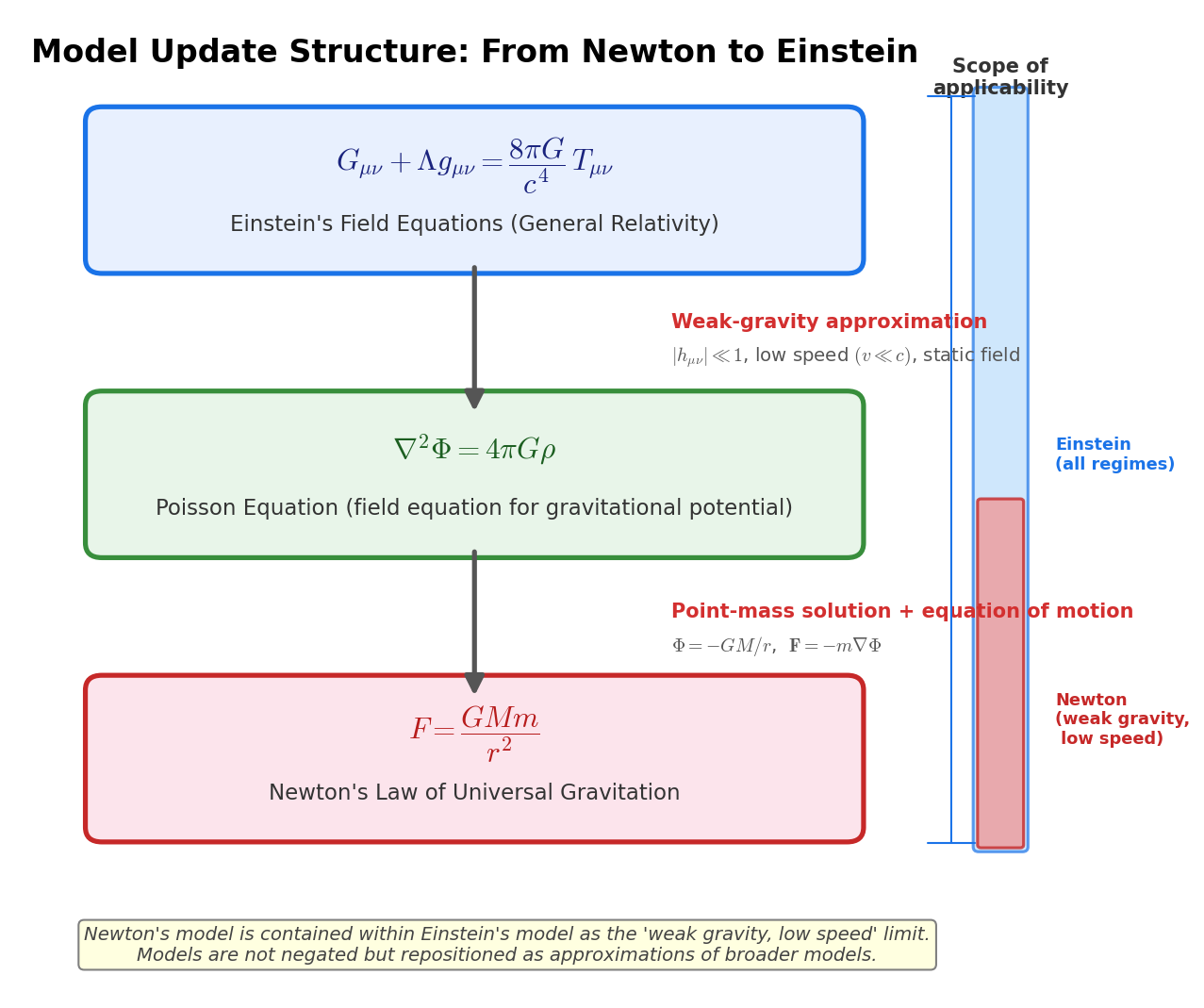
Figure 4: Newton's model is contained within Einstein's model as the "weak gravity, low speed" limit. Models are not rejected but repositioned as approximations of broader models.
✅ Comprehension Check: What approximation conditions must be imposed to derive Newton's universal gravitation from the Einstein equation?
Answer
① Gravity is weak (\(|h_{\mu\nu}| \ll 1\)), ② velocities are sufficiently slow compared to the speed of light, ③ matter is at rest (time variation is slow).
Differences from Conventional Content
⚪ Mei: Professor Lina, can I ask something? There are plenty of physics books and videos out there—what's different about this site?
🟡 Lina: Good question. There are four major differences.
🟡 Lina: First, the difference from popular science books. Popular books often end with "analogies." As Mei said, the world of equations behind the analogies remains invisible. On this site, you can follow the equations and verify "why it works that way" for yourself.
🔵 Kai: But can we really get to quantum gravity with just high school math?
🟡 Lina: Not everything from the start. But we begin with high school calculus and vectors, and introduce the necessary mathematics as we go. If you build up step by step, you can definitely get there.
🟡 Lina: Second, the difference from university textbooks. Textbooks often launch straight into equations without motivation. "Define the Lagrangian. Minimize the action. Done." On this site, we always show first why that model became necessary.
⚪ Mei: Chasing equations without knowing "what problem they're trying to solve" is certainly tough.
🟡 Lina: Third, the difference from existing explanatory books. Many books on string theory or quantum gravity tend to present a specific theory as "the correct theory." But this site treats all models strictly as hypotheses. We fairly present criticisms and alternative theories. The discussion of falsifiability will reappear in the final journey, "The Challenge of Quantum Gravity."
🟡 Lina: Fourth, not just reading but doing. Practice problems are placed in each chapter. Through the experience of deriving and calculating equations yourself, we aim for the level where you can say "I truly understand" rather than "I think I understood from reading."
🔵 Kai: Practice problems, huh... but if I can do the calculations myself, that would definitely feel good.
⚪ Mei: Being able to check your own work means experiencing falsifiability firsthand.
🟡 Lina: As expected of you, Mei. Exactly right.
✅ Comprehension Check: How does this site's approach to models differ from existing explanatory books?
Answer
It treats models not as "the correct theory" but strictly as "hypotheses," and fairly presents criticisms and alternative theories.
A Note on Terminology — Why We Unify Under "Model"
🟡 Lina: Finally, let me formally establish our terminology convention. On this site, when referring to descriptions in physics, we will in principle use the word "model."
🔵 Kai: So we won't say "Newton's laws" or "Einstein's theory"?
🟡 Lina: We'll keep historical proper nouns as they are. "Newton's equation of motion," "Einstein equation," "Standard Model"—these are proper nouns, so we don't change them. But in situations where you'd generally say "physical law" or "physical theory," we'll say "physical model."
⚪ Mei: Let me organize the reasoning.
| Term | Nuance | Problem |
|---|---|---|
| Law | Established rule, unbreakable | Actually gets updated |
| Theory | Systematic description | Tends to imply "correctness" |
| Model | Approximate description made by humans | Updatable, falsifiable |
🟡 Lina: Right. By using the word "model," we can always maintain awareness that "this is human-made," "it's merely an approximation," and "it might be updated someday." It's also an expression of scientific humility.
🔵 Kai: Got it. So should "string theory" really be called "string model"?
🟡 Lina: In principle yes, but "string theory" is a proper noun used worldwide, so we'll use it as is. However, when reading this site, I want you to always maintain the awareness that "this is a hypothesis."
Abbreviations for the Four Journeys
🟡 Lina: One more convention. In the text and equations, we'll sometimes refer to each of the four journeys by English abbreviations. We'll supplement with the full name at first occurrence each time, but let me summarize them here just in case.
List of abbreviations
- GR (General Relativity) = General Relativity
- QM (Quantum Mechanics) = Quantum Mechanics
- QFT (Quantum Field Theory) = Quantum Field Theory
- QG (Quantum Gravity) = The Quest for Quantum Gravity
These abbreviations are used in subscripts of equations (e.g., \(\rho_c^{\text{(qg)}}\), \(E_{\text{QM}}\)) or in chapter titles when saving space. For readers who skip ahead and come back later, each chapter will also re-supplement these at first occurrence.
The Journey Begins
🟡 Lina: So, are you ready? In the first journey—General Relativity—we start from the moment humanity first thought "let's describe nature in equations," beginning with Newton's universal gravitation.
🔵 Kai: I'm excited! But Professor, one last thing. When the four journeys are finished, what will we have gained?
🟡 Lina: ...Honestly, you won't gain a definitive "this is the answer." But you will gain the ability to trace in equations how far humanity has come, and to judge for yourself. And thinking about what comes next is—
⚪ Mei: —our generation's job.
🟡 Lina: Exactly. Let me leave you with one question.
"Why can nature be described by mathematics?"
🟡 Lina: This site won't provide an answer to this question. But as you chase nature through equations across the four journeys, this question will cross your mind again and again. Don't rush for an answer—keep thinking about it along the way.
🟡 Lina: Now then, to the first journey. Let's go from the Prologue to General Relativity.
✅ Comprehension Check: What can readers gain upon completing the four journeys of this site?
Answer
The ability to trace in equations how far humanity has come and to judge for themselves.
References
The content of this chapter was constructed with reference to the following works.
- Lee Smolin, The Trouble with Physics, Ch.1 "The Golden Age of Physics and the Unfinished Revolution" — An overview of physics' historical progress and the problem of stagnation
- Lee Smolin, The Trouble with Physics, Ch.2 "The Five Great Problems of Theoretical Physics" — The big picture of unsolved problems including quantum gravity
- Carlo Rovelli, Reality Is Not What It Seems, Ch.1 "Reality Is Not What It Seems" — Scientific attitude and "reliability rather than certainty"
- Karl Popper, Conjectures and Refutations — The philosophical foundation of falsifiability
Feedback on this page
Let us know if something was unclear, incorrect, or could be improved.