Appendix A: Complex Numbers and Basic Complex Functions
Position of this appendix: The probability amplitudes and wave functions that appear from Ch. 1 onward are all written in complex numbers. You will come to appreciate "why real numbers aren't enough" from Ch. 4 onward, but first let's prepare the tools. We'll start with a review of content covered in high school mathematics and climb all the way up to Euler's formula, which is indispensable in quantum mechanics.
Goals of this appendix
- Become able to freely perform arithmetic operations on complex numbers
- Understand the meaning of the complex plane and polar form geometrically
- Derive Euler's formula \(e^{i\theta} = \cos\theta + i\sin\theta\) and become able to use it fluently
- Get a sense of how the complex conjugate and the absolute value squared are used in quantum mechanics
Introducing the Imaginary Unit \(i\)
🟡 Lina: In this appendix, we'll organize the basics of "complex numbers" used in quantum mechanics. First, a question. Does a real number \(x\) satisfying \(x^2 = -1\) exist?
🔵 Kai: It doesn't, right? Because squaring any real number gives something 0 or greater.
🟡 Lina: Right. There's no solution within the real numbers. But what if we ask, "If there were a number whose square is \(-1\), what kind of calculations could we do?" We simply give that number a name.
This \(i\) is called the imaginary unit.
🔵 Kai: Is it okay to give a name to a "number that doesn't exist"?
🟡 Lina: Good question. If you look back at the history of mathematics, "negative numbers" were also once thought to "not exist." In ancient times, "subtracting 5 apples from 3 apples" was nonsensical. But once the concept of debt was born, negative numbers became commonplace. Nobody questions them today, right?
⚪ Mei: So it means that as long as \(i\) can be used as a computational tool without contradiction, that's sufficient.
🟡 Lina: Exactly. If we can perform arithmetic without contradiction and it's useful for describing physical phenomena, then it's a perfectly valid "number."
✅ Comprehension Check: State the definition of the imaginary unit \(i\). Also, what are the values of \(i^3\) and \(i^4\)?
Answer
The imaginary unit \(i\) is defined as the number satisfying \(i^2 = -1\). \(i^3 = i^2 \cdot i = -1 \cdot i = -i\), \(i^4 = (i^2)^2 = (-1)^2 = 1\). The powers of \(i\) repeat cyclically as \(1, i, -1, -i\) every four powers.
🟡 Lina: Let me say one more important thing upfront. In quantum mechanics, complex numbers are essentially needed to describe nature's behavior. However, the values that can actually be measured in experiments—for example, the position or energy of a particle—are mysteriously all real numbers.
🔵 Kai: Wait, complex numbers are important, but measured values are real? Isn't that contradictory?
🟡 Lina: It's not a contradiction—rather, the structure of quantum mechanics itself is built that way. Why this is so will become mathematically clear from Ch. 11 onward. For now, just remember: "backstage is complex numbers, what the audience sees is real numbers."
✅ Comprehension Check: In quantum mechanics, what roles do complex numbers and real numbers each play?
Answer
In quantum mechanics, complex numbers are essentially needed to describe nature's behavior (probability amplitudes and wave functions are complex numbers). On the other hand, physical quantities that can be measured experimentally (such as position and energy) are all real numbers. The structure is "backstage is complex numbers, what the audience sees is real numbers."
Arithmetic Operations on Complex Numbers
🟡 Lina: A complex number \(z\) can be written using real numbers \(a\) and \(b\) as
\(a\) is called the real part, and \(b\) is called the imaginary part. Although \(z\) has two components, it is one number.
🔵 Kai: What about when \(a = 0\)?
🟡 Lina: When \(a = 0\) and \(b \neq 0\), \(z = bi\) is called a purely imaginary number. Conversely, if \(b = 0\), then \(z = a\) is just a real number. Real numbers are a special case of complex numbers.
Now, let's look at arithmetic operations with \(z_1 = a + bi\) and \(z_2 = c + di\).
Addition and Subtraction
🟡 Lina: You simply compute real parts together and imaginary parts together.
⚪ Mei: This has the same structure as component-wise addition and subtraction of vectors.
🟡 Lina: Good observation. When we introduce the "complex plane" later, it really does become the same diagram as vector addition.
Multiplication
🟡 Lina: For multiplication, you just expand normally and use \(i^2 = -1\).
🔵 Kai: Do we need to memorize this as a formula?
🟡 Lina: You don't need to. As long as you know \(i^2 = -1\), you can just expand it like regular algebra.
Division
🟡 Lina: Division requires a small trick. We want to make the denominator real. To do this, we multiply both numerator and denominator by the "complex conjugate of the denominator." I'll explain the complex conjugate in detail later, but the complex conjugate of \(c + di\) is \(c - di\)—you just flip the sign of the imaginary part.
🟡 Lina: Let me verify the numerator expansion: \((a + bi)(c - di) = ac - adi + bci - bdi^2 = ac - adi + bci + bd = (ac + bd) + (bc - ad)i\). Same as multiplication—just using \(i^2 = -1\).
🔵 Kai: The denominator became \(c^2 + d^2\), which is real!
🟡 Lina: Right. \((c + di)(c - di) = c^2 - (di)^2\), and here \((di)^2 = d^2 i^2 = d^2 \times (-1) = -d^2\), so \(c^2 - (-d^2) = c^2 + d^2\). That's the key point. Since this is real, you just divide both the real and imaginary parts by \(c^2 + d^2\).
⚪ Mei: Making the denominator real—that's the essence of division. It's similar to rationalizing.
✅ Comprehension Check: Given \(z_1 = 3 + 2i\) and \(z_2 = 1 - i\), compute \(z_1 z_2\) and \(z_1 / z_2\).
Answer
Multiplication: \(z_1 z_2 = (3 + 2i)(1 - i) = 3 - 3i + 2i - 2i^2 = 3 - i + 2 = 5 - i\)
Division: \(\dfrac{z_1}{z_2} = \dfrac{3 + 2i}{1 - i} \cdot \dfrac{1 + i}{1 + i} = \dfrac{(3 + 2i)(1 + i)}{1^2 + 1^2} = \dfrac{3 + 3i + 2i + 2i^2}{2} = \dfrac{1 + 5i}{2} = \dfrac{1}{2} + \dfrac{5}{2}i\)
📝 Exercises:
- Practice with complex number arithmetic → Problem B-1. Multiplication of Complex Numbers
The Complex Plane and Polar Form
🟡 Lina: You could represent real numbers as points on a number line, right? Since complex numbers have two components (real part and imaginary part), we represent them as points on a plane.
- Horizontal axis: real axis — represents the real part \(a\)
- Vertical axis: imaginary axis — represents the imaginary part \(b\)
This plane is called the complex plane, or the Gauss plane. The complex number \(z = a + bi\) corresponds to the point that is \(a\) along the real axis and \(b\) along the imaginary axis.
🔵 Kai: So it's the point with coordinates \((a, b)\).
🟡 Lina: Right. Now, think of the "arrow" from the origin to that point. That arrow has a length and an angle.
- The length \(r\) of the arrow is called the absolute value of the complex number, written \(|z|\)
- The angle the arrow makes with the positive real axis is called the argument, written \(\arg(z)\). We often denote the argument by \(\theta\) (i.e., \(\theta = \arg(z)\))
✅ Comprehension Check: In the complex plane, what do the "absolute value" and "argument" of a complex number represent?
Answer
The absolute value \(|z|\) represents the distance from the origin to the point corresponding to the complex number \(z\) (the length of the arrow). The argument \(\arg(z)\) represents the angle that arrow makes with the positive direction of the real axis. These correspond to polar coordinates \((r, \theta)\).
⚪ Mei: The relationship between Cartesian coordinates \((a, b)\) and polar coordinates \((r, \theta)\). We learned that in high school.
🟡 Lina: Exactly. Using trigonometric functions:
So,
This is called the polar form of a complex number.
🔵 Kai: Oh, you can factor out \(r\). That's a clean form.
🟡 Lina: The absolute value \(r\) is just the Pythagorean theorem:
The argument \(\theta\) is determined from:
But there are two caveats. First, the inverse tangent function \(\arctan\) only returns values in the range \(-\pi/2\) to \(\pi/2\), so you need to look at the signs of \(a\) and \(b\) to determine which quadrant the number is in. Also, adding any integer multiple of \(2\pi\) to \(\theta\) represents the same point, so the argument is periodic with period \(2\pi\).
🔵 Kai: So the same complex number can have different representations of the argument.
🟡 Lina: Right. For example, an argument of \(\pi/4\) and \(\pi/4 + 2\pi = 9\pi/4\) point in the same direction. Usually we restrict to \(-\pi < \theta \leq \pi\) or \(0 \leq \theta < 2\pi\) and take the "principal value."
✅ Comprehension Check: Find the absolute value and argument of \(z = 1 + i\).
Answer
\(|z| = \sqrt{1^2 + 1^2} = \sqrt{2}\). \(\tan\theta = 1/1 = 1\), and since \(a > 0, b > 0\) (first quadrant), \(\theta = \pi/4\). Therefore \(z = \sqrt{2}(\cos(\pi/4) + i\sin(\pi/4))\).
📝 Exercises:
- Converting complex numbers to polar form → Problem B-4. Conversion to Polar Form
Geometric Meaning of Multiplication — Rotation and Scaling
🟡 Lina: The true power of polar form is revealed in multiplication. Let's write two complex numbers in polar form.
Let's compute their product.
⚪ Mei: The real and imaginary parts of the expanded result look familiar... it's the addition formulas.
🟡 Lina: Exactly. Recall the trigonometric addition formulas: \(\cos(A + B) = \cos A\cos B - \sin A\sin B\) and \(\sin(A + B) = \sin A\cos B + \cos A\sin B\). The real part of the expanded result, \(\cos\theta_1 \cos\theta_2 - \sin\theta_1 \sin\theta_2\), is exactly the form of \(\cos(\theta_1 + \theta_2)\), and the imaginary part, \(\cos\theta_1 \sin\theta_2 + \sin\theta_1 \cos\theta_2\), is the form of \(\sin(\theta_1 + \theta_2)\), so:
🔵 Kai: Oh! The absolute values multiply, and the arguments add!
🟡 Lina: This is the essence of complex number multiplication. To summarize:
Geometric meaning of complex number multiplication:
Multiplying by a complex number \(z_2\) means, on the complex plane: - Scaling the absolute value by \(|z_2|\) (enlargement/reduction) - Increasing the argument by \(\arg(z_2)\) (rotation)
✅ Comprehension Check: In the complex number product \(z_1 z_2\), what happens to the absolute value and argument of the product?
Answer
The absolute value of the product is \(|z_1 z_2| = |z_1| \cdot |z_2|\) (the product of the absolute values), and the argument is \(\arg(z_1 z_2) = \arg(z_1) + \arg(z_2)\) (the sum of the arguments). In other words, multiplication is "an operation that simultaneously performs scaling and rotation."
⚪ Mei: So if \(|z_2| = 1\), it's pure rotation only, and if \(\arg(z_2) = 0\), it's pure scaling only. The two effects can be separated independently.
🟡 Lina: Let's look at a concrete example. What happens when you multiply by the imaginary unit \(i\)? What are the absolute value and argument of \(i\)?
🔵 Kai: Let me see... \(i = 0 + 1 \cdot i\), so the absolute value is \(\sqrt{0^2 + 1^2} = 1\), and the argument is in the positive imaginary direction, so \(\pi/2\). That means... the magnitude doesn't change, and it rotates \(90°\)!
🟡 Lina: Perfect. Then what happens if you multiply by \(i\) twice?
🔵 Kai: \(90° + 90° = 180°\) rotation, and \(i^2 = -1\). It goes to the negative real direction.
🟡 Lina: Right. \(-1\) is a complex number that means "\(180°\) rotation." So \((-1) \times (-1) = 1\) means that performing two \(180°\) rotations gives \(360°\), returning to the start.
🔵 Kai: I never thought "negative times negative equals positive" could be so intuitive... But conversely, multiplying by \(i\) three times is a \(270°\) rotation giving \(-i\), right? That's "the negative imaginary direction," which matches \(i^3 = -i\)! So can I think of \(i^{100}\) in terms of rotation too?
🟡 Lina: Exactly. That's the power of the complex plane. Let's verify \(i^{100}\) that Kai mentioned. \(100 \times 90° = 9000°\), and \(9000 / 360 = 25\) full rotations, so it returns to \(1\)—algebraically, \(i^{100} = (i^4)^{25} = 1^{25} = 1\), which matches.
⚪ Mei: So computing \(i^n\) can be reinterpreted as "applying \(90°\) rotations \(n\) times." The same result from either the algebraic or geometric approach—that's the strength of the complex plane.
✅ Comprehension Check: Compute the result of multiplying the complex number \(z = 1 + i\) by \(i\), and explain how it moves on the complex plane.
Answer
\(iz = i(1 + i) = i + i^2 = -1 + i\). The original \(z = 1 + i\) is in the first quadrant (argument \(\pi/4\)), and \(iz = -1 + i\) is in the second quadrant (argument \(3\pi/4\)). The argument increased by \(\pi/2\), meaning it rotated \(90°\) counterclockwise about the origin. The absolute value remains \(\sqrt{2}\) for both.
Complex Conjugate — The Mirror Image of a Number
🟡 Lina: I previewed this a bit in the division section, but let me formally define it here. Taking the complex number \(z = a + bi\) and flipping only the sign of its imaginary part gives the complex conjugate. In physics, the standard notation is \(z^*\). In mathematics, \(\bar{z}\) is also used, but in this course we'll follow the physics convention and use \(z^*\).
🔵 Kai: Just flipping the sign of the imaginary part? Does something that simple really need a name?
🟡 Lina: It does. In quantum mechanics, it appears everywhere. Let me show you three useful properties.
Property 1: Extracting the Real and Imaginary Parts
🟡 Lina: Adding \(z\) and \(z^*\):
So,
Similarly, subtracting:
So,
Here \(\operatorname{Re}\) stands for real part, and \(\operatorname{Im}\) stands for imaginary part.
🔵 Kai: Adding cancels the imaginary part leaving only the real part; subtracting cancels the real part leaving only the imaginary part. Clever design.
Property 2: The Absolute Value Squared
🟡 Lina: Multiplying \(z\) by \(z^*\):
🔵 Kai: Multiplying by the complex conjugate gives the absolute value squared!
🟡 Lina: This is the most frequently used relation in quantum mechanics. When computing probability from a probability amplitude \(\phi\) in Ch. 4, you'll perform the calculation \(|\phi|^2 = \phi^* \phi\) every time.
✅ Comprehension Check: What is the product \(zz^*\) of a complex number \(z\) and its complex conjugate \(z^*\) equal to? Why is this relation important in quantum mechanics?
Answer
\(zz^* = |z|^2\) (the absolute value squared). In quantum mechanics, when computing probability from a probability amplitude \(\phi\), we perform the calculation \(|\phi|^2 = \phi^* \phi\), so this relation is used most frequently.
🔵 Kai: But if multiplying by \(z^*\) gives a real number, does the argument of \(z^*\) have something special about it?
🟡 Lina: Good question. Actually, the argument of \(z^*\) has the opposite sign of the argument of \(z\). In polar form, for \(z = r(\cos\theta + i\sin\theta)\), we have \(z^* = r(\cos\theta - i\sin\theta)\). Here \(\cos\theta - i\sin\theta = \cos(-\theta) + i\sin(-\theta)\) holds—since \(\cos(-\theta) = \cos\theta\) (the sign doesn't change) and \(\sin(-\theta) = -\sin\theta\) (the sign flips). So the argument is \(-\theta\). Multiplying gives an argument of \(\theta + (-\theta) = 0\), pointing along the real axis, and the absolute value is \(r \times r = r^2\). It's perfectly consistent, right?
⚪ Mei: The arguments cancel each other and return to the real axis—this matches perfectly with the geometric image of rotation.
🟡 Lina: After we learn Euler's formula, this will be written even more compactly. For now, it's enough to keep the intuition that "the complex conjugate reverses the argument."
🔵 Kai: The arguments cancel each other so it returns to the real axis—that's geometrically clean.
Property 3: Computation Rules for the Complex Conjugate
🟡 Lina: The complex conjugate has the following rules. Each can be proved by going back to the definition, but let me summarize them.
🔵 Kai: The complex conjugate can be "brought inside" addition, multiplication, and division. Subtraction works the same way too, right? \((z_1 - z_2)^* = z_1^* - z_2^*\)?
🟡 Lina: Right. Subtraction is a special case of addition, so it follows automatically. In mathematics, this property is stated as "\(*\) is a field automorphism," but we don't need to go that deep now. Just remember "the complex conjugate commutes with all arithmetic operations."
✅ Comprehension Check: For \(z = 3 - 4i\), compute \(|z|^2\) using \(zz^*\). Also, what is \(|z|\)?
Answer
\(z^* = 3 + 4i\). \(zz^* = (3 - 4i)(3 + 4i) = 9 + 16 = 25 = |z|^2\). Therefore \(|z| = 5\).
📝 Exercises:
- Proofs and calculations with complex conjugate properties → Problem M-1. General Proof of the Product Rule for Complex Conjugates
Preparation: Taylor Expansion
🟡 Lina: To derive Euler's formula, we need a tool called the Taylor expansion. Here we'll use knowledge of differentiation from high school calculus. If you haven't learned differentiation yet, you can skip the intermediate calculations in this section—the only results needed for the main text are the three formulas (A.23)–(A.25), so it's fine to accept them as "these formulas hold" and proceed to the next section "Euler's Formula."
Differentiation is the operation of finding the ratio of "how much \(f(x)\) changes when \(x\) changes by a tiny amount \(\Delta x\)." The derivative of \(f(x)\) is written \(f'(x)\). More specifically,
In other words, you divide "the change in \(f\) when \(x\) shifts by \(\Delta x\)" by "\(\Delta x\)," then take the limit as \(\Delta x\) becomes infinitely small. Graphically, it equals the slope of the tangent line—the limit of the slope of a secant line connecting two points on the curve as those two points are brought infinitely close together.
As a basic formula, the derivative of \(x^n\) is \((x^n)' = nx^{n-1}\)—you bring the exponent down in front and reduce the exponent by 1. For example, if \(f(x) = x^2\) then \(f'(x) = 2x^1 = 2x\), and if \(f(x) = x^3\) then \(f'(x) = 3x^2\). Intuitively, \((x + \Delta x)^2 - x^2 = 2x\,\Delta x + (\Delta x)^2\), so dividing by \(\Delta x\) and taking \(\Delta x \to 0\) leaves \(2x\)—the \((\Delta x)^2\) term vanishes. For trigonometric functions, \((\sin x)' = \cos x\) and \((\cos x)' = -\sin x\). The exponential function satisfies \((e^x)' = e^x\)—a special function that equals itself when differentiated. Rigorous derivations are left to calculus textbooks, but remember these results as they'll be used repeatedly.
🔵 Kai: Where does the minus sign in \((\cos x)' = -\sin x\) come from? Also, isn't \((e^x)' = e^x\) strange? Can there really be a function that doesn't change when differentiated?
🟡 Lina: Let me answer in order. First, about the minus sign in \(\cos x\). Picture the graph of \(\cos x\). At \(x = 0\), \(\cos 0 = 1\), which is the top of a hill. At the top, the slope is zero—indeed \(-\sin 0 = 0\), which checks out. As \(x\) increases slightly from there, \(\cos x\) decreases, meaning the slope becomes negative. \(-\sin x\) is negative for \(x > 0\), so it's consistent. You can verify \((\sin x)' = \cos x\) with the same reasoning. At \(x = 0\), \(\sin 0 = 0\) and the function is passing through the origin with positive slope—indeed \(\cos 0 = 1 > 0\), which checks out.
⚪ Mei: So you can read off the sign of the derivative from the shape of the graph. At the top of a hill the slope is 0, on a downhill the slope is negative—it's intuitive.
🟡 Lina: Now about \(e^x\). Intuitively, the graph of \(e^x\) increases more and more steeply to the right. The characteristic of an exponential function is that it "has a slope proportional to its current value." Where the value is large, the slope is large; where the value is small, the slope is small. Think of \(e^x\) as the function whose "rate of change equals itself." In fact, the number \(e\) is precisely the base chosen to satisfy this property.
🔵 Kai: I see, so it's a special function satisfying "rate of change = itself."
🟡 Lina: Now, we repeatedly apply differentiation. Differentiating \(f'(x)\) again gives \(f''(x)\) (the second derivative), and differentiating once more gives \(f'''(x)\) (the third derivative). For example, if \(f(x) = x^2\), then \(f'(x) = 2x\), \(f''(x) = 2\), \(f'''(x) = 0\). In general, the \(n\)-th derivative is written \(f^{(n)}(x)\). The parentheses indicate "\(n\)-th derivative," not "\(n\)-th power"—\(f^{(4)}(x)\) means \(f\) differentiated 4 times, and \(f^{(0)}(x) = f(x)\) means zero derivatives, i.e., the original function itself.
Before that, let me introduce a notation. \(n! = n \times (n-1) \times \cdots \times 1\) is called the factorial. For example, \(3! = 3 \times 2 \times 1 = 6\), \(4! = 4 \times 3 \times 2 \times 1 = 24\). We define \(0! = 1\) by convention (this way \(1! = 1 \times 0! = 1 \times 1 = 1\), and the recurrence \(n! = n \times (n-1)!\) holds without contradiction even at \(n = 1\), which is convenient). We'll use this notation shortly.
🔵 Kai: What is a Taylor expansion?
🟡 Lina: If you know the value of a function at a point \(x_0\) and all its derivative values at that point (first derivative, second derivative, third derivative, ...), then you can express the function's value at a point \(x\) slightly away from \(x_0\) as a sum of polynomial terms. That's the technique.
The idea goes like this. Very close to \(x_0\), the function can be approximated by its tangent line. Since \(f'(x_0)\) is the slope (rate of change) at \(x = x_0\), at a point shifted by \(\Delta x = x - x_0\), we can write \(f(x) \approx f(x_0) + f'(x_0)(x - x_0)\)—"original value + slope × displacement." But this is only a first-order approximation. To improve accuracy, we add second-order, third-order terms, and so on.
🔵 Kai: How do you determine the second-order term?
🟡 Lina: The coefficient of each term is determined so that "when you differentiate \(n\) times and substitute \(x = x_0\), exactly \(f^{(n)}(x_0)\) is extracted." For this, we attach \(1/n!\)—the factorial we just defined. The reason \(n!\) is needed is that differentiating \(x^n\) \(n\) times produces \(n!\). For example, differentiating \(x^3\) once gives \(3x^2\), once more gives \(6x\), once more gives \(6 = 3!\). In general, differentiating \((x - x_0)^n\) \(n\) times and substituting \(x = x_0\) leaves \(n!\). So placing \(n!\) in the denominator exactly cancels it, extracting only \(f^{(n)}(x_0)\). The result is:
Here \(f^{(0)} = f\) (zero derivatives = the original function). The "\(\cdots\)" on the right means this sum continues indefinitely.
🔵 Kai: You keep adding infinitely? Does it really converge to the original function?
🟡 Lina: Good question. First, let me explain what "adding infinitely" means. Consider \(1 + \frac{1}{2} + \frac{1}{4} + \frac{1}{8} + \cdots\). The values you get by adding just the first term, the first two terms, the first three terms, and so on are called partial sums. In this case, the partial sums are \(1, 1.5, 1.75, 1.875, \ldots\), approaching \(2\) more and more closely—each time advancing half the remaining distance, so they never exceed \(2\) but can get arbitrarily close. When partial sums approach a specific value like this, we define that value as the "sum" of the infinite series. Conversely, if partial sums like \(1 + 1 + 1 + \cdots\) grow without bound and don't settle on a single value, we say the series "diverges" and the sum is undefined.
🔵 Kai: I see, so even though we say "add infinitely," we're actually looking at where the partial sums head. But does the Taylor expansion actually converge? It can't work for every function, right?
🟡 Lina: Sharp. In fact, not every function's Taylor expansion converges to the original function. For example, the function \(f(x) = e^{-1/x^2}\) (for \(x \neq 0\)), \(f(0) = 0\) has all derivative values equal to \(0\) at \(x = 0\), so its Taylor expansion is identically \(0\)—completely different from the original function. But the three functions we'll use—\(\cos x\), \(\sin x\), and \(e^x\)—are mathematically proven to have their infinite series equal to the original function for any real number \(x\). So you can use them with confidence. Furthermore, the series for \(e^x\) converges even when a complex number is substituted for \(x\)—we'll use this when deriving Euler's formula in the next section. In practice, we often truncate the series at a certain point depending on the required precision.
⚪ Mei: Being able to reconstruct the value at a distant point from information only at \(x_0\) is amazing.
🟡 Lina: Equation (A.20) can also be written compactly using sigma (\(\Sigma\)) notation. Just as \(\displaystyle\sum_{n=1}^{3} n = 1 + 2 + 3 = 6\), the \(\sum\) notation means you start from the value written below the symbol, go up to the value written above, incrementing by 1 each time and summing. \(\displaystyle\sum_{n=0}^{3} n^2 = 0^2 + 1^2 + 2^2 + 3^2 = 14\)—if the lower limit is \(0\), you start from \(n = 0\). When the upper limit is \(\infty\), it means "the limit of partial sums" as I just explained. For example, \(\displaystyle\sum_{n=0}^{\infty} \left(\frac{1}{2}\right)^n = 1 + \frac{1}{2} + \frac{1}{4} + \cdots = 2\)—exactly the geometric series example from before.
🔵 Kai: So \(\sum\) is an instruction symbol meaning "add up everything from here to there."
🟡 Lina: Right. Using this, equation (A.20) can be written as follows. Here \(f^{(n)}(x_0)\) means "differentiate \(f\) \(n\) times and substitute \(x = x_0\)"—the notation we explained earlier:
🟡 Lina: The expansion around \(x_0 = 0\) in particular is called the Maclaurin expansion. Taylor and Maclaurin are both names of mathematicians.
✅ Comprehension Check: What is a Taylor expansion? Briefly explain why the coefficient of each term has a factor of \(1/n!\).
Answer
A Taylor expansion is a technique for expressing a function as a polynomial (power series) using the function's value and all orders of derivatives at a point \(x_0\). The \(1/n!\) factor is needed so that when the right-hand side is differentiated \(n\) times and \(x = x_0\) is substituted, exactly \(f^{(n)}(x_0)\) is extracted (since differentiating \(x^n\) \(n\) times produces \(n!\), which needs to be canceled).
🟡 Lina: Let's verify that this formula is correct. "Correct" means: substituting \(x = 0\) into the right-hand side yields \(f(0)\); differentiating once and substituting \(x = 0\) yields \(f'(0)\); ... differentiating \(n\) times and substituting \(x = 0\) yields \(f^{(n)}(0)\). Let's actually do it.
First, differentiate the right-hand side term by term with respect to \(x\). \(f(0)\) is a constant, so its derivative is \(0\). Differentiating \(f'(0)\,x\) gives \(f'(0)\). Differentiating \(\dfrac{f''(0)}{2!}\,x^2\) gives \(\dfrac{f''(0)}{2!} \cdot 2x = f''(0)\,x\). Differentiating \(\dfrac{f'''(0)}{3!}\,x^3\) gives \(\dfrac{f'''(0)}{3!} \cdot 3x^2 = \dfrac{f'''(0)}{2!}\,x^2\). That is,
The whole thing just shifted by one level but has the same form. Substituting \(x = 0\), all terms containing \(x\) vanish and only \(f'(0)\) remains—indeed matching \(f'(0)\) on the left side. Differentiating once more and substituting \(x = 0\) extracts \(f''(0)\). Repeating this confirms that differentiating \(n\) times and substituting \(x = 0\) yields \(f^{(n)}(0)\).
🔵 Kai: I see... each differentiation shifts by one level, and substituting \(x = 0\) leaves only the derivative of that order. It works because \(n!\) neatly absorbs the \(n\). What an elegant mechanism.
Maclaurin Expansions of Three Functions
🟡 Lina: To derive Euler's formula, we'll expand \(\cos x\), \(\sin x\), and \(e^x\).
Expansion of \(\cos x\):
Evaluating the successive derivatives of \(\cos x\) at \(x = 0\):
Table A.1: Successive derivatives of cos x and their values at x=0
| \(n\) | \(f^{(n)}(x)\) | \(f^{(n)}(0)\) |
|---|---|---|
| 0 | \(\cos x\) | \(1\) |
| 1 | \(-\sin x\) | \(0\) |
| 2 | \(-\cos x\) | \(-1\) |
| 3 | \(\sin x\) | \(0\) |
| 4 | \(\cos x\) | \(1\) |
The pattern repeats every 4 terms. Since the odd-order terms are \(0\),
Expansion of \(\sin x\):
Similarly,
Table A.2: Successive derivatives of sin x and their values at x=0
| \(n\) | \(f^{(n)}(x)\) | \(f^{(n)}(0)\) |
|---|---|---|
| 0 | \(\sin x\) | \(0\) |
| 1 | \(\cos x\) | \(1\) |
| 2 | \(-\sin x\) | \(0\) |
| 3 | \(-\cos x\) | \(-1\) |
| 4 | \(\sin x\) | \(0\) |
Since the even-order terms are \(0\),
🔵 Kai: \(\cos\) has only even powers, \(\sin\) has only odd powers. It corresponds to the 4-cycle of derivatives.
Expansion of \(e^x\):
🟡 Lina: The exponential function \(e^x\) is special in that "it equals itself no matter how many times you differentiate." Since \((e^x)' = e^x\), for all orders \(f^{(n)}(0) = e^0 = 1\).
🔵 Kai: The expansion of \(e^x\) is beautiful. All terms survive.
⚪ Mei: \(\cos x\) has only even-order terms, \(\sin x\) has only odd-order terms, \(e^x\) has all of them. Comparing these three, there seems to be some relationship...
🟡 Lina: Sharp. Euler's formula is born precisely from there.
✅ Comprehension Check: In the Maclaurin expansions of \(\cos x\), \(\sin x\), and \(e^x\), which orders of terms survive in each?
Answer
\(\cos x\) has only even-order terms (\(1, x^2, x^4, \ldots\)), \(\sin x\) has only odd-order terms (\(x, x^3, x^5, \ldots\)), and \(e^x\) has terms of all orders. The reason some terms vanish in \(\cos x\) and \(\sin x\) is that, due to the 4-periodicity of differentiation, certain orders have value 0 at \(x=0\).
✅ Comprehension Check: What do you get by substituting \(x = 1\) into the Maclaurin expansion of \(e^x\)?
Answer
\(e^1 = e = 1 + 1 + \frac{1}{2!} + \frac{1}{3!} + \cdots = 1 + 1 + 0.5 + 0.1667 + \cdots \approx 2.718\ldots\). The value of Napier's number \(e\) is expressed as an infinite series.
Euler's Formula — The True Identity of \(e^{i\theta}\)
🟡 Lina: Now for the climax of this appendix. Let's substitute \(i\theta\) for \(x\) in equation (A.25). Here \(\theta\) is a real number.
🔵 Kai: Wait, \(x\) was real, and we can put in an imaginary number?
🟡 Lina: Sharp question. In fact, it's been mathematically proven that the Taylor expansion \(\sum x^n/n!\) of \(e^x\) converges to a well-defined value even when \(x\) is a complex number. The intuitive key point is this: the numerator \(|x|^n\) is just "multiplying the same number \(|x|\) \(n\) times," but the denominator \(n! = 1 \times 2 \times 3 \times \cdots \times n\) has "a new, larger number multiplied each time." So for sufficiently large \(n\), the growth of the denominator overwhelms the numerator, and each term becomes rapidly small. Let's see concretely. When \(|x| = 10\), the \(n\)-th term is \(10^n/n!\), but \(10! = 3628800\), \(20! \approx 2.4 \times 10^{18}\)—the denominator grows explosively. The \(n = 20\) term is \(10^{20}/20! \approx 41\), still sizeable, but the \(n = 30\) term is \(10^{30}/30! \approx 0.004\), rapidly shrinking. As \(n\) increases further, terms become effectively zero, so the entire series converges to a finite value. The rigorous proof is learned in university analysis, but you can trust and use the result.
🔵 Kai: I understand it converges, but what actually is "\(e\) to the power \(i\theta\)"? When it was real, I had the image of "multiplying \(e\) many times," but multiplying an imaginary number of times doesn't make sense.
🟡 Lina: That's exactly the point. The real \(e^x\) was characterized by the property "equals itself no matter how many times you differentiate," but when \(x\) is imaginary, it's hard to give direct meaning to "raising \(e\) to the power \(i\theta\)." So we shift our thinking.
First, let's confirm: for real \(x\), the value of the series \(\sum x^n/n!\) exactly matches "the \(e^x\) we already know"—for example, substituting \(x = 1\) gives \(e \approx 2.718\ldots\), and \(x = 2\) gives \(e^2 \approx 7.389\ldots\). So within the real numbers, the series is just "another way to write" \(e^x\).
But the series can be computed even when a complex number is substituted for \(x\). So we adopt the series \(\sum x^n/n!\) directly as the definition of \(e^{i\theta}\). In other words, we define "what \(e^{i\theta}\) is" by this series. It's like "extending" a formula that gives the right answer for real numbers into the complex domain.
⚪ Mei: "If we can compute it, make it the definition"—the same thinking as when we introduced the imaginary unit \(i\). For \(i\), it was "assume a number satisfying \(i^2 = -1\) exists," and now it's "we call the value of this series \(e^{i\theta}\)."
🟡 Lina: Right. So let's actually write it out. The definition is
The powers of \(i\) cycle every four:
🔵 Kai: They cycle every four.
🟡 Lina: Right. Using this to expand equation (A.26):
Here we use \((i\theta)^n = i^n \theta^n\). This is just the rule "the power of a product equals the product of the powers"—\((ab)^n = a^n b^n\), meaning multiplying \(ab\) \(n\) times equals multiplying \(a\) \(n\) times and \(b\) \(n\) times and taking their product—applied with \(a = i\), \(b = \theta\). Since complex number multiplication obeys the same commutative and associative laws as real numbers, this rule applies directly. Using the cyclic pattern of \(i\)'s powers: \((i\theta)^2 = i^2 \theta^2 = -\theta^2\), \((i\theta)^3 = i^3 \theta^3 = -i\theta^3\), \((i\theta)^4 = i^4 \theta^4 = \theta^4\), .... Substituting:
🔵 Kai: The signs go \(+, +, -, -, +, +, \ldots\), changing in pairs of two—that's because of \(i\)'s cyclic pattern.
🟡 Lina: Exactly. Now let's separate into real and imaginary parts. The terms without \(i\) (the \(n = 0, 2, 4, \ldots\) terms) form the real part, and factoring \(i\) out of the terms with \(i\) (the \(n = 1, 3, 5, \ldots\) terms) gives the imaginary part.
🔵 Kai: Ah! The real part is \(\cos\theta\) from equation (A.23), and the imaginary part is \(\sin\theta\) from equation (A.24)!
🟡 Lina: Exactly. This is Euler's formula:
⚪ Mei: Putting \(i\) into the "all-inclusive" series of \(e^x\) automatically sorts the even-order terms into \(\cos\) and the odd-order terms into \(\sin\)... beautiful.
🟡 Lina: Can you see why this happens? Since the series of \(e^x\) contains all orders, the pattern of \(i\)'s powers (\(1, i, -1, -i, \ldots\)) sorts even-order terms into the real part and odd-order terms into the imaginary part. Collecting only even-order terms gives \(\cos\theta\), and only odd-order terms gives \(\sin\theta\)—that's why the exponential function connects to trigonometric functions.
🔵 Kai: The powers of \(i\) act as the "sorting agent." \(i^2 = -1\) returns to the real part, \(i^3 = -i\) returns to the imaginary part... the 4-cycle automatically performs the even/odd classification.
⚪ Mei: So because \(e^x\) is the "all-inclusive" series, when you put in \(i\), both \(\cos\) and \(\sin\) emerge naturally.
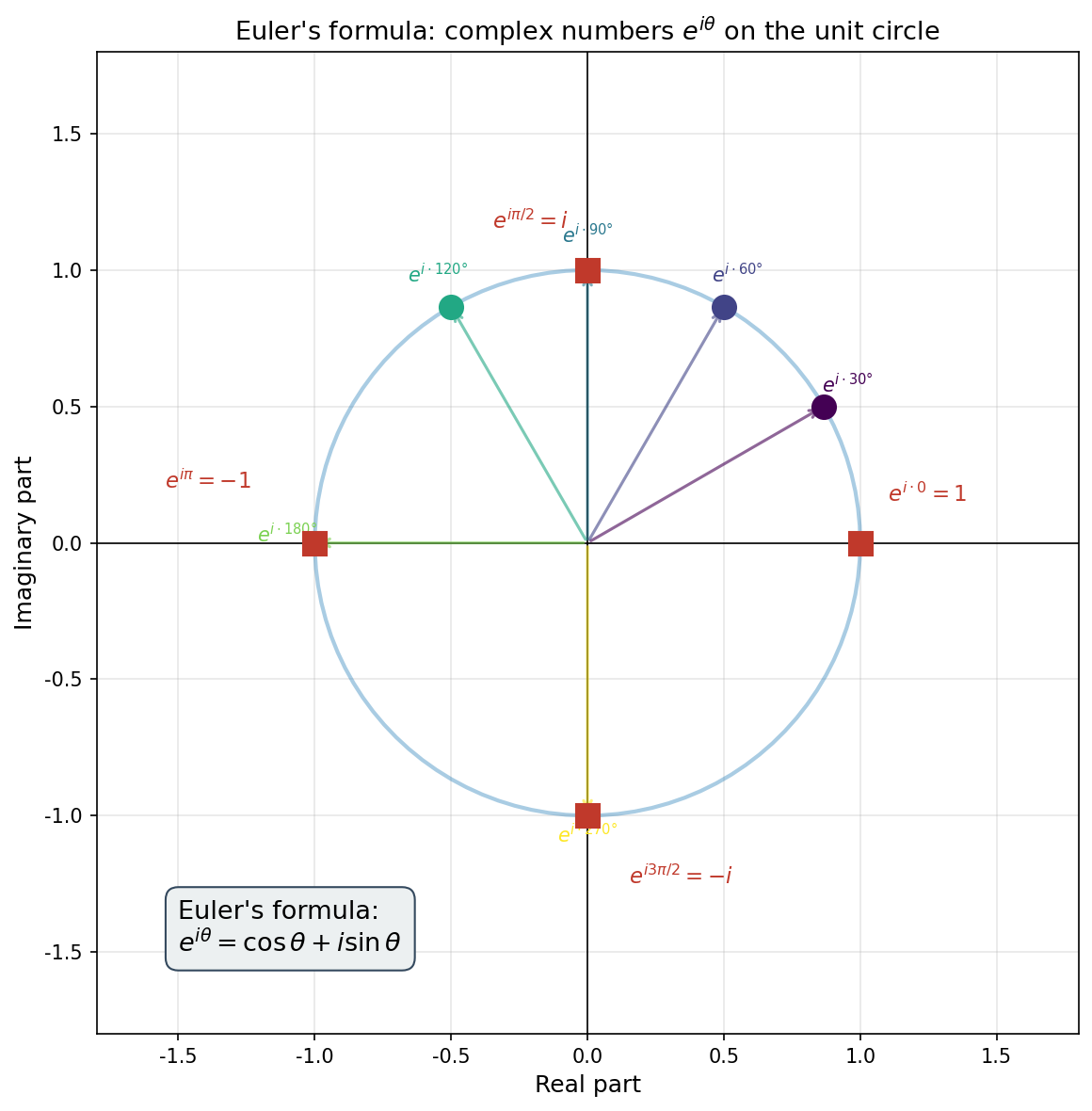
Fig. A.1: Euler's formula and the unit circle. \(e^{i\theta} = \cos\theta + i\sin\theta\) represents a point on the unit circle in the complex plane. Special values: \(e^{i\cdot 0}=1\), \(e^{i\pi/2}=i\), \(e^{i\pi}=-1\) (Euler's identity), \(e^{i3\pi/2}=-i\). As \(\theta\) varies, the point rotates around the unit circle.
🟡 Lina: Look at Fig. A.1 "Euler's formula and the unit circle". The absolute value of \(e^{i\theta}\) is \(|e^{i\theta}| = \sqrt{\cos^2\theta + \sin^2\theta} = 1\), so \(e^{i\theta}\) is always at distance 1 from the origin—it represents a point on the unit circle (a circle of radius 1). Check the special values shown in the figure. At \(\theta = 0\), \(e^{i \cdot 0} = 1\) (positive real direction); at \(\theta = \pi/2\), \(e^{i\pi/2} = i\) (positive imaginary direction); at \(\theta = \pi\), \(e^{i\pi} = -1\) (negative real direction); at \(\theta = 3\pi/2\), \(e^{i3\pi/2} = -i\) (negative imaginary direction)—as \(\theta\) changes, the point goes around and around the unit circle.
🔵 Kai: The earlier "multiplying by \(i\) is a \(90°\) rotation" is visible as moving \(\pi/2\) at a time along the unit circle.
🟡 Lina: The 18th-century mathematician Euler discovered this formula, and it's considered one of the most beautiful relationships in mathematics. But what matters to us is not beauty—it's utility. In quantum mechanics, this formula appears literally on every page.
Special Cases of Euler's Formula
🟡 Lina: Try substituting \(\theta = \pi\).
That is,
🔵 Kai: \(e\), \(i\), \(\pi\), \(1\), and \(0\) all in one equation...!
🟡 Lina: This is called Euler's identity, where five of mathematics' most important constants are linked in one relation. However, it's just a special case of equation (A.28), so what's truly important is equation (A.28) itself.
Rewriting the Polar Form
🟡 Lina: Using Euler's formula, the polar form (A.8) can be written very compactly.
⚪ Mei: The polar form in just 3 characters, \(re^{i\theta}\)! Multiplication should be compact too.
🟡 Lina: Right. In fact, the exponential law \(e^A \cdot e^B = e^{A+B}\) that holds for real numbers also works when the exponents are purely imaginary. This can be proven directly from the series definition, but here we'll just use the result. So,
🔵 Kai: Wow, what took so much effort in equation (A.11) is done in one shot with exponential laws!
🟡 Lina: What we laboriously showed in equation (A.11) using trigonometric addition formulas comes out instantly with just exponential laws. That's the power of Euler's formula.
🔵 Kai: But why do the laws for real numbers still work for imaginary numbers? We defined "\(e\) to an imaginary power" using a series, so isn't it strange that the laws automatically hold?
🟡 Lina: Good question. Intuitively, when you multiply the series of \(e^{i\theta_1}\) and \(e^{i\theta_2}\) term by term and rearrange, you get exactly the series of \(e^{i(\theta_1+\theta_2)}\). Actually, the calculation we did in equation (A.11) using addition formulas is just being restated in the language of series. In other words, the exponential law and the addition formulas are two expressions of the same thing. I'll skip the rigorous proof, but it's guaranteed to hold without contradiction.
⚪ Mei: The exponential law and the addition formulas are two sides of the same coin... and Euler's formula is the bridge between them.
🔵 Kai: The fact that arguments add is the exponential law itself.
✅ Comprehension Check: Find the value of \(e^{i\pi/2}\) from Euler's formula. Also, which point is this on the complex plane?
Answer
\(e^{i\pi/2} = \cos(\pi/2) + i\sin(\pi/2) = 0 + i \cdot 1 = i\). On the complex plane, it's the positive imaginary direction, the point \((0, 1)\). In other words, \(i\) is the complex number with "absolute value 1, argument \(\pi/2\)."
📝 Exercises:
- Calculations using Euler's formula → Problem B-9. Polar Form and Rewriting with Euler's Formula
Applications of Euler's Formula — A Bridge to Quantum Mechanics
🟡 Lina: Finally, let me organize several important relations derived from Euler's formula. These will be used repeatedly from Ch. 4 onward.
Euler Representation of Trigonometric Functions
🟡 Lina: From Euler's formula,
Replacing \(\theta\) with \(-\theta\): since \(\cos\) is an even function (\(\cos(-\theta) = \cos\theta\), graph symmetric about the \(y\)-axis) and \(\sin\) is an odd function (\(\sin(-\theta) = -\sin\theta\), symmetric about the origin),
Adding these two:
Subtracting:
🔵 Kai: Adding gives \(\cos\), subtracting gives \(\sin\)... it's just like extracting the real and imaginary parts with the complex conjugate!
⚪ Mei: It's the same structure as equations (A.13) and (A.14) for extracting real and imaginary parts. And \(e^{-i\theta}\) has the sign of the imaginary part flipped compared to \(e^{i\theta}\).
🟡 Lina: Right, you noticed that? Actually, taking the complex conjugate of \(e^{i\theta} = \cos\theta + i\sin\theta\) flips the sign of the imaginary part to give \(\cos\theta - i\sin\theta = e^{-i\theta}\). That is,
This is the Euler's formula version of "the argument gets its sign reversed" that we discussed in the complex conjugate section. It's simply the result of applying the definition (A.12) to the rectangular form \(\cos\theta + i\sin\theta\).
⚪ Mei: I see, it naturally comes from the definition of the complex conjugate. When the same result emerges from a different angle, it deepens understanding.
The Absolute Value of \(e^{i\theta}\)
🟡 Lina: Let's compute the absolute value of \(e^{i\theta}\).
🔵 Kai: \(e^{i\theta}\) always has absolute value 1. On the complex plane, it moves on a circle of radius 1 centered at the origin.
🟡 Lina: Right. As \(\theta\) changes, the magnitude doesn't change—only the direction changes. \(e^{i\theta}\) represents "pure rotation." In quantum mechanics, this is called a phase factor.
🔵 Kai: Phase factor?
🟡 Lina: It means "a factor that changes only the angle (phase) without changing the magnitude." From Ch. 4 onward, there will be many situations where \(e^{i\theta}\) multiplies a probability amplitude, but since probability is \(|\phi|^2\), if only the phase factor changes, the probability doesn't change. However, when two amplitudes are added together, the difference in phase matters. This is the mathematical heart of interference phenomena in quantum mechanics.
⚪ Mei: It doesn't affect probability, yet it matters when you add them together.... We'll see that mechanism in Ch. 4.
🟡 Lina: Right. For now we've only prepared the tools. You'll experience how to use them in the main text.
✅ Comprehension Check: What is the absolute value of the phase factor \(e^{i\theta}\)? Also, in what situation does the phase factor become important in quantum mechanics?
Answer
\(|e^{i\theta}| = 1\), always 1. In quantum mechanics, since probability is calculated as \(|\phi|^2\), a change in phase factor alone doesn't change the probability. However, when two amplitudes are added together (interference), the difference in phase matters. This is the mathematical heart of interference phenomena in quantum mechanics.
Summary of Complex Conjugate and Polar Form
🟡 Lina: Finally, let me summarize the results of this appendix in one table.
Table A.3: Correspondence between rectangular and polar forms of complex numbers
| Expression | Rectangular form | Polar form |
|---|---|---|
| Complex number \(z\) | \(a + bi\) | \(re^{i\theta}\) |
| Complex conjugate \(z^*\) | \(a - bi\) | \(re^{-i\theta}\) |
| Absolute value squared \(\lvert z \rvert^2\) | \(a^2 + b^2\) | \(r^2\) |
| Real part \(\operatorname{Re}(z)\) | \(a\) | \(r\cos\theta\) |
| Imaginary part \(\operatorname{Im}(z)\) | \(b\) | \(r\sin\theta\) |
🔵 Kai: Which should we use, rectangular form or polar form?
🟡 Lina: It depends on the situation. Addition and subtraction are easier in rectangular form; multiplication and division are easier in polar form. In quantum mechanics, you'll go back and forth between both, so get comfortable with each.
✅ Comprehension Check: Simplify the following expression: \(|3e^{i\pi/6}|^2\).
Answer
\(|3e^{i\pi/6}|^2 = 3^2 \cdot |e^{i\pi/6}|^2 = 9 \times 1 = 9\). Since the absolute value of the phase factor \(e^{i\pi/6}\) is 1, the absolute value squared is just the amplitude squared \(r^2 = 9\).
📝 Exercises:
- Application problems using Euler's formula → Problem M-4. Exponential Representations of \(\cos\theta\) and \(\sin\theta\)
Summary of This Appendix
🟡 Lina: Let's look back at what we learned in this appendix.
- Imaginary unit \(i\) satisfies \(i^2 = -1\). A complex number \(z = a + bi\) has real part \(a\) and imaginary part \(b\)
- Arithmetic operations are performed using only \(i^2 = -1\) and ordinary algebraic rules. For division, multiply by the complex conjugate of the denominator to make the denominator real
- In the complex plane, complex numbers are represented as points (arrows). Using absolute value \(|z| = \sqrt{a^2 + b^2}\) and argument \(\theta\), we write the polar form \(z = re^{i\theta}\)
- Geometric meaning of multiplication: absolute values multiply, arguments add → rotation and scaling
- Complex conjugate \(z^* = a - bi = re^{-i\theta}\). \(zz^* = |z|^2\) is the most frequently used relation in quantum mechanics
- Euler's formula \(e^{i\theta} = \cos\theta + i\sin\theta\) is derived from the Taylor expansion and connects exponential and trigonometric functions
- Phase factor \(e^{i\theta}\) is a complex number with absolute value 1, representing rotation that "changes only direction without changing magnitude"
🔵 Kai: Honestly, at first I thought "why would we use imaginary numbers?" but having reached Euler's formula, I'm starting to understand why we need complex numbers. But the talk about using \(e^{i\theta}\) as a "phase factor" still doesn't quite click for me... "it doesn't affect probability because the absolute value is 1" yet "it matters when you add"—what kind of calculation specifically shows the difference?
🟡 Lina: Let me show you just one preview example. \(e^{i \cdot 0} = 1\) and \(e^{i\pi} = -1\) both have absolute value 1, but adding them gives \(1 + (-1) = 0\)—they completely cancel. Conversely, \(e^{i \cdot 0} + e^{i \cdot 0} = 2\) gives constructive reinforcement. Whether the phases are aligned or opposite completely changes the result of addition. In quantum mechanics, this "addition" happens with probability amplitudes—you'll experience the details in Ch. 4.
🔵 Kai: Both have the same absolute value of 1, yet adding them can give either 0 or 2... phase is invisible but critically important. But why does nature adopt a rule like "add first, then square"?
🟡 Lina: That's a deep question. Actually, that itself is one of the fundamental mysteries of quantum mechanics, and "why are probability amplitudes complex numbers?" is still being debated. In this course, we take the experimental fact "nature works this way" as our starting point, but keep that question in the back of your mind.
🔵 Kai: It's interesting that there exist questions without answers yet. "Why complex numbers?"—maybe real numbers alone lack something? I'm looking forward to what's ahead.
🟡 Lina: Good intuition. In fact, recent research has been showing—both theoretically and experimentally—that "real numbers alone cannot reproduce all experimental results of quantum mechanics." But let's save that story for later. Getting back to tools, \(|z|^2 = zz^*\) and \(e^{i\theta}\) in particular appear so frequently in quantum mechanics that they can be called its "common language." Make sure to practice and get comfortable with the calculations.
Preview of the Next Chapter
🟡 Lina: In this appendix, we organized complex number algebra and Euler's formula. In the next Appendix B, we'll cover another mathematical pillar of quantum mechanics—the basics of linear algebra and Hilbert spaces. Concepts like vectors, matrices, eigenvalues, and inner products are directly connected to the discussions of spin and state vectors from Ch. 5 onward.
🔵 Kai: I learned vectors in high school, but what's a Hilbert space?
🟡 Lina: Roughly speaking, it's "a vector space where an inner product is defined." Strictly speaking there are a few more conditions, but I'll explain those in Appendix B. Complex inner products come in, so the knowledge from this appendix is a prerequisite. Look forward to it.
🔵 Kai: Complex inner products... are they different from regular inner products? I'm curious, but I'll wait for the next appendix.
References
- Katsuhiko Hiroe, Quantum Mechanics as a Hobby (2014) — Careful derivation of complex number basics and Euler's formula. The explanations of arithmetic operations, complex conjugate, and Taylor expansion in this appendix were informed by the structure of this book
- Akira Shimizu, Foundations of Quantum Theory, New Edition — For a Gentle Understanding of Its Essence (Saiensu-sha, 2004) — Physical motivation for the role of complex numbers in quantum mechanics
- R. P. Feynman, R. B. Leighton, M. Sands, The Feynman Lectures on Physics, Vol. I, Ch. 22 (Algebra) — Geometric meaning of complex numbers and applications to physics
- J. J. Sakurai, J. Napolitano, Modern Quantum Mechanics, 3rd ed. (Cambridge University Press, 2021) — The essential role of complex numbers in describing two-state systems
Feedback on this page
Let us know if something was unclear, incorrect, or could be improved.