Appendix A Problems
← Back to chapter | View solutions
Table of Contents
Basic
- B-1. Component Calculation of the Cross Product
- B-2. Orthogonality of the Cross Product
- B-3. Scalar Triple Product
- B-4. Gradient of a Scalar Field
- B-5. Divergence of a Vector Field
- B-6. Curl of a Vector Field
- B-7. Laplacian of a Scalar Field
- B-8. Verification of the Lagrange Identity
- B-9. Verification of the BAC-CAB Formula
- B-10. Verifying rot(grad) = 0
Medium
- M-1. Proof of the BAC-CAB Formula
- M-2. Proof that div(curl) = 0
- M-3. Inner Product of Two Cross Products Formula
- M-4. Product Rule for Divergence
- M-5. Gauss's Theorem and the Coulomb Electric Field
Advanced
Basic
B-1. Component Calculation of the Cross Product
Calculate the cross product \(\boldsymbol{a} \times \boldsymbol{b}\) of vectors \(\boldsymbol{a} = (2,\, 1,\, -1)\) and \(\boldsymbol{b} = (0,\, 3,\, 2)\) component by component according to the definition.
Hint
The \(i\)-th component is \((\boldsymbol{a} \times \boldsymbol{b})_i = a_j b_k - a_k b_j\) (indices are cyclic). You may also use cofactor expansion along the first row of the formal determinant.
B-2. Orthogonality of the Cross Product
Verify that \(\boldsymbol{a} \times \boldsymbol{b}\) obtained in Problem A.1 is orthogonal to \(\boldsymbol{a}\) by computing the dot product \((\boldsymbol{a} \times \boldsymbol{b}) \cdot \boldsymbol{a}\).
Hint
You only need to substitute into the definition of the dot product \(\boldsymbol{u} \cdot \boldsymbol{v} = u_1 v_1 + u_2 v_2 + u_3 v_3\).
B-3. Scalar Triple Product
Calculate the scalar triple product \(\boldsymbol{a} \cdot (\boldsymbol{b} \times \boldsymbol{c})\) of the vectors \(\boldsymbol{a} = (1,\, 0,\, 2)\), \(\boldsymbol{b} = (3,\, 1,\, 0)\), \(\boldsymbol{c} = (0,\, -1,\, 1)\) as a \(3 \times 3\) determinant.
Hint
Find \(\boldsymbol{a} \cdot (\boldsymbol{b} \times \boldsymbol{c}) = \begin{vmatrix} a_1 & a_2 & a_3 \\ b_1 & b_2 & b_3 \\ c_1 & c_2 & c_3 \end{vmatrix}\) using Sarrus' rule or cofactor expansion.
B-4. Gradient of a Scalar Field
Find the gradient \(\nabla\varphi\) of the scalar field \(\varphi(x, y, z) = x^2 y + y^2 z + z^2 x\).
Hint
Find each component of \(\nabla\varphi = \left(\frac{\partial\varphi}{\partial x},\; \frac{\partial\varphi}{\partial y},\; \frac{\partial\varphi}{\partial z}\right)\) by partial differentiation.
B-5. Divergence of a Vector Field
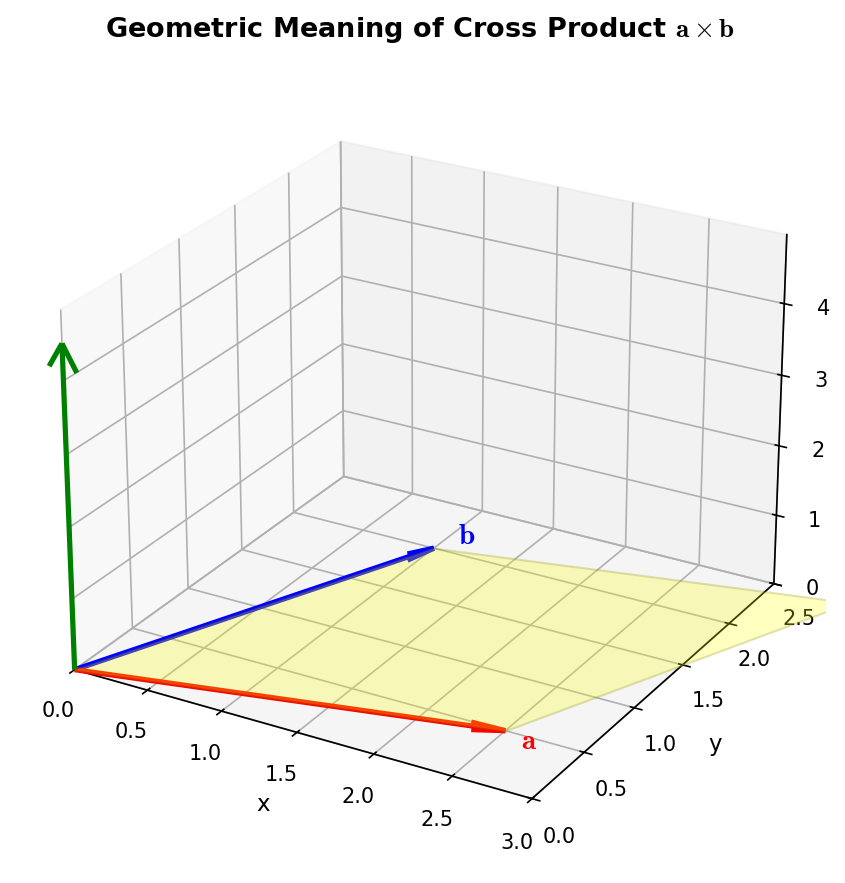
Reference Figure: Figure A.1: Cross Product (Appendix A)
Calculate the divergence \(\nabla \cdot \boldsymbol{F}\) of the vector field \(\boldsymbol{F} = (x^2 y,\; y^2 z,\; z^2 x)\).
Hint
Substitute into \(\operatorname{div}\boldsymbol{F} = \frac{\partial F_x}{\partial x} + \frac{\partial F_y}{\partial y} + \frac{\partial F_z}{\partial z}\).
B-6. Curl of a Vector Field
Reference Figure: Figure A.1: Geometry of the Cross Product (Appendix A)
Compute the curl \(\nabla \times \boldsymbol{F}\) of the vector field \(\boldsymbol{F} = (yz,\; xz,\; xy)\) component by component.
Hint
Find each component using "subtraction" as in \((\nabla \times \boldsymbol{F})_x = \frac{\partial F_z}{\partial y} - \frac{\partial F_y}{\partial z}\).
B-7. Laplacian of a Scalar Field
Compute the Laplacian \(\Delta\varphi = \nabla^2\varphi\) of the scalar field \(\varphi = e^x \sin y + z^3\).
Hint
Calculate \(\Delta\varphi = \frac{\partial^2\varphi}{\partial x^2} + \frac{\partial^2\varphi}{\partial y^2} + \frac{\partial^2\varphi}{\partial z^2}\) term by term.
B-8. Verification of the Lagrange Identity
Using the Lagrange identity, compute \(|\boldsymbol{a} \times \boldsymbol{b}|^2\) as \(|\boldsymbol{a}|^2|\boldsymbol{b}|^2 - (\boldsymbol{a} \cdot \boldsymbol{b})^2\) for \(\boldsymbol{a} = (1,\, 2,\, 0)\) and \(\boldsymbol{b} = (0,\, 1,\, 3)\), and verify that the result agrees with the square of the magnitude of the cross product computed directly.
Hint
First find \(|\boldsymbol{a}|^2\), \(|\boldsymbol{b}|^2\), and \(\boldsymbol{a} \cdot \boldsymbol{b}\), then compute the sum of the squares of each component of \(\boldsymbol{a} \times \boldsymbol{b}\) and compare the two results.
B-9. Verification of the BAC-CAB Formula
Verify the BAC-CAB formula \(\boldsymbol{a} \times (\boldsymbol{b} \times \boldsymbol{c}) = \boldsymbol{b}(\boldsymbol{a} \cdot \boldsymbol{c}) - \boldsymbol{c}(\boldsymbol{a} \cdot \boldsymbol{b})\) by computing the left-hand side and the right-hand side separately for \(\boldsymbol{a} = (1,0,0)\), \(\boldsymbol{b} = (0,1,0)\), \(\boldsymbol{c} = (0,0,1)\), and confirm that they are equal.
Hint
First find \(\boldsymbol{b} \times \boldsymbol{c}\), then compute \(\boldsymbol{a} \times (\boldsymbol{b} \times \boldsymbol{c})\). For the right-hand side, first evaluate the scalars \(\boldsymbol{a} \cdot \boldsymbol{c}\) and \(\boldsymbol{a} \cdot \boldsymbol{b}\).
B-10. Verifying rot(grad) = 0
Reference: The rotation identity \(\nabla \times (\nabla\varphi) = 0\) is explained in Section A.5 of Appendix A.
For the scalar field \(\varphi(x, y, z) = x^2 + y^2 + z^2\), verify by component calculation that \(\operatorname{rot}(\operatorname{grad}\varphi) = \boldsymbol{0}\) holds.
Hint
First find \(\nabla\varphi\), then treat it as a vector field and compute each component of \(\nabla \times (\nabla\varphi)\). Pay attention to the interchangeability of the order of partial differentiation.
Medium
M-1. Proof of the BAC-CAB Formula
Prove that
by expanding the \(x\)-components of both sides in terms of the general components \(a_i, b_i, c_i\) and comparing them. Explain (using a symmetry argument) why the same identity holds for the \(y\) and \(z\) components as well.
Hint
Write out the components of \(\boldsymbol{b} \times \boldsymbol{c}\), then obtain the \(x\)-component of \(\boldsymbol{a} \times (\boldsymbol{b} \times \boldsymbol{c})\) from the definition of the cross product. Expand the \(x\)-component of the right-hand side, \(b_1(\boldsymbol{a} \cdot \boldsymbol{c}) - c_1(\boldsymbol{a} \cdot \boldsymbol{b})\), and compare.
M-2. Proof that div(curl) = 0
Reference: The divergence identity \(\nabla \cdot (\nabla \times \mathbf{F}) = 0\) is discussed in Section A.5 of Appendix A.
Prove that this holds using component representation. Also, briefly explain how this identity is related to the physical fact that "magnetic monopoles do not exist" (\(\operatorname{div}\boldsymbol{B} = 0\) and \(\boldsymbol{B} = \operatorname{rot}\boldsymbol{A}\)).
Hint
Write out each component of \(\operatorname{rot}\boldsymbol{F}\), then take the \(\operatorname{div}\). Show that the terms \(\frac{\partial^2 F_i}{\partial x_j \partial x_k}\) and \(\frac{\partial^2 F_i}{\partial x_k \partial x_j}\) pair up and cancel.
M-3. Inner Product of Two Cross Products Formula
By substituting \(\boldsymbol{c} = \boldsymbol{a}\) and \(\boldsymbol{d} = \boldsymbol{b}\) into
derive the Lagrange identity
Furthermore, using this result, show that \(|\boldsymbol{a} \times \boldsymbol{b}| = |\boldsymbol{a}||\boldsymbol{b}|\sin\theta\) (where \(\theta\) is the angle between \(\boldsymbol{a}\) and \(\boldsymbol{b}\)).
Hint
Substitute \(\boldsymbol{a} \cdot \boldsymbol{b} = |\boldsymbol{a}||\boldsymbol{b}|\cos\theta\) and use \(1 - \cos^2\theta = \sin^2\theta\).
M-4. Product Rule for Divergence
Reference: For product rule identities, see the list of identities in A.5 of Appendix A.
Prove the following identity using component notation:
Hint
Expand \(\operatorname{div}(\varphi\,\boldsymbol{F}) = \frac{\partial(\varphi F_x)}{\partial x} + \cdots\) using the product rule for differentiation (Leibniz rule).
M-5. Gauss's Theorem and the Coulomb Electric Field
Using Gauss's theorem (the divergence theorem), show that for the Coulomb electric field \(\boldsymbol{E} = \frac{q}{4\pi\varepsilon_0}\frac{\boldsymbol{r}}{r^3}\) (\(\boldsymbol{r} = (x, y, z)\), \(r = |\boldsymbol{r}|\)) produced by a point charge \(q\) at the origin, the surface integral of the electric field (electric flux) through any closed surface \(S\) containing the origin equals \(q/\varepsilon_0\). You may use a sphere of radius \(R\) centered at the origin as an auxiliary surface, and you may use the fact that \(\operatorname{div}\boldsymbol{E} = 0\) for \(r \neq 0\).
Hint
Apply Gauss's theorem to the region between an arbitrary closed surface containing the origin and a small sphere centered at the origin. Using \(\operatorname{div}\boldsymbol{E} = 0\), show that the surface integral equals the value on the sphere. On the spherical surface, \(\boldsymbol{E}\) and \(d\boldsymbol{S}\) are parallel and the magnitude is constant.
Advanced
A-1. Identities Using the Levi-Civita Symbol
We can write
Answer the following questions.
(a) Accepting the contraction formula
derive the dot product formula for two cross products
using only index calculations.
(b) Using the same contraction formula, derive the BAC-CAB formula \(\boldsymbol{a} \times (\boldsymbol{b} \times \boldsymbol{c}) = \boldsymbol{b}(\boldsymbol{a} \cdot \boldsymbol{c}) - \boldsymbol{c}(\boldsymbol{a} \cdot \boldsymbol{b})\).
(c) With the correspondence to the 4-dimensional Levi-Civita tensor \(\varepsilon^{\mu\nu\rho\sigma}\) introduced in the main text in mind, write down the \(i\)-th component of \(\operatorname{rot}\boldsymbol{F}\) using the 3-dimensional \(\varepsilon_{ijk}\), and re-prove the identity \(\operatorname{div}(\operatorname{rot}\boldsymbol{F}) = 0\) through index calculations.
Hint
(a) Write \((\boldsymbol{a} \times \boldsymbol{b}) \cdot (\boldsymbol{c} \times \boldsymbol{d}) = \sum_i (\sum_{j,k}\varepsilon_{ijk} a_j b_k)(\sum_{l,m}\varepsilon_{ilm} c_l d_m)\) and apply the contraction formula to \(\sum_i \varepsilon_{ijk}\varepsilon_{ilm}\). (b) Expand \([\boldsymbol{a} \times (\boldsymbol{b} \times \boldsymbol{c})]_i = \sum_{j,k}\varepsilon_{ijk} a_j (\boldsymbol{b} \times \boldsymbol{c})_k\) further and contract the product of \(\varepsilon\)'s. (c) In \(\operatorname{div}(\operatorname{rot}\boldsymbol{F}) = \sum_i \partial_i (\sum_{j,k}\varepsilon_{ijk}\partial_j F_k)\), contrast the antisymmetry of \(\varepsilon_{ijk}\) with the symmetry of \(\partial_i \partial_j\).
A-2. Applications of Stokes' Theorem
Reference: Stokes' theorem is explained in A.6 of Appendix A. Using
discuss the following.
(a) When a vector field \(\boldsymbol{F}\) can be written as \(\boldsymbol{F} = \nabla\varphi\) (the gradient of some scalar field \(\varphi\)), show that the line integral along any closed curve \(C\) satisfies \(\oint_C \boldsymbol{F} \cdot d\boldsymbol{r} = 0\), using Stokes' theorem and the identity \(\nabla \times (\nabla\varphi) = \boldsymbol{0}\).
(b) Conversely, if \(\nabla \times \boldsymbol{F} = \boldsymbol{0}\) holds in a simply connected region, prove that there exists a scalar field \(\varphi\) such that \(\boldsymbol{F} = \nabla\varphi\), by showing a construction of \(\varphi\) using line integrals.
(c) In the context of general relativity treated in the main text, "the deviation of a vector after parallel transport along a closed curve" is described by the curvature tensor. Discuss qualitatively the relationship between Stokes' theorem and curvature, from the viewpoint that \(\operatorname{rot}\boldsymbol{F}\) represents "the circulation per infinitesimal closed curve" (no quantitative calculation is required).
Hint
(a) simply substitute the identity into the right-hand side of Stokes' theorem. (b) Show that the line integral \(\varphi(\boldsymbol{r}) = \int_{\boldsymbol{r}_0}^{\boldsymbol{r}} \boldsymbol{F} \cdot d\boldsymbol{r}'\) from a fixed point \(\boldsymbol{r}_0\) to \(\boldsymbol{r}\) is path-independent, and verify that \(\nabla\varphi = \boldsymbol{F}\). (c) State the analogy between the fact that in Stokes' theorem the integrand of the surface integral represents "circulation per area element," and the fact that the curvature tensor describes "the deviation from parallel transport along an infinitesimal parallelogram."
Feedback on this page
Let us know if something was unclear, incorrect, or could be improved.