Ch. 5 Problems
← Back to chapter | View solutions
Table of Contents
Basic
- B-1. Comparison of Poisson's Equation and the Wave Equation
- B-2. Free-Fall Acceleration from Inertial and Gravitational Mass
- B-3. Linear Approximation of the Eötvös Parameter
- B-4. Velocity and Acceleration under Transformation to Free-Fall Coordinates
- B-5. Free-Fall Coordinate Transformation When \(m_I \neq m_G\)
- B-6. Light Travel Time and Velocity Acquired by Ground Apparatus
- B-7. Frequency of Light from the Doppler Effect
- B-8. Gravitational Redshift Formula in Potential Form
Medium
- M-1. Free-Fall Elevator Experiment with Different Materials
- M-2. Equivalence Principle for a Multi-Particle System
- M-3. Tidal Force and Locality of the Equivalence Principle
- M-4. Derivation of Gravitational Redshift from the Equivalence Principle
- M-5. Time Dilation at Tokyo Skytree
- M-6. Shift in Interpretation between Newtonian Mechanics and General Relativity
Advanced
Basic
B-1. Comparison of Poisson's Equation and the Wave Equation
Expand Newton's Poisson equation
in 3-dimensional Cartesian coordinates \((x, y, z)\), and write \(\nabla^2 \Phi\) in terms of partial derivatives of \(\Phi\). Furthermore, compare it with the wave equation satisfied by the electromagnetic potential
and identify the term missing from Poisson's equation, stating its physical meaning.
Hint
\(\nabla^2 = \dfrac{\partial^2}{\partial x^2} + \dfrac{\partial^2}{\partial y^2} + \dfrac{\partial^2}{\partial z^2}\). The difference from the wave equation lies in the presence or absence of the time derivative term.
B-2. Free-Fall Acceleration from Inertial and Gravitational Mass
An object of mass \(m\) is in a uniform gravitational field \(\mathbf{g}\). Let the inertial mass be \(m_I\) and the gravitational mass be \(m_G\). Express the falling acceleration \(a\) of this object in terms of \(m_I\), \(m_G\), and \(g\).
Hint
Solve for \(a\) from the equation of motion \(m_I a = m_G g\).
B-3. Linear Approximation of the Eötvös Parameter
Let the inertial mass of substance A be \(m_{A,I}\), its gravitational mass be \(m_{A,G}\), the inertial mass of substance B be \(m_{B,I}\), and its gravitational mass be \(m_{B,G}\). For the Eötvös parameter
set \(m_{A,G}/m_{A,I} = 1 + \epsilon_A\) and \(m_{B,G}/m_{B,I} = 1 + \epsilon_B\) (where \(|\epsilon_A|, |\epsilon_B| \ll 1\)), and approximate \(\eta\) to first order in \(\epsilon_A\) and \(\epsilon_B\).
Hint
The denominator can be approximated as \(1 + (\epsilon_A + \epsilon_B)/2 \approx 1\).
B-4. Velocity and Acceleration under Transformation to Free-Fall Coordinates
For the position \(\bar{x}(t)\) of a particle in a uniform gravitational field \(\mathbf{g}\), consider the transformation to free-fall coordinates:
Express the velocity \(\dot{\bar{x}}' \equiv d\bar{x}'/dt'\) in terms of \(\dot{\bar{x}}\), \(\mathbf{g}\), and \(t\). Furthermore, express the acceleration \(\ddot{\bar{x}}'\) in terms of \(\ddot{\bar{x}}\) and \(\mathbf{g}\).
Hint
Since \(t' = t\), we have \(d/dt' = d/dt\). Differentiate both sides of \(\bar{x}' = \bar{x} - \frac{1}{2}\mathbf{g}\,t^2\) with respect to \(t\).
B-5. Free-Fall Coordinate Transformation When \(m_I \neq m_G\)
Reference figure: Figure 4.1: Equivalence Principle Thought Experiment
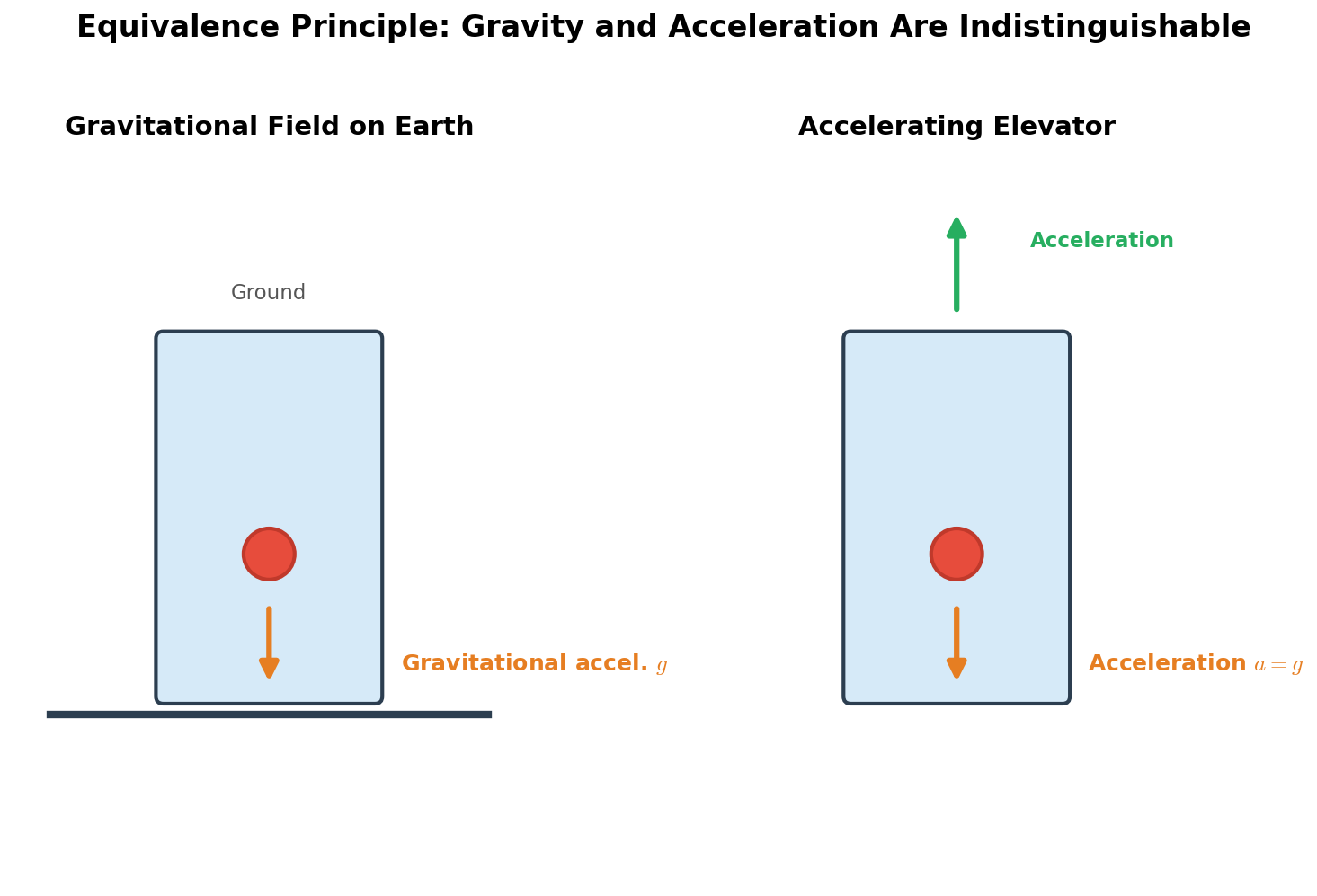
In the calculation showing that gravity vanishes in a free-fall coordinate system, consider the equation of motion
When \(m_I \neq m_G\), apply the coordinate transformation \(\bar{x}' = \bar{x} - \frac{1}{2}\mathbf{g}\,t^2\) and determine the resulting equation of motion after the transformation. Show that the gravitational term does not completely vanish.
Hint
Substituting \(\ddot{\bar{x}}' = \ddot{\bar{x}} - \mathbf{g}\) gives \(m_I(\ddot{\bar{x}}' + \mathbf{g}) = m_G \mathbf{g} + \bar{F}_{\text{ext}}\). What remains when \(m_I \neq m_G\)?
B-6. Light Travel Time and Velocity Acquired by Ground Apparatus
Light is emitted from the top of a tower (height \(h\)) toward the ground. As seen by a freely falling observer, express the time \(\Delta t\) for the light to reach the ground approximately in terms of \(h\) and \(c\). Furthermore, express the velocity \(v\) that the ground apparatus acquires relative to the freely falling frame during this time in terms of \(g\), \(h\), and \(c\).
Hint
The light travel time is \(\Delta t \approx h/c\). The ground apparatus is accelerating at acceleration \(g\) relative to the freely falling frame.
B-7. Frequency of Light from the Doppler Effect
As a non-relativistic approximation of the Doppler effect in special relativity, the frequency \(\nu\) received by an observer approaching a light source at velocity \(v\) (\(v \ll c\)) is given by
where \(\nu'\) is the frequency of the light source. Substitute the result from Problem B-6. Light Travel Time and Velocity Acquired by Ground Apparatus and express the frequency \(\nu\) of light received at the ground in terms of \(\nu'\), \(g\), \(h\), and \(c\).
Hint
Directly substitute \(v = gh/c\) obtained in Problem B-6. Light Travel Time and Velocity Acquired by Ground Apparatus.
B-8. Gravitational Redshift Formula in Potential Form
The gravitational redshift formula
represents the frequency shift when light is sent from the ground to the top. Using the general gravitational potential \(\Phi\), the frequency shift between two locations with a potential difference \(\Delta\Phi\) can be written as
In a uniform gravitational field, set \(\Phi = gh\) (with the ground as the reference) and verify that the two expressions above are consistent.
Hint
Substitute \(\Delta\Phi = \Phi_{\text{top}} - \Phi_{\text{bottom}} = gh - 0 = gh\).
Medium
M-1. Free-Fall Elevator Experiment with Different Materials
Assume that the inertial mass \(m_I\) and gravitational mass \(m_G\) take different values depending on the material. Explain what would be observed when an iron ball and an aluminum ball are simultaneously released from one's hands inside a freely falling elevator. Also explain why this would imply a violation of the equivalence principle.
M-2. Equivalence Principle for a Multi-Particle System
\(N\) particles are in a uniform gravitational field \(\mathbf{g}\), with non-gravitational forces \(\bar{F}\) acting between the particles. Given that the inertial mass and gravitational mass are equal (\(m_I = m_G = m\)), show that by applying the transformation to free-fall coordinates
the gravitational term is eliminated from the equations of motion of all particles simultaneously. Also, explain why this argument breaks down when \(m_{I} \neq m_{G}\).
Hint
Write the equation of motion for the \(i\)-th particle, and verify the condition under which the gravitational term cancels after the coordinate transformation. Consider what happens if the ratio \(m_G/m_I\) differs from particle to particle.
M-3. Tidal Force and Locality of the Equivalence Principle
Answer the following questions about tidal force.
(a) The gravitational acceleration at a distance \(r\) from the center of the Earth is \(g(r) = GM/r^2\). In a freely falling frame at distance \(r_0\) from the center of the Earth, express the difference in gravitational acceleration (tidal acceleration) \(\delta g\) at a point displaced by a small distance \(\delta r\) from \(r_0\), in terms of \(G\), \(M\), \(r_0\), and \(\delta r\).
(b) Using the result from (a), explain quantitatively what it means that the equivalence principle holds only in a "sufficiently small region."
Hint
(a) Taylor expand \(g(r_0 + \delta r)\) with respect to \(\delta r\). (b) Express the condition under which the tidal acceleration is negligible as a constraint on \(\delta r\).
M-4. Derivation of Gravitational Redshift from the Equivalence Principle
Using the equivalence principle, derive the gravitational redshift formula
Follow the steps below.
(a) Set up an observer who begins free fall at the instant light is emitted from the top of a tower, and explain using the equivalence principle why this observer is in an inertial frame.
(b) Find the time \(\Delta t\) for the light to reach the ground, and the velocity \(v\) that the ground-based apparatus acquires relative to the free-falling frame during this time.
(c) Apply the non-relativistic approximation of the Doppler effect to derive the frequency change when light is sent from the ground to the top of the tower.
Hint
Reformulate the elevator thought experiment from the text by replacing it with the tower-and-light setup. The key point is that special relativity can be used in the free-falling frame.
M-5. Time Dilation at Tokyo Skytree
Estimate the clock discrepancy per day between the top of Tokyo Skytree at height \(h = 450\) m and the ground. Use \(g \approx 9.8\;\text{m/s}^2\) and \(c \approx 3.0 \times 10^8\;\text{m/s}\).
Hint
Use \(\Delta\nu/\nu \approx gh/c^2\), and with 1 day = 86400 seconds, express the discrepancy in nanoseconds.
M-6. Shift in Interpretation between Newtonian Mechanics and General Relativity
In Newtonian mechanics, we interpret that "an observer stationary on the ground is in an inertial frame, and a gravitational force acts on the falling apple." Explain how this interpretation changes in general relativity, using ALL of the following terms: free fall, inertial motion, geodesic, spacetime curvature.
Hint
In general relativity, "moving without any force = following a geodesic = being in free fall," and it is the person standing on the ground who is accelerating.
Advanced
A-1. Metric Correction Derived from Gravitational Redshift
By combining knowledge of the equivalence principle and special relativity, discuss the following.
An object of rest mass \(m\) is raised from a position with gravitational potential \(\Phi_1\) to a position with \(\Phi_2\) (\(\Phi_2 > \Phi_1\)).
(a) From the result of gravitational redshift, explain why the proper time \(d\tau\) of a clock placed at a position with potential \(\Phi\) and the coordinate time \(dt\) at infinity (\(\Phi = 0\)) are related by
(in the approximation \(|\Phi|/c^2 \ll 1\)).
(b) Using this result, express how the Minkowski metric \(ds^2 = -c^2 dt^2 + dx^2 + dy^2 + dz^2\) is modified in the presence of a weak gravitational field, in terms of the change in the \(g_{00}\) component.
(c) The result of (b) is the first indication that "spacetime with a gravitational field is not Minkowski spacetime," that is, that spacetime is curved. Discuss how this argument contradicts the concept of Lorentz frames in Ch. 3, and why the extension to general relativity is unavoidable.
Hint
(a) The ratio of frequencies corresponds to the inverse ratio of proper times. (b) For the worldline of a particle at rest, \(dx = dy = dz = 0\), so \(ds^2 = -c^2 d\tau^2\). (c) The fact that \(g_{00}\) depends on position means that the metric is not in Minkowski form.
A-2. Relativistic Corrections for GPS Satellites
Observer A stands on the surface of the Earth (mass \(M\), radius \(R\)), and observer B rides on a satellite in uniform circular orbit at altitude \(H\) above the ground.
(a) Due to the gravitational redshift effect, how much faster does B's clock run compared to A's clock per second? Using the potential difference
find the ratio \(\Delta\tau_{\text{grav}}/\Delta t\). (Note: In the case \(H \ll R\), this reduces to \(\Delta\Phi \approx gH\), but for GPS satellites where \(H \approx 3.2R\), this approximation cannot be used.)
(b) Due to the special relativistic time dilation effect studied in Ch. 3, how much slower does the clock on a satellite moving at orbital velocity \(v = \sqrt{gR^2/(R+H)} \approx \sqrt{g(R+H)}\) run compared to A? Assuming \(v \ll c\), find the ratio \(\Delta\tau_{\text{SR}}/\Delta t\).
(c) For a GPS satellite (\(H \approx 20{,}200\;\text{km}\)), compare the magnitudes of the effects from (a) and (b), and determine which is dominant. Use \(g \approx 9.8\;\text{m/s}^2\), \(R \approx 6{,}370\;\text{km}\), and \(c \approx 3.0 \times 10^8\;\text{m/s}\) as needed.
Hint
(a) \(\Delta\tau_{\text{grav}}/\Delta t \approx \Delta\Phi/c^2 = gRH/[c^2(R+H)]\). (b) The special relativistic time dilation is \(\Delta\tau_{\text{SR}}/\Delta t \approx -v^2/(2c^2)\). (c) Substitute numerical values and compare. Pay attention to signs: the gravitational effect speeds up the clock, while the velocity effect slows it down.
Feedback on this page
Let us know if something was unclear, incorrect, or could be improved.