Prologue — Welcome to This Journey
Before You Begin
If you haven't read it yet, please start with Introduction — Before the Four Journeys. It establishes the philosophy-of-science stance that runs through all four journeys (models are hypotheses / equations are tools for falsifiability / how we use the term "model"), so you can enter this journey with that shared foundation.
Story so far: Readers who have followed the recommended reading order (general relativity → quantum mechanics → quantum field theory → quantum gravity) are now entering the fourth and final journey. In general relativity, you explored the "large and heavy" world; in quantum mechanics and quantum field theory, you explored the "small and light" world—each through equations. In this final journey, we tackle the realm where those two collide: the "small and heavy" domain—the center of black holes and the instant of the Big Bang.
Goals of This Prologue
By the end of this prologue, you will understand the following three points:
- What the quantum gravity problem is — What happens in the "small and heavy" regime where general relativity and quantum theory collide
- The overall structure of The Quest for Quantum Gravity — How the 26 chapters of this final journey are organized, and how each part connects
- The stance of this content — That The Quest for Quantum Gravity does not aim to "convince you string theory is correct" but rather to "provide materials so you can judge for yourself"
These will serve as your compass when following equations from Ch. 1 onward. This is preparation before stepping into the last of the four journeys—the challenge of quantum gravity. We confirm that the relativity, quantum mechanics, and quantum field theory built up across the previous three journeys collide here, confronting us with the greatest unsolved problem in modern physics.
Welcome Back — To You Who Have Completed Three Journeys
🟡 Lina: …Well then. You two have come a long way on this journey.
🔵 Kai: Man, it really was long! 25 chapters for general relativity, 28 for quantum mechanics, 24 for quantum field theory. That's 77 chapters total…
⚪ Mei: But it was fascinating how all three journeys connected. Toward the end, I felt like they were converging on some common theme…
🟡 Lina: Good instinct. Through Newton's gravity → special relativity → general relativity, you learned the "large and heavy" world; through blackbody radiation → quantum mechanics → quantum field theory, you learned the "small and light" world. And do you remember how each journey's final chapter previewed the same problem?
🔵 Kai: Oh, yes. General Relativity Ch. 25 "The Challenge of Quantum Gravity," Quantum Mechanics Ch. 28 "Why QM and GR Don't Get Along," Quantum Field Theory Ch. 24 "The Challenge of Quantum Gravity — The Limits of QFT and the Gateway to Quantum Gravity"… They all ended on the same topic.
🟡 Lina: Exactly. All three journeys stopped at the edge of the same cliff. The quantum gravity problem—the breakdown that occurs when you try to unify general relativity and quantum theory into a single model. In this final journey, we're going to peer over the edge of that cliff.
🔵 Kai: String theory and… are there other candidates too?
🟡 Lina: Yes. String theory, loop quantum gravity, asymptotic safety, causal dynamical triangulations (CDT), noncommutative geometry, among others. I'll just mention the names for now, but don't worry—Part V will introduce each of these ideas. Since none of them have been experimentally verified, we treat them all as "candidates" rather than "answers." The stance that has run through this entire site—all models in physics are hypotheses—will be tested most severely in this journey. How far can we follow hypothetical models with equations, and how do we evaluate them?
🔵 Kai: There are multiple candidates, and none of them are verified… So will we eventually be able to say "this is the correct answer" by the end of this journey?
🟡 Lina: No, we won't. That's precisely what makes it fascinating, and precisely why we need to proceed carefully. And there's one more distinctive feature of this journey: we'll proceed in a historical style.
🔵 Kai: Historical?
🟡 Lina: In the previous three journeys, we built up the "completed" mathematics of each field while showing motivation. For general relativity, we headed toward the Einstein equations; for quantum mechanics, toward the Schrödinger equation; for quantum field theory, toward the Standard Model—in other words, the goal was predetermined.
⚪ Mei: This journey is different?
🟡 Lina: In quantum gravity, the goal hasn't been determined yet. So we'll look back over the entire flow of physics from the beginning. Part I covers classical physics from Newton, Maxwell, and Boltzmann through the crisis of classical physics. Part II covers how relativity and quantum theory were born independently. Part III shows where the two collide. Part IV presents the solution proposed by string theory. Part V covers criticisms of string theory and alternative theories. And finally, we ask how you yourself judge these matters.
🔵 Kai: So there are chapters that serve as a recap of the previous three journeys?
🟡 Lina: Parts I and II serve that purpose. They function as review, but from a different angle. In the previous journeys, you studied "what is relativity?" and "what is quantum theory?" in detail. In this journey, the axis is "why do relativity and quantum theory contradict each other?" and we retrace the same history along that axis. Two enormous models, born from different questions using different methods, achieving different successes—and then colliding. We'll survey this entire flow on a single map.
⚪ Mei: Looking back at a path we've already climbed, but from a different vantage point.
🟡 Lina: Exactly. Now, let's start by seeing what this "quantum gravity problem" we'll face looks like in a single picture.
✅ Comprehension Check: What common topic did the final chapters of the previous three journeys (general relativity, quantum mechanics, and quantum field theory) all arrive at?
Answer
All three journeys ended by previewing the "quantum gravity problem"—the breakdown that occurs when you try to unify general relativity and quantum theory into a single model. This final journey is about exploring what lies beyond that problem.
The Quantum Gravity Problem — Collision in the "Small and Heavy" Regime
🟡 Lina: Recall the overall map of the four journeys. General relativity describes large and heavy things, and quantum theory describes small and light things, both with astonishing precision. Within their respective domains, each is nearly perfect.
🔵 Kai: Right. With general relativity we calculated GPS time corrections and gravitational wave detection, and with quantum mechanics we calculated semiconductors and lasers.
🟡 Lina: But—the center of a black hole or the instant of the Big Bang is small and heavy. You need both models simultaneously, yet they contradict each other. This is the "quantum gravity problem."
🔵 Kai: Large and heavy → relativity, small and light → quantum theory, small and heavy → need both but they contradict…
🟡 Lina: Exactly. Look at Fig. 0.1 "The domains of physics and the quantum gravity problem". Think of the horizontal axis as size and the vertical axis as mass (energy). The "small and heavy" region where the domains of relativity and quantum theory overlap—that's the stage for quantum gravity.
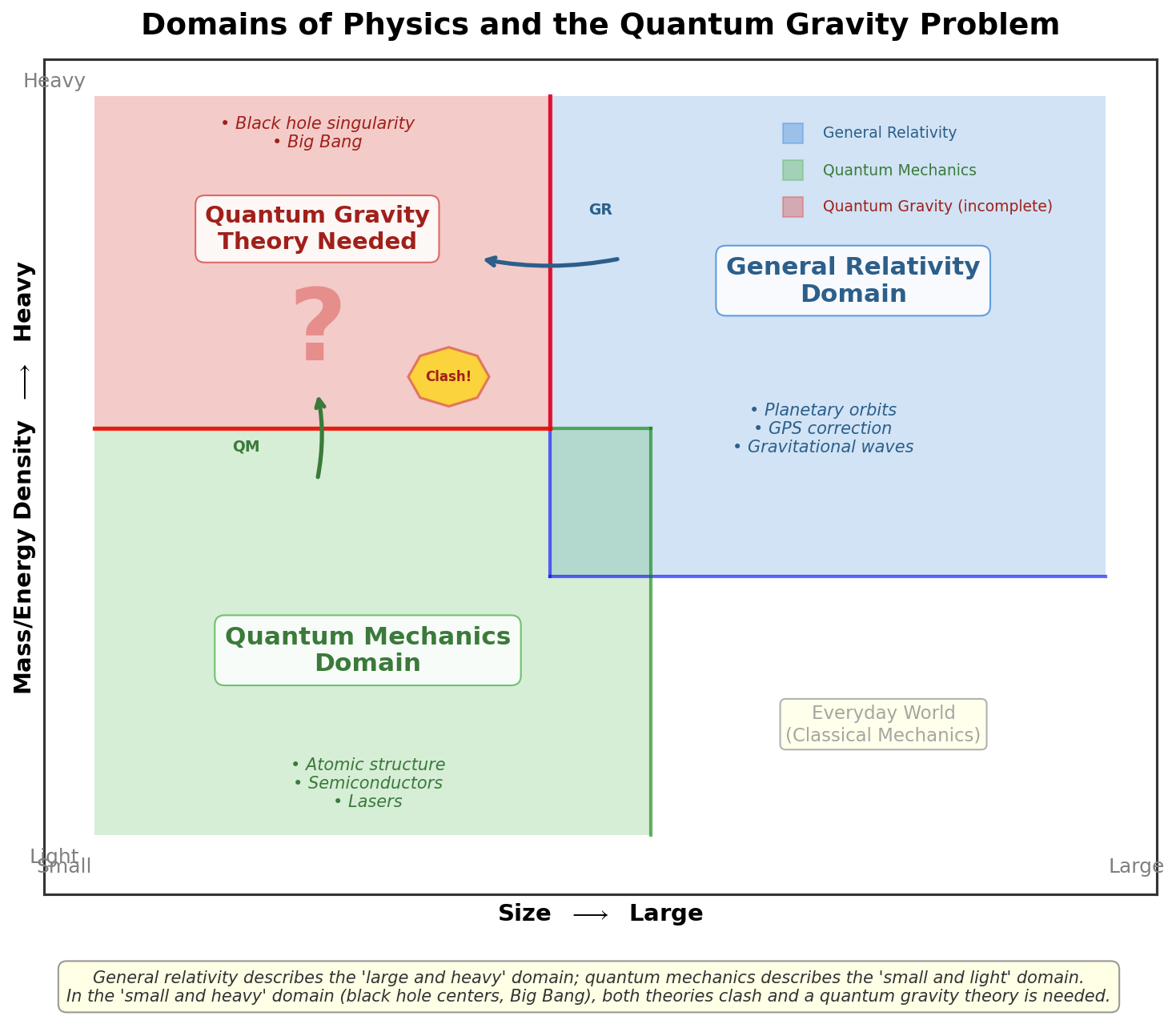
Fig. 0.1: The domains of physics and the quantum gravity problem. The horizontal axis represents size (small ←→ large), and the vertical axis represents mass/energy (light ←→ heavy). Relativity describes the "large and heavy" regime, quantum theory describes the "small and light" regime. In the "small and heavy" regime (black hole centers, the Big Bang), the two collide, and a theory of quantum gravity becomes necessary.
⚪ Mei: Specifically, how do they contradict?
🟡 Lina: You learned about renormalization in Quantum Field Theory Ch. 14, right? There, you learned the prescription for absorbing the infinities that appear in loop calculations into finite physical quantities. But when you try to quantize gravity within the framework of quantum field theory, this prescription fails. The answers become infinite, and you can't extract finite predictions. This is called "non-renormalizable" (see Quantum Field Theory Ch. 14 and Quantum Field Theory Ch. 24 for details).
🔵 Kai: Umm… "renormalization" was the idea that even if infinities appear, it's okay as long as you can absorb them into a finite number of parameters, right? Why doesn't that work for gravity?
🟡 Lina: Put simply, it's because the mass dimension of gravity's coupling constant (Newton's constant \(G\)) is negative—meaning the "effective strength" of gravity grows ever larger at higher energies. As a result, each time you go to higher orders in the loop expansion, new types of infinities appear that can't be absorbed into a finite number of parameters. We'll follow this with equations in Part III, so for now just remember: "gravity alone cannot be tamed with the same prescription as the other forces."
⚪ Mei: So in quantum field theory, the electromagnetic, weak, and strong forces were all renormalizable, but gravity alone was not.
🟡 Lina: Right. The reason—that quantum field theory, which treats particles as "points," cannot control the quantum effects of gravity—will be examined in detail in Part III. And in Part IV, we'll see the solution proposed by string theory: "What if instead of points, we use strings (one-dimensional objects with finite extent)? Then the divergences might be naturally softened."
🔵 Kai: So that's the main theme of The Quest for Quantum Gravity.
🟡 Lina: Yes. But even calling it the "goal," the answer isn't settled. String theory is the most systematically developed candidate answer, but it hasn't been experimentally verified. So the "goal" isn't "to teach you the answer" but "to understand our current position through equations."
✅ Comprehension Check: When you try to quantize gravity within the framework of quantum field theory, what differs from the case of the electromagnetic, weak, and strong forces?
Answer
The electromagnetic, weak, and strong forces could absorb infinities into finite physical quantities through the renormalization prescription, but for gravity this prescription fails (non-renormalizable). As a result, finite predictions cannot be extracted, and the quantum effects of gravity cannot be controlled within the framework of quantum field theory alone.
✅ Comprehension Check: What is the quantum gravity problem, and in what situation does this contradiction arise?
Answer
In situations like the center of a black hole or the instant of the Big Bang—where things are "small and heavy"—both relativity (smooth spacetime) and quantum theory (discrete values) must be used simultaneously, yet they contradict. In particular, when you try to quantize gravity within the framework of quantum field theory, it is "non-renormalizable" and the answers become infinite.
The Overall Picture of The Quest for Quantum Gravity
🟡 Lina: Now, here's the main topic. Over the next 25 chapters, we'll retrace the history of physics toward the quantum gravity problem, following string theory as a candidate solution, along with its criticisms and alternative theories, all through equations. Let me show you the overall picture of this journey first.
🔵 Kai: A map!
🟡 Lina: Yes, a map. Excluding this prologue, it's divided into five major parts (Parts I–V). Let's look at the big picture first.
%%{init: {"theme": "default", "themeCSS": ".edgePath .path, .flowchart-link { stroke-width: 2px !important; }"}}%%
graph TD
    P0["Part 0: Introduction (this chapter)<br/>Preview of the quantum gravity problem"]
    P1["Part I (Chapters 1–4)<br/>Newton → Maxwell → Thermodynamics → Crisis"]
    P2A["Branch A (Chapters 5–6)<br/>Special Relativity → General Relativity"]
    P2B["Branch B (Chapters 7–9)<br/>Quantum Mechanics → QFT → Standard Model"]
    P3["Part III (Chapters 10–12)<br/>Black Holes & Big Bang<br/>→ Why quantum gravity is needed"]
    P4["Part IV (Chapters 13–21)<br/>Classical string → Quantization → Superstrings<br/>→ D-branes → AdS/CFT"]
    P5["Part V (Chapters 22–25)<br/>Criticisms of string theory<br/>Loop quantum gravity<br/>Current state of quantum gravity"]

    P0 --> P1
    P1 -->|"Crisis of classical physics"| P2A
    P1 -->|"Crisis of classical physics"| P2B
    P2A -->|"Prediction of singularities"| P3
    P2B -->|"Gravity is non-renormalizable"| P3
    P3 -->|"What if we replace with strings?"| P4
    P3 -->|"What if we directly quantize space?"| P5
    P4 --> P5
    P5 -.->|"Return to falsifiability"| P0

    style P0 fill:#f9f,stroke:#333
    style P3 fill:#ff9,stroke:#333
    style P5 fill:#9ff,stroke:#333
Fig. 0.2: Overview of the 25-chapter structure and its circular architecture
🔵 Kai: Oh, Fig. 0.2 "Overview of the 25-chapter structure and its circular architecture" shows the whole thing in one diagram! …But Part IV alone has 9 chapters. Does string theory really require that much buildup?
🟡 Lina: Yes, string theory uses both relativity and quantum mechanics as its foundation, so inevitably there's a lot to build up. But one chapter at a time, you'll be fine.
⚪ Mei: Part I builds up classical physics, which hits a crisis, then branches into two trunks. Those two collide in Part III, leading to string theory in Part IV and criticisms/alternatives in Part V. …What's the arrow going back to Part 0 at the end?
🟡 Lina: Good catch. The final chapter returns to "falsifiability"—creating a circular structure that loops back to the journey's starting point. Now let's look at each part in a bit more detail.
Part I (Chapters 1–4): Why Did Humans Build Models?
🟡 Lina: First, we trace the history of physics through "motivation." Newton mathematized planetary motion, Maxwell unified electricity and magnetism, and Carnot gave birth to thermodynamics from the steam engine. And then we witness the moment these successful models break down.
🔵 Kai: They break down? After all the effort of creating them?
🟡 Lina: Hypotheses don't last forever. More precise experiments expose the limits of models. That "crisis" gives birth to the next revolution.
Part II (Chapters 5–9): The Revolutions of the 20th Century
🟡 Lina: From the crisis of classical physics, two revolutions arise independently. One is the relativity branch—from special relativity to general relativity. The other is the quantum branch—from quantum mechanics to quantum field theory, and then to the Standard Model.
⚪ Mei: The image of two trunks growing independently.
🟡 Lina: Exactly. And each of these two trunks succeeds spectacularly within its own domain. Relativity for large and heavy things—planetary orbits, GPS time corrections, gravitational wave detection (see General Relativity Ch. 10–General Relativity Ch. 11 and General Relativity Ch. 20 for details). Quantum theory for small and light things—atomic structure, semiconductor design, the principles of lasers (see Quantum Mechanics Ch. 16 and Quantum Field Theory Ch. 9 for details). But—
Part III (Chapters 10–12): The Collision of Two Pillars
🟡 Lina: —the center of a black hole or the instant of the Big Bang is small and heavy. Where the two domains overlap, both models must be used simultaneously, yet they contradict. Here we rigorously formulate the "quantum gravity problem" in equations.
🔵 Kai: That's the Fig. 0.1 "The domains of physics and the quantum gravity problem" part, right? When you say "rigorously formulate in equations," what kind of calculation does that involve specifically?
🟡 Lina: For example, computing the scattering amplitude of gravitons in a loop expansion and checking whether the divergences at each order can be eliminated—that sort of work. We'll follow this step by step in Part III, so for now just remember "witnessing the contradiction through equations."
🔵 Kai: Honestly, when you say "loop expansion" it still doesn't quite click for me… but if I follow along in Part III, I'll understand, right?
🟡 Lina: You'll be fine. It's an extension of the loop calculations you learned in Quantum Field Theory Ch. 13–Quantum Field Theory Ch. 14, so if you recall those as we proceed, it will connect naturally. And to resolve this contradiction—
✅ Comprehension Check: Briefly explain the flow from Part I to Part III. How does the history of classical physics lead to the quantum gravity problem?
Answer
In Part I, we build up classical physics with Newton, Maxwell, and thermodynamics, and witness its crisis. In Part II, two revolutions—relativity and quantum theory—arise independently from that crisis, each succeeding within its own domain. In Part III, the two models collide in the "small and heavy" regime (black hole centers, the Big Bang), and the quantum gravity problem is formulated in equations.
Part IV (Chapters 13–21): String Theory
🟡 Lina: —the idea was born: "What if particles like electrons and photons are not dimensionless 'points' but tiny 'strings'?" This is string theory. Gravitons emerge naturally, ultraviolet divergences vanish, and the entropy of black holes can be calculated microscopically. It is currently the most systematically developed candidate answer.
🔵 Kai: Just changing "points" to "strings" solves that many things?
⚪ Mei: If a single idea resolves multiple problems simultaneously, it certainly seems compelling.
Part V (Chapters 22–25): Criticism and Alternative Theories
🟡 Lina: However, string theory has not been experimentally verified. Moreover, the number of universe shapes string theory allows is \(10^{500}\), and it cannot explain "why our universe has this particular shape"—meaning it can explain anything, which effectively means it predicts nothing. That's one criticism. So we treat criticisms fairly as well. We'll also introduce alternative approaches including loop quantum gravity. In the final chapter, taking into account the latest developments as of 2026, we end by asking how you yourself judge these matters.
🔵 Kai: So you're not going to give us the answer—you're telling us to judge for ourselves?
🟡 Lina: Exactly. The purpose of The Quest for Quantum Gravity is not to make you believe "string theory is correct." It's to follow hypotheses through equations and provide materials so you can judge for yourself. The final judgment is yours to make.
✅ Comprehension Check: What is one of the main criticisms of string theory mentioned in the text?
Answer
String theory allows \(10^{500}\) possible shapes for the universe and cannot explain "why our universe has this particular shape." Because it can explain anything, it effectively predicts nothing. Additionally, it has not been experimentally verified, which is a major challenge.
The Relationship Between "Superstring Theory" and "String Theory"
🔵 Kai: Wait a moment, professor. In popular news, I often hear names like "superstring theory" or "super string theory"—is that different from "string theory"?
🟡 Lina: Good question. Let me clarify. "String theory" is the overarching concept, and within it there are several types.
%%{init: {"theme": "default", "themeCSS": ".edgePath .path, .flowchart-link { stroke-width: 2px !important; }"}}%%
graph TD
    S["String theory<br/>= Framework treating particles as 'strings' rather than points"]
    B["Bosonic string theory<br/>26 dimensions"]
    SS["Superstring theory<br/>10 dimensions"]

    S --> B
    S --> SS

    B -.->|"The Quest for Quantum Gravity<br/>Chapters 13–16"| C1["Historically first.<br/>Has the tachyon problem;<br/>incomplete as a physical model"]
    SS -.->|"The Quest for Quantum Gravity<br/>[Ch. 17](../../content_string/chapters/ch17.md) onward"| C2["String theory with<br/>'supersymmetry' added.<br/>Modern research focuses mainly on this"]

    style S fill:#f9f,stroke:#333
    style B fill:#fec,stroke:#333
    style SS fill:#cef,stroke:#333
Fig. 0.3: Classification of string theory: bosonic strings and superstrings
🟡 Lina: In other words, "superstring theory" is "string theory with supersymmetry added." In The Quest for Quantum Gravity, we start with bosonic strings following the historical order, then introduce superstrings as the resolution to its problems. That's why the title uses the overarching term "string theory."
⚪ Mei: I see—bosonic strings came first historically, and superstrings are the improved version.
🟡 Lina: Exactly. When popular books say "string theory," be aware that depending on context it may refer to bosonic strings or superstrings.
🔵 Kai: So when the news says "superstring theory," that's the story after the problems with bosonic strings have been resolved. The reason we don't start with superstrings right away is to follow the historical order. …Oh, the diagram says "tachyon problem"—what's a tachyon?
🟡 Lina: A tachyon is "a particle whose mass squared is negative," and when this appears in a model, the vacuum becomes unstable—like a ball sitting on top of a hill. The name comes from "faster than light" (if you plug \(m^2 < 0\) into the relativistic energy-momentum relation, you formally get solutions exceeding the speed of light), but the essence isn't about speed—it's that "the vacuum is unstable." Bosonic string theory contains such a tachyon—that's the "tachyon problem." We'll follow this with equations in Ch. 16, so for now just remember "bosonic strings have a fatal flaw."
🔵 Kai: A ball on top of a hill… an unstable vacuum means it spontaneously rolls down. I see—that's definitely a problem.
✅ Comprehension Check: What is the relationship between "superstring theory" and "string theory"?
Answer
"String theory" is the overarching concept, and "superstring theory" is string theory with supersymmetry added.
The Journey Begins
🟡 Lina: So, are you ready? Starting with the next chapter, this final journey begins. From a review of Newton's universal gravitation—but from a different perspective than the previous three journeys. We'll retrace the entire flow of physics through the lens of: "What motivated this model? Where did it hit its limits? What model did it give birth to next?"
🔵 Kai: …Honestly, hearing that there won't be a definitive answer makes me a little anxious. But professor, just one last thing. At the end of this journey, what will we have gained?
🟡 Lina: …To be honest, you won't gain an answer that says "this is correct." But you will gain the ability to follow how far humanity has pushed forward, through equations, and to judge for yourself. And thinking about what comes next—
⚪ Mei: —is our generation's job.
🟡 Lina: Exactly. Remember the question posed in the Introduction: "Why can nature be described by mathematics?" Now that you've spent four journeys chasing nature through equations, check within yourself how that question resonates. Let's go.
✅ Comprehension Check: What will readers gain by the end of the The Quest for Quantum Gravity journey?
Answer
The ability to follow how far humanity has pushed forward through equations, and to judge for yourself.
Next Chapter Preview
Ch. 1「Why Do Planets Move the Way They Do? — The Birth of Newtonian Mechanics」 — The story of how Kepler asked "why" about the three laws he found from observational data, how Newton mathematized universal gravitation, and showed that a single model could explain both planetary orbits and ocean tides. And the unsolved question that model left behind: "What is the true nature of gravity?"
References
The content of this chapter was structured with reference to the following works:
- Lee Smolin, The Trouble with Physics, Introduction — Overview of historical progress in physics and the problem of stagnation
- Lee Smolin, The Trouble with Physics, Ch.1: "The Five Great Problems in Theoretical Physics" — The full picture of unsolved problems including quantum gravity
- Carlo Rovelli, Reality Is Not What It Seems, Preface — Scientific attitude and "reliability rather than certainty"
- Elias Kiritsis, String Theory in a Nutshell, Ch.1: "Introduction" — Motivation for string theory and limitations of the Standard Model
Feedback on this page
Let us know if something was unclear, incorrect, or could be improved.