Appendix B: Physical Constants and Unit Systems
Story so far: Throughout the main text, the speed of light \(c\), the Planck constant \(\hbar\), and Newton's gravitational constant \(G\) have appeared repeatedly. Particularly from Ch. 12 onward, we write "\(\hbar = c = 1\)" to simplify equations. Here, we clarify the meaning of this convention and organize the concrete conversion methods.
Goals of this appendix
- Understand the values of physical constants appearing in the main text, and the concepts behind natural units (\(\hbar = c = 1\)) and Planck units (\(\hbar = c = G = 1\))
- Furthermore, grasp the relationship with scales specific to string theory (\(\ell_s\), \(\alpha'\)), and become able to convert equations from Ch. 12 onward back to SI units on your own
🟡 Lina: If you ever get confused about the values of constants or unit conversions in formulas, come back here. Natural units are used as a matter of course from Ch. 12 onward, so it's worth reading through this once.
🔵 Kai: Honestly, when I see \(c = 1\) written down, I'm like "Wait, isn't the speed of light \(3 \times 10^8\) m/s?" It's confusing.
⚪ Mei: Me too. But we did this once before in General Relativity at General Relativity Appendix D, remember? That time it was in the context of relativity though.
🟡 Lina: Right. The basic idea is the same as in General Relativity's General Relativity Appendix D and Quantum Field Theory's Quantum Field Theory Appendix D. Here, I'll bring everything together in one place, including \(\alpha'\) and \(\ell_s\) that are added in string theory.
B.1: List of Fundamental Physical Constants
Table B.1: List of fundamental physical constants
| Constant | Symbol | Value (SI) | Appearance in main text |
|---|---|---|---|
| Speed of light | \(c\) | \(2.998 \times 10^8\) m/s | Ch. 2, Ch. 5 |
| Planck constant | \(h\) | \(6.626 \times 10^{-34}\) J·s | Ch. 4, Ch. 7 |
| Reduced Planck constant | \(\hbar = h/(2\pi)\) | \(1.055 \times 10^{-34}\) J·s | Ch. 7 onward |
| Newton's gravitational constant | \(G\) | \(6.674 \times 10^{-11}\) m³/(kg·s²) | Ch. 1, Ch. 6, Ch. 12 |
| Boltzmann constant | \(k_B\) | \(1.381 \times 10^{-23}\) J/K | Ch. 3 |
| Elementary charge | \(e\) | \(1.602 \times 10^{-19}\) C | Ch. 4, Ch. 7 |
| Electron mass | \(m_e\) | \(9.109 \times 10^{-31}\) kg | Ch. 7, Ch. 9 |
| Fine-structure constant | \(\alpha = \dfrac{e^2}{4\pi\varepsilon_0\hbar c}\) | \(\approx 1/137\) | Ch. 8 |
🔵 Kai: How do you write \(\alpha \approx 1/137\) in natural units?
🟡 Lina: In natural units (\(\hbar = c = 1\)), if you also change how electromagnetic units are defined (there are systems called "Lorentz-Heaviside units" and "Gaussian units" that absorb the \(4\pi\varepsilon_0\) appearing in the SI expression \(\alpha = e^2/(4\pi\varepsilon_0 \hbar c)\) into the definition of charge. For now, just knowing the names is enough—see Quantum Field Theory's Quantum Field Theory Appendix D for details), the expression for \(\alpha\) changes to something like \(e^2/(4\pi)\) or \(e^2\). But the important point is that \(\alpha\) itself is a dimensionless quantity, so its value is the same \(\approx 1/137\) in any unit system (only the numerical value of \(e\) changes between unit systems). This is discussed in detail as the QED coupling constant in Quantum Field Theory's Quantum Field Theory Ch. 9.
⚪ Mei: So even though the form of the equation changes, the "numerical value" of \(\alpha\) doesn't depend on the unit system. It's obvious when you think about it, since it's dimensionless.
📝 Exercises:
- Verify the expression for the fine-structure constant in natural units → Problem M-2. Fine-Structure Constant in Natural Units
✅ Comprehension Check: How is the reduced Planck constant \(\hbar\) defined in terms of \(h\)?
Answer
It is defined as \(\hbar = h/(2\pi)\).
✅ Comprehension Check: What is the approximate value of the fine-structure constant \(\alpha\)?
Answer
\(\alpha \approx 1/137\). Since it is dimensionless, it is independent of the unit system.
B.2: Natural Units (\(\hbar = c = 1\))
Why Use Natural Units
🟡 Lina: In the SI unit system, energy is in J, length in m, and time in s—each with independent dimensions. But when you combine special relativity and quantum mechanics, they all become connected. \(E = mc^2\) connects mass and energy, and \(E = \hbar\omega\) connects energy and frequency.
⚪ Mei: So dimensions that we thought were separate are actually linked by conversion factors.
🟡 Lina: Exactly. Let's look at this more carefully.
Step 1: Setting \(c = 1\)
In special relativity (see General Relativity General Relativity Ch. 3), the spacetime interval is written as
Here \(c\) is merely "a coefficient that converts between units of time and length." If we measure lengths in terms of "the distance light travels in a given time" (for example, using 1 light-second \(= 3 \times 10^8\) m as the unit of length), then \(c\) becomes unnecessary.
🔵 Kai: Wait a moment. When we "set \(c = 1\)," does that mean the speed of light becomes 1 m/s? Or are we changing the units themselves?
🟡 Lina: The latter. We "choose new units so that the speed of light equals 1." The "light-second" example I just gave is exactly this—if you make the unit of length "the distance light travels in 1 second," then the speed of light is "1 light-second / 1 second = 1." By measuring both length and time using the same standard of "light propagation," the conversion factor \(c\) becomes unnecessary. Setting \(c = 1\) gives:
Furthermore, from \(E = mc^2\):
So mass and energy have the same dimension.
🔵 Kai: Whoa, dimensions collapse all at once. Length = time, and mass = energy.
Step 2: Setting \(\hbar = 1\)
In quantum mechanics (see Quantum Mechanics Quantum Mechanics Ch. 7), \(E = \hbar\omega\) is the fundamental relation. Setting \(\hbar = 1\) gives:
Since we already have \([\text{energy}] = [\text{mass}]\) and \([\text{length}] = [\text{time}]\) from \(c = 1\):
And we also obtain \([\text{length}] = [\text{time}] = [\text{energy}]^{-1}\).
⚪ Mei: Let me organize this. With \(c = 1\) we get "length = time, mass = energy," and adding \(\hbar = 1\) gives "time = inverse of energy"... so that means length, time, and mass can all be written in terms of energy?
🟡 Lina: Exactly. In the end, all physical quantities can be expressed as powers of energy alone. Take a look at Fig. B.1 "The process of dimensional unification in natural units" where I've summarized the whole flow.
%%{init: {"theme": "default", "themeCSS": ".edgePath .path, .flowchart-link { stroke-width: 2px !important; }"}}%%
flowchart TD
    subgraph SI["SI Unit System"]
        M["Mass kg"]
        L["Length m"]
        T["Time s"]
        E["Energy J"]
    end
    subgraph step1["Step 1: c = 1"]
        LT["Length = Time"]
        EM["Energy = Mass"]
    end
    subgraph step2["Step 2: ℏ = 1"]
        ALL["Everything = powers of E"]
    end
    M -->|"E = mc²"| EM
    L -->|"c = length/time"| LT
    T -->|"c = length/time"| LT
    E --> EM
    LT -->|"E = ℏω"| ALL
    EM -->|"E = ℏω"| ALL
    ALL --> R1["Mass → E¹"]
    ALL --> R2["Length → E⁻¹"]
    ALL --> R3["Time → E⁻¹"]
    ALL --> R4["Velocity → E⁰"]
Fig. B.1: The process of dimensional unification in natural units
Summary: All Physical Quantities as Powers of Energy
🟡 Lina: Here's a summary of the results.
Table B.2: Dimensions of physical quantities in natural units
| Physical quantity | SI dimensions | Natural unit dimensions | Reason |
|---|---|---|---|
| Energy | kg·m²/s² | \([\text{E}]^1\) | Reference |
| Mass | kg | \([\text{E}]^1\) | \(E = mc^2\), \(c = 1\) |
| Momentum | kg·m/s | \([\text{E}]^1\) | \(E = pc\), \(c = 1\) |
| Length | m | \([\text{E}]^{-1}\) | \(\hbar c / E\), \(\hbar = c = 1\) |
| Time | s | \([\text{E}]^{-1}\) | \(\hbar / E\), \(\hbar = 1\) |
| Velocity | m/s | \([\text{E}]^0\) (dimensionless) | \(v/c\), \(c = 1\) |
| Angular momentum | kg·m²/s | \([\text{E}]^0\) (dimensionless) | \(L/\hbar\), \(\hbar = 1\) |
| Force | kg·m/s² | \([\text{E}]^2\) | \(F = E/\ell\), \([\ell] = [\text{E}]^{-1}\) |
🔵 Kai: So what dimension does Newton's gravitational constant \(G\) have in natural units?
🟡 Lina: Good question. The SI dimension of \(G\) is \(\text{m}^3 \text{kg}^{-1} \text{s}^{-2}\). Translating to natural units:
⚪ Mei: \(-3 - 1 + 2 = -2\)... indeed \([\text{E}]^{-2}\). You just substitute from the table entries like "force = \([\text{E}]^2\)" and "length = \([\text{E}]^{-1}\)" directly.
🟡 Lina: Right. So \(G\) has dimensions of energy to the \(-2\) power. Specifically:
where \(M_P\) is the Planck mass (derived in the next section).
📝 Exercises:
- Verify the dimensions of \(G\) in natural units → Problem M-1. Dimension of \(G\) in Natural Units
✅ Comprehension Check: In natural units, what power of \([\text{E}]\) does Newton's gravitational constant \(G\) have?
Answer
\([\text{E}]^{-2}\) (energy to the \(-2\) power). This corresponds to being able to write \(G = 1/M_P^2\).
✅ Comprehension Check: In natural units, all physical quantities can be expressed as powers of what?
Answer
Powers of energy (\([\text{E}]^n\)).
✅ Comprehension Check: In natural units, what power of \([\text{E}]\) does length have?
Answer
\([\text{E}]^{-1}\) (energy to the \(-1\) power).
B.3: Planck Units
The Meaning of Planck Units
🟡 Lina: In natural units we have \(\hbar = c = 1\), but \(G\) still has dimensions (\([G] = [\text{E}]^{-2}\)). If we additionally set \(G = 1\), all physical quantities become pure numbers. This is the Planck unit system.
⚪ Mei: But what's the reference point?
🟡 Lina: It's based on "the scale where all three—quantum mechanics (\(\hbar\)), relativity (\(c\)), and gravity (\(G\))—become simultaneously important." At everyday scales, only one or two of these three matter.
- Planetary motion: \(G\) and \(c\) are important, but \(\hbar\) is negligible
- Atomic physics: \(\hbar\) and \(c\) are important, but \(G\) is negligible
- Everyday mechanics: all three can be ignored
The situation where all three are simultaneously important occurs at the center of black holes or the instant of the Big Bang—that is, situations requiring quantum gravity (Ch. 12).
🔵 Kai: I see, so the Planck unit system is tuned to "the scale where everything matters at once." That's why it's used in quantum gravity textbooks.
Derivation of the Planck Length
🟡 Lina: Let's derive the Planck length through dimensional analysis. We want to construct a quantity with dimensions of "length" using only \(\hbar\), \(c\), and \(G\).
Substituting the SI dimensions of each quantity:
The dimensions of the right-hand side are:
Setting this equal to \([\text{m}]^1 = \text{kg}^0 \cdot \text{m}^1 \cdot \text{s}^0\), we set up the system of equations:
🔵 Kai: A system of three equations with three unknowns. That's what we learned in high school.
🟡 Lina: Right, the solution is straightforward. From the first equation, \(\alpha = \gamma\). Substituting into the third equation:
$$ -\alpha - \beta - 2\alpha = 0 \quad \Longrightarrow \quad \beta = -3\alpha $$ Substituting \(\beta = -3\alpha\) and \(\gamma = \alpha\) into the second equation:
Therefore \(\alpha = \gamma = 1/2\), \(\beta = -3/2\).
⚪ Mei: What a clean formula. It's fascinating that a length is uniquely determined just by combining three fundamental constants.
🟡 Lina: Substituting numerical values:
✅ Comprehension Check: What are the three fundamental constants used in deriving the Planck length?
Answer
\(\hbar\) (reduced Planck constant), \(c\) (speed of light), and \(G\) (Newton's gravitational constant). A quantity with dimensions of length is constructed from their combination.
Computing the numerator:
Computing the denominator:
Dividing and taking the square root:
🔵 Kai: \(10^{-35}\) m... that's 20 orders of magnitude smaller than an atomic nucleus (\(10^{-15}\) m)! I can't even imagine how small that is.
🟡 Lina: Take a look at Fig. B.2 "Length scale hierarchy from everyday to the Planck scale". You can see just how vast the distance is from everyday scales to the Planck scale.
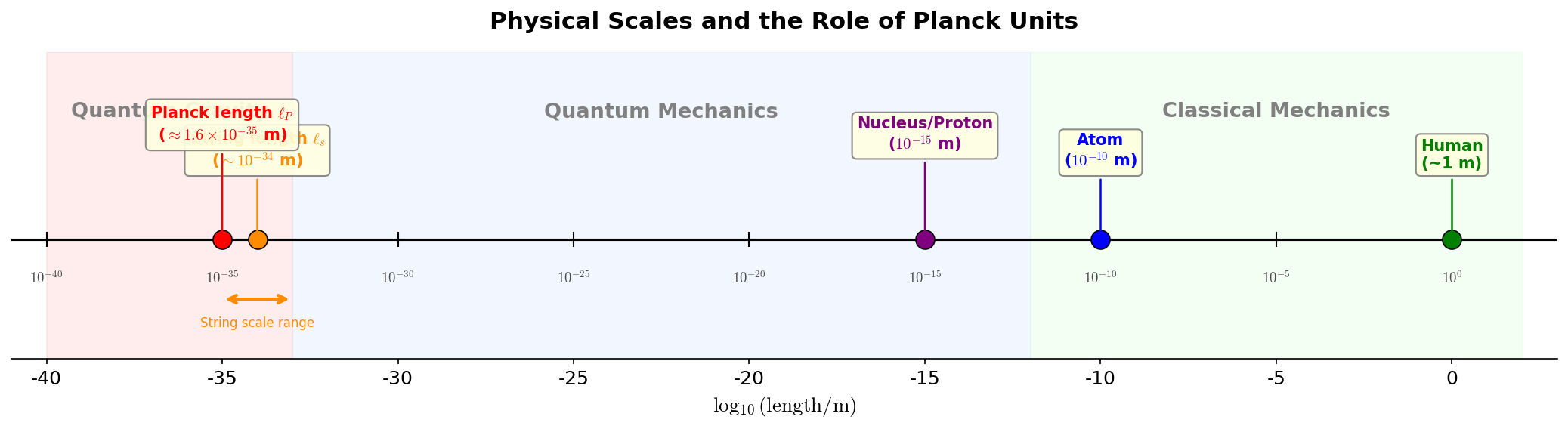
Fig. B.2: Length scale hierarchy from everyday to the Planck scale. The positions from the atomic nucleus/proton (\(\sim 10^{-15}\) m) to the Planck length (\(\sim 10^{-35}\) m) are shown on a logarithmic scale
🟡 Lina: That's why directly verifying physics at this scale through experiments is nearly impossible with current technology. This is one of the fundamental reasons why testing string theory is so difficult.
Derivation of Planck Time
The Planck time is naturally defined as "the time it takes light to travel one Planck length":
Computing the numerical value:
🔵 Kai: \(10^{-44}\) seconds—how small is that? Is there anything to compare it to?
🟡 Lina: The age of the universe is about 13.8 billion years, which in seconds is \(1.38 \times 10^{10} \times 365 \times 24 \times 3600 \approx 4.4 \times 10^{17}\) s. The Planck time is more than 60 orders of magnitude smaller than that.
⚪ Mei: Whether in length or time, the Planck scale is unimaginably small compared to everyday experience.
Derivation of Planck Mass
🟡 Lina: Let's perform the same dimensional analysis for "mass." Again setting \(M_P = \hbar^\alpha c^\beta G^\gamma\) to produce \([\text{kg}]^1\) (note that \(\alpha, \beta, \gamma\) will have different values from the Planck length case). The dimensions of the right-hand side have the same form as before:
This time our target is \(\text{kg}^1 \cdot \text{m}^0 \cdot \text{s}^0\), so only the kg exponent is 1, while the m and s exponents are 0.
From the first equation, \(\alpha = \gamma + 1\). Substituting into the third equation:
Substituting \(\alpha = \gamma + 1\) and \(\beta = -3\gamma - 1\) into the second equation:
Therefore \(\alpha = 1/2\), \(\beta = 1/2\), \(\gamma = -1/2\).
🔵 Kai: So compared to the Planck length, \(G\) is in the denominator instead of the numerator.
🟡 Lina: Right—mass increases as gravity becomes weaker (as \(G\) gets smaller). Substituting numerical values:
🔵 Kai: Huh, the Planck length and Planck time were incredibly tiny, but the Planck mass is \(10^{-8}\) kg ≈ 0.02 mg—that's close to a visible scale! About the weight of a grain of sand. How come length and time are super microscopic, but mass is "normal"?
🟡 Lina: Sharp observation. The Planck mass is "enormous as an elementary particle." Intuitively, it's the mass you get when you pack all the energy into an extremely small region the size of the Planck length, so conversely, it becomes large. Converting to energy:
Converting to GeV (\(1\;\text{GeV} = 1.602 \times 10^{-10}\;\text{J}\)):
⚪ Mei: \(10^{19}\) GeV... The LHC operates at \(10^4\) GeV, so we're 15 orders of magnitude short.
🟡 Lina: Right. Since the LHC's collision energy is \(\sim 10^4\) GeV, the Planck energy is \(10^{15}\) times larger. It's a scale completely beyond our reach.
📝 Exercises:
- Evaluate the Planck mass in GeV → Problem B-2. Planck Mass in GeV
✅ Comprehension Check: Is the Planck mass large or small compared to elementary particle scales? And approximately how many GeV is the Planck energy?
Answer
The Planck mass is enormous as an elementary particle (about \(2.18 \times 10^{-8}\) kg). The Planck energy is approximately \(1.22 \times 10^{19}\) GeV, which is \(10^{15}\) times the LHC collision energy (\(\sim 10^4\) GeV).
Table of Planck Units
Table B.3: Definitions and values of Planck units
| Quantity | Definition | Value |
|---|---|---|
| Planck length | \(\ell_P = \sqrt{\hbar G / c^3}\) | \(1.616 \times 10^{-35}\) m |
| Planck time | \(t_P = \ell_P / c = \sqrt{\hbar G / c^5}\) | \(5.39 \times 10^{-44}\) s |
| Planck mass | \(M_P = \sqrt{\hbar c / G}\) | \(2.18 \times 10^{-8}\) kg |
| Planck energy | \(E_P = M_P c^2\) | \(1.22 \times 10^{19}\) GeV |
| Planck temperature | \(T_P = E_P / k_B\) | \(1.42 \times 10^{32}\) K |
⚪ Mei: In the Planck unit system (\(\hbar = c = G = 1\)), all of these become "1."
🟡 Lina: Right. If you say "length = 10" in Planck units, it means \(10 \ell_P \approx 1.6 \times 10^{-34}\) m.
✅ Comprehension Check: At what scale do Planck units become important—specifically, when which three areas of physics become simultaneously important?
Answer
The scale where quantum mechanics (\(\hbar\)), relativity (\(c\)), and gravity (\(G\)) all become simultaneously important.
✅ Comprehension Check: Write the defining formula for the Planck length \(\ell_P\).
Answer
\(\ell_P = \sqrt{\hbar G / c^3}\).
B.4: String Theory Units and Scales
The Regge Slope \(\alpha'\) and String Length \(\ell_s\)
🟡 Lina: String theory has its own characteristic scale distinct from the Planck scale. That is the string length \(\ell_s\).
As discussed in detail in Ch. 13, the fundamental parameter of string theory is a quantity called the Regge slope \(\alpha'\) (alpha prime). Historically, this comes from the Regge trajectories of hadrons (the collective name for composite particles made of quarks, such as protons, neutrons, and pions). Regge trajectories are an empirical rule discovered in accelerator experiments in the 1960s, where a clean linear relationship was observed between the angular momentum \(J\) and mass squared \(M^2\) of hadrons:
Intuitively, the faster a rotating string spins (= the larger its angular momentum), the more its energy increases, and through \(E = Mc^2\) its mass also increases—the proportionality constant is \(\alpha'\).
🔵 Kai: Wait, why is it \(M\) squared and not \(M\) to the first power? Intuitively, "heavier things are harder to spin" suggests \(J \propto M\).
🟡 Lina: Good question. Roughly speaking, the length of the string itself is proportional to the energy (= mass). Longer strings are heavier. And angular momentum is "mass × velocity × arm length," so since the arm length (string length) is also proportional to mass, we get \(J \propto M \times M = M^2\). The rigorous derivation is in Ch. 13, so for now just hold onto this picture. For now, it's enough to understand "the origin of the symbol \(\alpha'\) and its dimensions."
🔵 Kai: I see, the heavier the string, the longer it is, and the longer it is, the longer the rotational arm—so it becomes squared. ...OK, going back to dimensions, angular momentum was dimensionless (\([\text{E}]^0\)) in natural units from the earlier table. \(M^2\) is \([\text{E}]^2\), so... for \(J = \alpha' M^2\) to hold, \(\alpha'\) must have dimensions \([\text{E}]^{-2}\), right?
🟡 Lina: Correct. In natural units, \([\alpha'] = [\text{E}]^{-2} = [\text{length}]^2\). So the square root of \(\alpha'\) has dimensions of length. This is what we define as the string length:
The string length \(\ell_s\) represents "the typical size of a string."
String Tension \(T\)
🟡 Lina: Since a string is "a one-dimensional object with tension," the tension \(T\) is a fundamental physical quantity. Think about the dimensions of tension.
🔵 Kai: Umm, tension has the same dimensions as force, right? Force is... \([\text{E}]^2\), wasn't it?
⚪ Mei: Yeah, that's what was in the table earlier.
🔵 Kai: ...Wait a second. Why is force \([\text{E}]^2\) in the first place? Energy squared isn't intuitive at all.
🟡 Lina: Good question. Remember the definition of work. \(W = F \times d\) (force × distance = energy), so conversely \(F = W/d = E/\ell\). In natural units, \([\ell] = [\text{E}]^{-1}\), so \([F] = [\text{E}]/[\text{E}]^{-1} = [\text{E}]^2\). In other words, "energy squared" is just "energy divided by length" rewritten in natural units. In SI, force is N = J/m, which is indeed "energy ÷ length," right? So tension indeed has dimensions \([\text{E}]^2\).
🔵 Kai: Ah, it's just translating J/m into natural units. That makes sense.
🟡 Lina: However, "tension" in string theory carries a slightly different intuitive meaning from the everyday "pulling force."
🔵 Kai: Hm? Tension is "a pulling force," right? What's the different meaning?
🟡 Lina: Good question. The rest energy of a string is proportional to its length—a string of length \(L\) has energy \(E = T \times L\). So \(T = E/L\), meaning "the energy required to extend the string by unit length." It has the same dimensions as an everyday "pulling force" (\([\text{E}]/[\text{length}] = [\text{E}]^2\)), but in string theory, the perspective of "energy per unit length" is more fundamental.
⚪ Mei: So for a string, tension is "energy density per unit length that it possesses just by existing."
🟡 Lina: Now, to describe the motion of a string, we use a quantity called the "action." Remember the principle of least action from General Relativity's General Relativity Ch. 1? It's the same idea. The string action is called the Nambu-Goto action—named after Japanese physicists Yoichiro Nambu and Tetsuo Goto (see Ch. 13). Its form is
🔵 Kai: Hold on. What's a "worldsheet"? And we did the action in General Relativity, but how does it change for strings?
🟡 Lina: Let me explain in order. First, the worldsheet—when a point particle moves through spacetime, its trajectory is a "line" (worldline). Since a string is one-dimensional, its trajectory through spacetime becomes a "surface"—that's the worldsheet.
Next, the action \(S\). As you learned in General Relativity's General Relativity Ch. 1, there's the principle that "the motion actually realized is the path for which the action is stationary." For a point particle, the action was proportional to the length of the worldline. For a string, this generalizes to "the area of the worldsheet." Think of a soap film—if you fix a wire frame (boundary conditions), the soap film settles into the shape that minimizes its area, right? The string worldsheet works the same way. The surface that minimizes area corresponds to the actual motion of the string.
🔵 Kai: I see, so the "length of the line" for a point particle becomes "area of a surface" for a string. So what are the dimensions of the action?
🟡 Lina: Good question. The dimensions of the action are the same for strings and point particles. Recall the point particle case: the action is \(S = \int L \, dt\), where \(L\) is the Lagrangian (the difference between kinetic and potential energy, introduced in General Relativity's General Relativity Ch. 1). So in SI, the dimensions are \([\text{energy}] \times [\text{time}]\), the same dimensions as \(\hbar\). For strings, the integral becomes two-dimensional (a surface integral), but the dimensions of the total action don't change—the dimensions of the tension \(T\) absorb the dimensions of the surface integral.
🔵 Kai: Is it a coincidence that it has the same dimensions as \(\hbar\)?
🟡 Lina: It's not a coincidence. In quantum mechanics, the action \(S\) is always compared against \(\hbar\). For example, the right-hand side of the uncertainty principle \(\Delta x \cdot \Delta p \gtrsim \hbar\) has dimensions of "position × momentum"—which is exactly the same as "energy × time," the dimensions of action itself. So \(S/\hbar\) is dimensionless. Whether this ratio is large or small determines the importance of quantum effects (\(S \gg \hbar\) means classical, \(S \sim \hbar\) means quantum effects are important). For now, just remember "dimensions of action = dimensions of \(\hbar\) = energy × time."
🔵 Kai: Right, if \(S/\hbar\) weren't dimensionless, you couldn't make a physically meaningful comparison.
🟡 Lina: Exactly. So in natural units (\(\hbar = 1\)), \(S\) also becomes dimensionless. That is, \([S] = [\text{E}]^0\).
⚪ Mei: So since \(S\) originally had the same dimensions as \(\hbar\), it becomes dimensionless the moment we set \(\hbar = 1\).
🟡 Lina: Now I'll derive the dimensions of the tension from this. The worldsheet is a two-dimensional surface in spacetime—the trajectory of a string (1 spatial dimension) propagating in the time direction, so one direction is "the spatial direction along the string" and the other is "the time direction." If you draw this on paper with the horizontal axis as the string's position and the vertical axis as time, the string's continued existence over time forms a band-shaped surface. That's the worldsheet.
🔵 Kai: "Length in the time direction"... oh right, since we set \(c = 1\) in B.2, time and length have the same dimensions. But the "area" of the worldsheet is "spatial direction × time direction," which is different from ordinary area (length × width), right? Does it still come out to \([\text{E}]^{-2}\)?
🟡 Lina: Yes, good check. In SI, the worldsheet area is "length × time" = m·s, which indeed has different dimensions from ordinary area m². But in natural units, both time and length are the same \([\text{E}]^{-1}\), so the worldsheet area is also \([\text{E}]^{-1} \times [\text{E}]^{-1} = [\text{E}]^{-2}\). That distinction disappears in natural units. Therefore:
⚪ Mei: That's consistent with how we confirmed force has dimensions \([\text{E}]^2\) earlier.
🟡 Lina: Let's see the relationship between \(T\) and \(\alpha'\). The coefficient in the Nambu-Goto action is set as \(T = 1/(2\pi\alpha')\) (the \(2\pi\) comes from the normalization convention of taking the period of the closed string parameter to be \(2\pi\)—details in Ch. 13):
Checking dimensions: \([\alpha'] = [\text{E}]^{-2}\) so \([1/\alpha'] = [\text{E}]^2 = [T]\). ✓
Rewriting in terms of \(\ell_s\):
🔵 Kai: So the larger the string tension, the smaller \(\ell_s\)—meaning the string is shorter. ...But wait, with a rubber band, greater tension means it stretches more, right? Isn't that the opposite?
🟡 Lina: Good question. A rubber band has "tension that increases as you stretch it," but the fundamental string in string theory is the reverse: "the tension is fixed, and that tension determines the typical size of the string." The higher the tension, the higher the cost of stretching the string, so the range over which quantum fluctuations can spread it out becomes smaller—that's why \(\ell_s\) decreases.
🔵 Kai: Ah, with a rubber band we're talking about "applying force to stretch it," but in string theory "the tension is determined first, and it constrains the string's size"—the order is reversed.
Relation to the Planck Scale
🟡 Lina: The string length \(\ell_s\) and the Planck length \(\ell_P\) are generally different. The relationship between the two is connected through the string coupling constant \(g_s\) (introduced in Ch. 14).
String theory is formulated in 10-dimensional spacetime (see Ch. 13). When the number of dimensions increases, the dimensions of the gravitational constant also change.
🔵 Kai: Why do the dimensions of the gravitational constant change when the number of dimensions increases?
🟡 Lina: Intuitively, when dimensions increase, gravity "spreads out" in more directions, so a larger constant is needed to produce the same gravitational strength. What follows gets somewhat advanced, but since the dimensions of \(G_{10}\) are needed from Ch. 13 onward, I'll derive it here first. If you get lost, just remember the result (\([G_D] = [\text{E}]^{2-D}\)) and move on.
⚪ Mei: Got it. If you show us the result first, we won't get lost even if the derivation is tricky.
🟡 Lina: Let me be more precise. Newton's law of gravitation \(F = GMm/r^2\) can be rewritten in a form that connects "how much mass is in a region" with "how the gravitational field around it behaves." That's called the Poisson equation, written using the gravitational potential \(\Phi\) (the potential energy of a mass \(m\) at that location divided by \(m\)) as \(\nabla^2 \Phi = 4\pi G \rho\) (derived in General Relativity's General Relativity Ch. 1). Our goal from here is "to find the dimensions of the gravitational constant \(G_D\) in \(D\) dimensions." The conclusion is \([G_D] = [\text{E}]^{2-D}\), and substituting \(D=4\) recovers the result from B.2, \([G] = [\text{E}]^{-2}\). If the derivation is too difficult, just remember this conclusion and move on.
The approach is simple—just count the dimensions of each term in the Poisson equation \(\nabla^2 \Phi \sim G_D \rho\) and solve for \(G_D\). When generalizing to \(D\) dimensions, the structure of this equation—"spatial derivative of potential = gravitational constant × mass density"—doesn't change. Only the number of spatial dimensions changes. I'll focus only on dimensional analysis.
🔵 Kai: What's \(\nabla^2\)? And \(\Phi\)—you said it's "potential energy divided by mass," but can you give a more intuitive explanation?
🟡 Lina: Let me go in order. First, \(\Phi\) (gravitational potential)—remember \(mgh\) from high school. A mass \(m\) at height \(h\) has potential energy \(mgh\), right? Dividing by \(m\) gives \(gh\), which is the "gravitational potential" at that location. In a general gravitational field, we use \(\Phi\) instead of \(gh\).
Next, \(\nabla^2\) (the Laplacian)—this is the sum of second derivatives in each spatial direction. In 3 dimensions, \(\nabla^2 = \partial^2/\partial x^2 + \partial^2/\partial y^2 + \partial^2/\partial z^2\). Intuitively, it measures "how much the value at a point is concave (or convex) compared to its surroundings." The right-hand side \(\rho\) is mass density, so the Poisson equation is a relation saying "gravitational potential is sourced wherever there is mass."
🔵 Kai: OK, so \(\Phi\) is "potential energy per unit mass," and \(\nabla^2\) measures "the difference from surroundings."
🟡 Lina: Right. Generalizing to \(D\) dimensions, dropping numerical coefficients, we write \(\nabla^2 \Phi \sim G_D \rho\) (where \(\sim\) means "dimensionally equal," ignoring numerical factors like \(4\pi\)). What matters here is only the dimensions. Each term of \(\nabla^2\) has dimensions \([\text{length}]^{-2}\)—whether there are 3 terms (3 dimensions) or 9 terms (9 dimensions), the dimension of each term is the same, so the dimension of the sum doesn't change. That is, \([\nabla^2] = [\text{length}]^{-2} = [\text{E}]^2\).
⚪ Mei: Right, the dimension is determined by each term, so it remains \([\text{length}]^{-2}\) regardless of how many terms there are.
🟡 Lina: Exactly. Next, let's consider mass density \(\rho\). Density is "mass ÷ volume," right? In our universe (\(D=4\)), space is 3-dimensional, so volume is in m³ and density is kg/m³. In natural units, this gives \([\rho] = [\text{E}]^1 / [\text{E}]^{-3} = [\text{E}]^4\).
In a general \(D\)-dimensional spacetime, the structure is "1 time dimension + \(D-1\) spatial dimensions," so the spatial volume has \(D-1\) dimensions. Density is "how much mass is packed into a spatial region at a given instant," so we divide only by the spatial volume—the time direction isn't included. In 10-dimensional spacetime, space is 9-dimensional, and volume has dimensions like m⁹. Since the dimensions of volume are \([\text{length}]^{D-1} = [\text{E}]^{-(D-1)}\), mass density is "mass ÷ volume":
Substituting \(D=4\) gives \([\rho] = [\text{E}]^4\), matching what we confirmed earlier.
🔵 Kai: What about the dimensions of the potential \(\Phi\)?
🟡 Lina: I said earlier it's "potential energy divided by mass." That means \([\Phi] = [\text{energy}]/[\text{mass}]\). Let's verify concretely in SI units: \([\Phi] = \text{J}/\text{kg} = \text{m}^2/\text{s}^2\). For example, near Earth's surface, \(\Phi = gh\), where \(g \approx 9.8\;\text{m/s}^2\) and \(h\) is in m, so it's indeed m²/s².
🔵 Kai: Yeah, that makes sense. So what about in natural units?
🟡 Lina: In natural units, both energy and mass are the same \([\text{E}]^1\), so \([\Phi] = [\text{E}]^1 / [\text{E}]^1 = [\text{E}]^0\) (dimensionless).
🔵 Kai: Huh, the potential being dimensionless seems weird, doesn't it? In high school we called it "potential energy"...
🟡 Lina: Be careful—"potential energy" and "gravitational potential" are different things. Potential energy is \(m\Phi\), which is the potential multiplied by mass. \(\Phi\) itself is "energy per unit mass," so in natural units it's \([\text{E}]^1 / [\text{E}]^1 = [\text{E}]^0\) (dimensionless). By the way, this distinction also came up in General Relativity's General Relativity Ch. 1.
⚪ Mei: So only when you multiply \(\Phi\) by mass \(m\) does it get the dimensions of energy. \(\Phi\) alone is "energy ÷ mass," hence dimensionless.
🟡 Lina: Exactly. Therefore \([\nabla^2 \Phi] = [\text{E}]^2 \cdot [\text{E}]^0 = [\text{E}]^2\), and \([G_D] = [\nabla^2 \Phi] / [\rho] = [\text{E}]^2 / [\text{E}]^D = [\text{E}]^{2-D}\) (the detailed derivation is in Ch. 13). For example, in our 4 dimensions (\(D=4\)), \([G_4] = [\text{E}]^{2-4} = [\text{E}]^{-2}\), matching the result from B.2.
⚪ Mei: I see, so from the general formula for arbitrary \(D\), substituting \(D=4\) reproduces the B.2 result. It's reassuring that everything is consistent.
🔵 Kai: So in 10 dimensions, \([G_{10}] = [\text{E}]^{2-10} = [\text{E}]^{-8}\). The dimensions of \(G\) keep decreasing as the number of dimensions increases. ...So the 10-dimensional \(G_{10}\) and the 4-dimensional \(G\) are completely different things? How are they related?
🟡 Lina: Great question. Actually, when you compactify (curl up) the extra dimensions, you can derive the 4-dimensional \(G\) from \(G_{10}\). Specifically, using the volume \(V_6\) of the extra dimensions, the relation is \(G_4 \sim G_{10} / V_6\) (details in Ch. 14). Let me first show the relation with string parameters in 10 dimensions. I'll defer the derivation to Ch. 14, but here's the result:
Here \(g_s\) is a dimensionless parameter called the string coupling constant, representing the strength of interactions where strings split and join (its formal definition and physical meaning are introduced in Ch. 14). The exact numerical coefficient depends on the type of theory. Why it's the square of \(g_s\) will also be explained in Ch. 14. The factor \(\ell_s^8\) is needed to match dimensions.
🔵 Kai: Let me check the dimensions... Left side: \([G_{10}] = [\text{E}]^{-8}\), right side: \([g_s^2] \cdot [\ell_s^8] = [\text{E}]^0 \cdot [\text{E}]^{-8} = [\text{E}]^{-8}\). OK, it checks out!
🟡 Lina: Exactly. From this equation, we can find the relationship between \(\ell_s\) and \(\ell_P\). In 4 dimensions, \([G_4] = [\text{E}]^{-2}\), so \(G_4^{1/2}\) has the dimensions of length \([\text{E}]^{-1}\)—this is the origin of the Planck length \(\ell_P \sim \sqrt{G_4}\). By the same logic, in 10 dimensions \([G_{10}] = [\text{E}]^{-8}\), so \(G_{10}^{1/8}\) has the dimensions of length \([\text{E}]^{-1}\). This defines the 10-dimensional Planck length \(\ell_P^{(10)} \sim G_{10}^{1/8}\) (note this is different from the 11-dimensional \(\ell_P^{(11)} \sim g_s^{1/3} \ell_s\) that appeared in Ch. 18). Substituting \(G_{10} \sim g_s^2 \ell_s^8\) gives \(\ell_P^{(10)} \sim g_s^{1/4} \ell_s\). That is:
- If \(g_s \ll 1\) (weak coupling), then \(g_s^{1/4} \ll 1\) so \(\ell_P^{(10)} \ll \ell_s\): the string scale is larger than the Planck scale
- If \(g_s \sim 1\) (strong coupling), then \(\ell_s \sim \ell_P^{(10)}\): both become comparable
⚪ Mei: So the relative size of the string scale and Planck scale is determined by a single value of \(g_s\).
🟡 Lina: I've illustrated this relationship in Fig. B.3 "Scale hierarchy and coupling constant relationship in string theory".
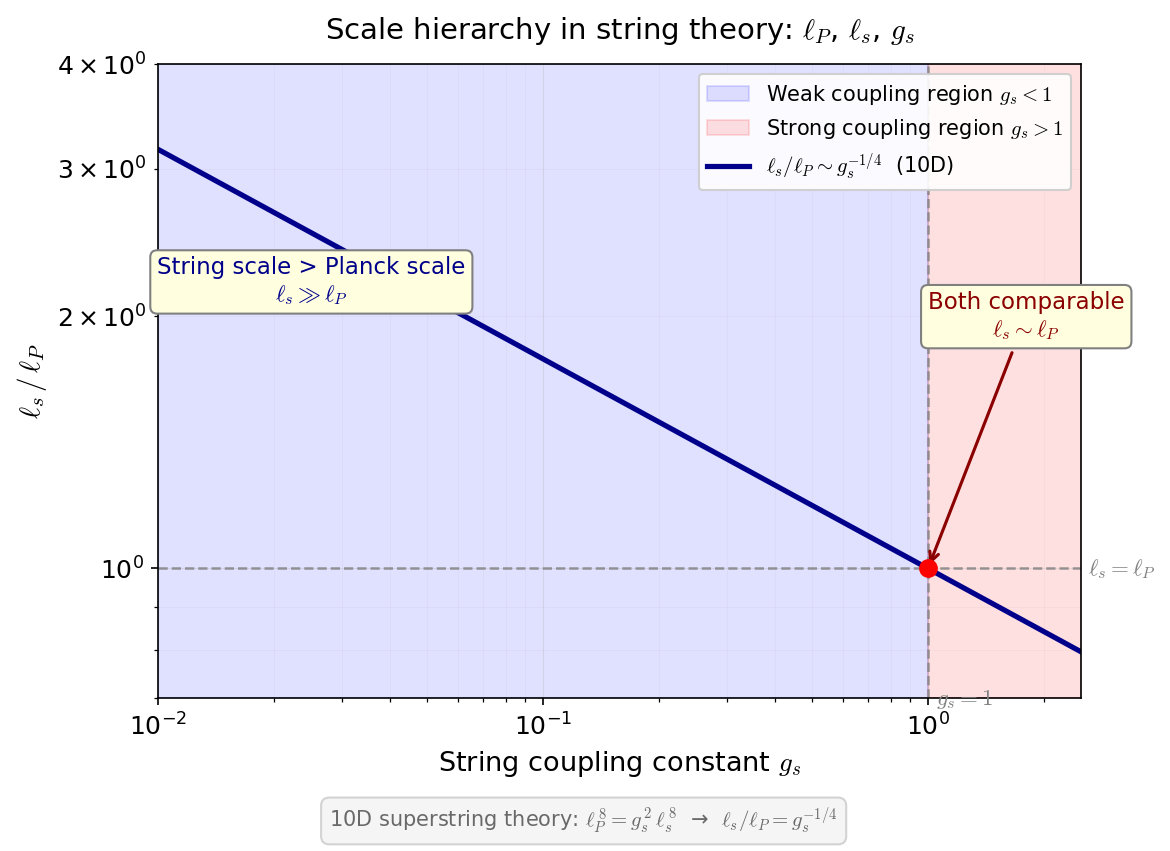
Fig. B.3: Scale hierarchy and coupling constant relationship in string theory. Depending on the magnitude of the string coupling constant \(g_s\), the relationship between the string length \(\ell_s\) and Planck length \(\ell_P\) changes
🔵 Kai: Huh, so the string length is a separate thing from the Planck length. Why does string theory need its own scale?
🟡 Lina: Good question. The Planck scale tells us "the scale where quantum gravity becomes important," but how large the string is, is a separate matter. \(\alpha'\) (i.e., \(\ell_s\)) and \(g_s\) are the two free parameters of string theory, existing independently of the Planck scale. Their values cannot be determined from theory alone and should in principle be determined by experiment—but their scale is too small for direct measurement with current technology.
✅ Comprehension Check: What are the two free parameters of string theory? Are they uniquely determined by the theory?
Answer
\(\alpha'\) (or \(\ell_s\)) and the string coupling constant \(g_s\). Their values cannot be determined from theory alone and should in principle be determined by experiment.
Table of String Theory Parameters
Table B.4: List of string theory parameters
| Quantity | Definition | Dimensions in natural units | Relation to Planck units |
|---|---|---|---|
| Regge slope | \(\alpha'\) | \([\text{E}]^{-2}\) | \(\alpha' = \ell_s^2\) |
| String length | \(\ell_s = \sqrt{\alpha'}\) | \([\text{E}]^{-1}\) | \(\ell_s \geq \ell_P\) (typically) |
| String tension | \(T = 1/(2\pi\alpha')\) | \([\text{E}]^2\) | \(T = 1/(2\pi\ell_s^2)\) |
| String coupling constant | \(g_s\) (defined in Ch. 14) | Dimensionless | Introduced in Ch. 14 |
✅ Comprehension Check: What is the relationship between the string length \(\ell_s\) and the Regge slope \(\alpha'\)?
Answer
\(\ell_s = \sqrt{\alpha'}\).
✅ Comprehension Check: Express the string tension \(T\) in terms of \(\alpha'\).
Answer
\(T = 1/(2\pi\alpha')\).
B.5: Practical Conversion Examples
Basic Tool: The Value of \(\hbar c\)
🟡 Lina: The most important tool for converting from natural units back to SI is the value of \(\hbar c\).
Converting to MeV·fm (\(1\;\text{MeV} = 1.602 \times 10^{-13}\;\text{J}\), \(1\;\text{fm} = 10^{-15}\;\text{m}\)):
🔵 Kai: 197.3 MeV·fm. So I just need to remember this one number.
🟡 Lina: If you remember this value, you can do almost any conversion.
✅ Comprehension Check: What is the most important combination of constants for converting from natural units to SI units, and what is its value?
Answer
\(\hbar c \approx 197.3\) MeV·fm (\(= 0.1973\) GeV·fm). Using this value, conversions between energy and length can be done immediately.
Example 1: How many m\(^{-1}\) is 1 GeV?
In natural units, \([\text{E}] = [\text{length}]^{-1}\), so for a given energy \(E\), the quantity \(\lambda = 1/E\) has dimensions of length. Physically, this corresponds to the typical length scale associated with a particle of energy \(E\) (for example, the Compton wavelength). To convert back to SI, we need to match dimensions so that \(\lambda\) is in meters and \(E\) is in joules. Since \([\hbar c] = [\text{energy}] \times [\text{length}]\), \(\hbar c / E\) has dimensions of length:
For \(E = 1\;\text{GeV}\):
Conversely:
⚪ Mei: Just "dividing by \(\hbar c\)" lets you go back and forth between length and energy. Simple.
Example 2: Compton Wavelength of the Electron
The electron mass in natural units is \(m_e = 0.511\;\text{MeV}\). Converting the Compton wavelength \(\bar{\lambda}_C = 1/m_e\) (natural units) back to SI:
📝 Exercises:
- SI calculation of the Compton wavelength → Problem B-1. SI Calculation of the Electron Compton Wavelength
Example 3: Value of \(G\) in Natural Units
In natural units, \([G] = [\text{E}]^{-2}\), so \(G\) can be expressed in GeV\(^{-2}\).
Rearranging the definition of the Planck mass \(M_P = \sqrt{\hbar c / G}\) gives \(G = \hbar c / M_P^2\). In natural units (\(\hbar = c = 1\)):
Let me be more careful. Using \(G = 1/M_P^2\) (natural units), we just need to express \(M_P\) in GeV. The Planck mass we found in B.3 was \(M_P = 2.18 \times 10^{-8}\) kg in SI, and converting to energy gives \(M_P c^2 = 1.22 \times 10^{19}\) GeV. In natural units (\(c = 1\)), mass and energy have the same dimensions, so we can write \(M_P = 1.22 \times 10^{19}\) GeV directly. Therefore:
🔵 Kai: Whoa, \(10^{-39}\)... that's incredibly small. You can really see how weak gravity is as a force.
🟡 Lina: You can also convert directly from the SI value \(G = 6.674 \times 10^{-11}\;\text{m}^3\text{kg}^{-1}\text{s}^{-2}\) by using \(\hbar c = 0.1973\) GeV·fm and replacing m, kg, s all with powers of GeV (this is somewhat tedious, so the method above is more practical).
Example 4: How Many Seconds is 1 GeV\(^{-1}\)?
In natural units, time is \([\text{E}]^{-1}\). To convert back to SI:
For \(E = 1\;\text{GeV} = 1.602 \times 10^{-10}\;\text{J}\):
Useful Conversion Table
Table B.5: Useful unit conversion table
| Conversion | Value |
|---|---|
| \(\hbar c\) | \(197.3\) MeV·fm \(= 0.1973\) GeV·fm |
| \(1\) fm | \(10^{-15}\) m |
| \(1\) GeV | \(1.602 \times 10^{-10}\) J |
| \(1\) GeV | \(5.068 \times 10^{15}\) m\(^{-1}\) (inverse length) |
| \(1\) GeV\(^{-1}\) | \(0.1973\) fm (length) |
| \(1\) GeV\(^{-1}\) | \(6.58 \times 10^{-25}\) s (time) |
| \(1\) GeV\(^{-2}\) | \(0.389\) mb (cross section, \(1\;\text{mb} = 10^{-31}\;\text{m}^2\)) |
| \((\hbar c)^2\) | \(0.3894\) GeV²·mb |
🔵 Kai: I get that as long as I remember \(\hbar c = 197.3\) MeV·fm, everything follows. But conversely, if I get "what power of \([\text{E}]\) is this term" wrong, everything gets messed up, right? That's the only scary part.
🟡 Lina: Good point. Let me organize the procedure. When you want to convert an equation written with "\(c = \hbar = 1\)" in the main text back to SI, you restore the appropriate powers of \(\hbar\) and \(c\) through dimensional analysis. I've summarized the procedure in Fig. B.4 "Procedure for restoring SI units from natural units":
- In the natural-unit equation, check the power of \([\text{E}]\) for each term
- Decide what SI dimensions you want for the quantity (m, kg, s)
- Multiply by appropriate powers of \(\hbar\) (\([\text{E}] \cdot [\text{time}]\)) and \(c\) (\([\text{length}]/[\text{time}]\)) to match dimensions
%%{init: {"theme": "default", "themeCSS": ".edgePath .path, .flowchart-link { stroke-width: 2px !important; }"}}%%
flowchart TD
    A["Equation in natural units"] --> B["Step 1: Check [E]ⁿ of each term"]
    B --> C["Step 2: Decide desired SI dimensions\n(m? kg? s?)"]
    C --> D["Step 3: Restore powers of ℏ and c\nℏ = [E]·[time]\nc = [length]/[time]"]
    D --> E["Equation in SI units"]
    D -.->|"Useful constant"| F["ℏc = 197.3 MeV·fm"]
    F -.-> E
Fig. B.4: Procedure for restoring SI units from natural units
⚪ Mei: So when you see an equation in natural units, it's a two-step process: "count the power of \([\text{E}]\) for each term → multiply by \(\hbar\) and \(c\) to match the desired SI dimensions." And \(\hbar c \approx 197\) MeV·fm is the universal conversion factor.
🔵 Kai: Having 4 concrete examples helps a lot. But hey, if I get the power of \([\text{E}]\) wrong, everything shifts, right? Is there a way to check?
🟡 Lina: Verify that the powers of \([\text{E}]\) match on both sides of the equation. It's the same idea as dimensional analysis in SI. For example, writing \(E = mc^2\) in natural units gives just \(E = m\), but the left side is \([\text{E}]^1\) and the right side (mass) is also \([\text{E}]^1\)—they match. If you think "wait, these don't match," that's a sign you've made an error in restoring \(\hbar\) or \(c\). Come back here whenever you get stuck from Ch. 12 onward.
🔵 Kai: I see, it's the same thing as "checking that units match on both sides" in SI, but done with powers of \([\text{E}]\). Let me try it with \(G = 1/M_P^2\)... left side \([G] = [\text{E}]^{-2}\), right side \([1/M_P^2] = [\text{E}]^{-2}\). OK, it checks out!
⚪ Mei: Yeah, dimensional checking works the same way in natural units as in SI.
🔵 Kai: But honestly, I'm not confident I can do it instantly when the equations in the main text get more complicated. Like when a string action has both \(\alpha'\) and \(g_s\), counting the powers of \([\text{E}]\) alone seems like a pain...
🟡 Lina: Good concern. But the trick is the same—"first write out the power of \([\text{E}]\) for each factor in the expression." For \(\alpha'\) it's \([\text{E}]^{-2}\), for \(g_s\) it's \([\text{E}]^0\) (dimensionless)—you already know these, so you just substitute. Concretely, for example \(g_s^2 \alpha'^4\) gives \([\text{E}]^0 \cdot [\text{E}]^{-8} = [\text{E}]^{-8}\)—you can count it mechanically like this.
🔵 Kai: OK, the method itself is simple. I just need to get used to it as it comes up in the main text. ...Though, when \(\alpha'\) and \(g_s\) appear together in things like the string action, it seems hard to judge whether I need to convert to SI or not.
🟡 Lina: Good point. Actually, in string theory calculations, you almost never need to convert back to SI. It's much more common to work entirely in natural units, discussing things as "how many times \(\ell_s\)" or "what fraction of \(M_P\)." You only convert to SI when comparing with experimental values.
🔵 Kai: Is that so? Then I'll just read the main text in natural units and come back here when I want to compare with experiments.
⚪ Mei: Yeah, since this appendix has tables and conversion examples, we can just reference it when needed.
Preview of the Next Chapter
In Appendix C, we organize the basics of tensors and differential geometry, including raising and lowering indices and covariant derivatives. The metric tensor \(g_{\mu\nu}\) and Christoffel symbols that describe curved spacetime are tools that appear repeatedly from general relativity (Ch. 6) through the background spacetime in which strings propagate (Ch. 12 onward). Let's experience the power of geometric descriptions that are independent of coordinates.
Practice Problems
📝 Exercises:
- Verify the expression for the fine-structure constant in natural units → Problem M-2. Fine-Structure Constant in Natural Units
- Verify the dimensions of \(G\) in natural units → Problem M-1. Dimension of \(G\) in Natural Units
- Evaluate the Planck mass in GeV → Problem B-2. Planck Mass in GeV
- SI calculation of the Compton wavelength → Problem B-1. SI Calculation of the Electron Compton Wavelength
References
- Barton Zwiebach, A First Course in String Theory, Ch.2: "Special Relativity and Extra Dimensions" — Natural units, Lorentz transformations
- Elias Kiritsis, String Theory in a Nutshell, Ch.1 — Discussion of the Planck scale
- Michael Peskin & Daniel Schroeder, An Introduction to Quantum Field Theory, Introduction — Introduction to natural units and conversions
- General Relativity Appendix D (Conversion procedures from geometric units to SI units)
- Quantum Field Theory Appendix D (Unit systems and physical constants — conventions in Quantum Field Theory)
Feedback on this page
Let us know if something was unclear, incorrect, or could be improved.