Ch. 5 Solutions
← Back to problems | Back to chapter
Table of Contents
Basic
- B-1. Comparison of Poisson's Equation and the Wave Equation
- B-2. Free-Fall Acceleration from Inertial and Gravitational Mass
- B-3. Linear Approximation of the Eötvös Parameter
- B-4. Velocity and Acceleration under Transformation to Free-Fall Coordinates
- B-5. Free-Fall Coordinate Transformation When \(m_I \neq m_G\)
- B-6. Light Travel Time and Velocity Acquired by Ground Apparatus
- B-7. Frequency of Light from the Doppler Effect
- B-8. Gravitational Redshift Formula in Potential Form
Medium
- M-1. Free-Fall Elevator Experiment with Different Materials
- M-2. Equivalence Principle for a Multi-Particle System
- M-3. Tidal Force and Locality of the Equivalence Principle
- M-4. Derivation of Gravitational Redshift from the Equivalence Principle
- M-5. Time Dilation at Tokyo Skytree
- M-6. Shift in Interpretation between Newtonian Mechanics and General Relativity
Advanced
Basic
B-1. Comparison of Poisson's Equation and the Wave Equation
Problem:
Expand Newton's Poisson equation
in 3-dimensional Cartesian coordinates \((x, y, z)\), and write \(\nabla^2 \Phi\) in terms of partial derivatives of \(\Phi\). Furthermore, compare it with the wave equation satisfied by the electromagnetic potential
and identify the term missing from Poisson's equation, stating its physical meaning.
Solution strategy: Expand the Poisson equation in Cartesian coordinates and compare it with the wave equation for electromagnetic potentials.
Expansion of the Poisson Equation:
Comparison with the Wave Equation:
The wave equation for the electromagnetic potential is
that is,
What is missing from the Poisson equation is the second-order time derivative term \(\displaystyle -\frac{1}{c^2}\frac{\partial^2 \Phi}{\partial t^2}\).
Physical Meaning:
The time derivative term in the wave equation ensures that changes in the field propagate at a finite speed \(c\). Because of this term, changes in the source \(\rho_e\) travel as waves at the speed of light \(c\).
On the other hand, since the Poisson equation contains no time derivatives, when the source \(\rho\) changes, the gravitational potential \(\Phi\) must change instantaneously throughout all of space. This implies instantaneous action at a distance, which contradicts the principle of special relativity that "information cannot propagate faster than the speed of light."
B-2. Free-Fall Acceleration from Inertial and Gravitational Mass
Problem:
An object of mass \(m\) is in a uniform gravitational field \(\mathbf{g}\). Let the inertial mass be \(m_I\) and the gravitational mass be \(m_G\). Express the falling acceleration \(a\) of this object in terms of \(m_I\), \(m_G\), and \(g\).
Solution strategy: Solve the equation of motion \(m_I a = m_G g\) for \(a\).
Verification: When \(m_I = m_G\), we get \(a = g\), which is consistent with Galileo's law of free fall. The dimensions are also correct: \([a] = \text{m/s}^2\).
B-3. Linear Approximation of the Eötvös Parameter
Problem:
Let the inertial mass of substance A be \(m_{A,I}\), its gravitational mass be \(m_{A,G}\), the inertial mass of substance B be \(m_{B,I}\), and its gravitational mass be \(m_{B,G}\). For the Eötvös parameter
set \(m_{A,G}/m_{A,I} = 1 + \epsilon_A\) and \(m_{B,G}/m_{B,I} = 1 + \epsilon_B\) (where \(|\epsilon_A|, |\epsilon_B| \ll 1\)), and approximate \(\eta\) to first order in \(\epsilon_A\) and \(\epsilon_B\).
Solution strategy: Substitute \(m_{A,G}/m_{A,I} = 1 + \epsilon_A\) and \(m_{B,G}/m_{B,I} = 1 + \epsilon_B\) into the Eötvös parameter and approximate to first order in \(\epsilon\).
Calculation:
Numerator:
Denominator:
Since \(|\epsilon_A|, |\epsilon_B| \ll 1\), the denominator \(\approx 1\).
Therefore,
Verification: When \(\epsilon_A = \epsilon_B\), we get \(\eta = 0\), meaning the Eötvös parameter vanishes when the two materials have equal \(m_G/m_I\). This is physically correct.
B-4. Velocity and Acceleration under Transformation to Free-Fall Coordinates
Problem:
For the position \(\bar{x}(t)\) of a particle in a uniform gravitational field \(\mathbf{g}\), consider the transformation to free-fall coordinates:
Express the velocity \(\dot{\bar{x}}' \equiv d\bar{x}'/dt'\) in terms of \(\dot{\bar{x}}\), \(\mathbf{g}\), and \(t\). Furthermore, express the acceleration \(\ddot{\bar{x}}'\) in terms of \(\ddot{\bar{x}}\) and \(\mathbf{g}\).
Solution strategy: Since \(t' = t\), we have \(d/dt' = d/dt\). Differentiate the coordinate transformation \(\bar{x}' = \bar{x} - \frac{1}{2}\mathbf{g}\,t^2\) with respect to time.
Velocity:
Acceleration:
Verification: For a freely falling particle (\(\ddot{\bar{x}} = \mathbf{g}\)), we get \(\ddot{\bar{x}}' = \mathbf{g} - \mathbf{g} = 0\), so the acceleration vanishes in the free-fall frame. This is consistent with the equivalence principle.
B-5. Free-Fall Coordinate Transformation When \(m_I \neq m_G\)
Problem:
Reference figure: Figure 4.1: Equivalence Principle Thought Experiment
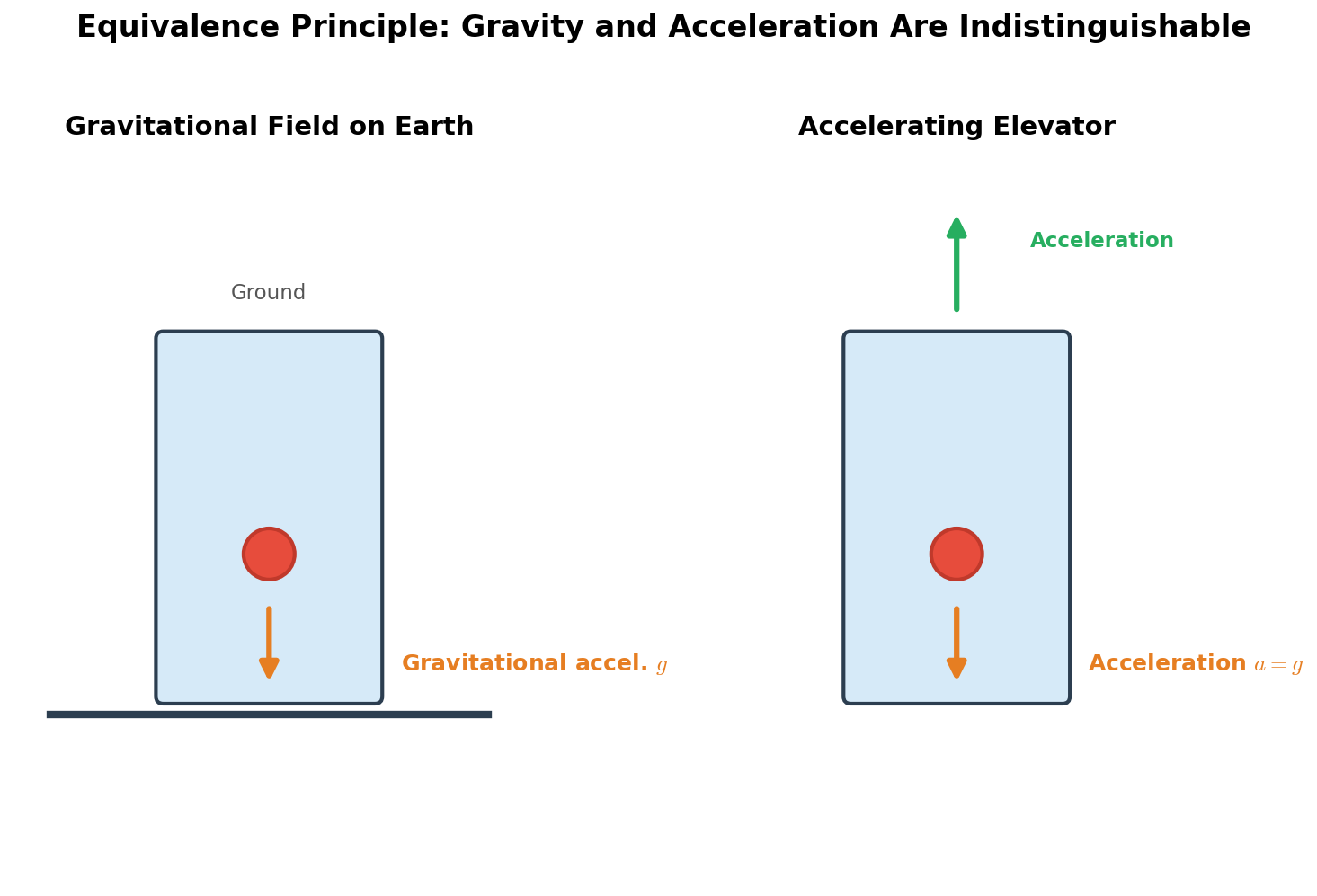
In the calculation showing that gravity vanishes in a free-fall coordinate system, consider the equation of motion
When \(m_I \neq m_G\), apply the coordinate transformation \(\bar{x}' = \bar{x} - \frac{1}{2}\mathbf{g}\,t^2\) and determine the resulting equation of motion after the transformation. Show that the gravitational term does not completely vanish.
Solution strategy: Apply a coordinate transformation in the case \(m_I \neq m_G\) and show that a gravitational term remains.
The original equation of motion:
Substituting the result \(\ddot{\bar{x}} = \ddot{\bar{x}}' + \mathbf{g}\) from Problem B-4. Velocity and Acceleration under Transformation to Free-Fall Coordinates,
Expanding and rearranging,
When \(m_I \neq m_G\), we have \(\left(\dfrac{m_G}{m_I} - 1\right)\mathbf{g} \neq 0\), and the gravitational term does not completely vanish.
Furthermore, if the ratio \(m_G/m_I\) differs depending on the type of particle, the residual gravitational acceleration \(\left(\frac{m_G}{m_I} - 1\right)\mathbf{g}\) differs from particle to particle, making it impossible to eliminate gravity for all particles simultaneously with a single coordinate transformation.
Verification: When \(m_G = m_I\), we obtain \(\ddot{\bar{x}}' = \bar{F}_{\text{ext}}/m_I\), and the gravitational term vanishes completely. This is consistent with the result in the main text.
B-6. Light Travel Time and Velocity Acquired by Ground Apparatus
Problem:
Light is emitted from the top of a tower (height \(h\)) toward the ground. As seen by a freely falling observer, express the time \(\Delta t\) for the light to reach the ground approximately in terms of \(h\) and \(c\). Furthermore, express the velocity \(v\) that the ground apparatus acquires relative to the freely falling frame during this time in terms of \(g\), \(h\), and \(c\).
Solution strategy: Find the travel time of light, then calculate the velocity acquired by the ground-based apparatus relative to the free-fall frame during that time.
Travel time of light:
Light travels a height \(h\) at speed \(c\), so
Velocity acquired by the ground-based apparatus:
As seen from the free-fall frame, the ground-based apparatus accelerates upward with acceleration \(g\). The velocity acquired during time \(\Delta t\) is:
Verification: Check the dimensions. \([g \cdot h / c] = (\text{m/s}^2)(\text{m})/(\text{m/s}) = \text{m/s}\). This correctly has dimensions of velocity. Also, when \(h = 0\), \(v = 0\), which is reasonable.
B-7. Frequency of Light from the Doppler Effect
Problem:
As a non-relativistic approximation of the Doppler effect in special relativity, the frequency \(\nu\) received by an observer approaching a light source at velocity \(v\) (\(v \ll c\)) is given by
where \(\nu'\) is the frequency of the light source. Substitute the result from Problem B-6. Light Travel Time and Velocity Acquired by Ground Apparatus and express the frequency \(\nu\) of light received at the ground in terms of \(\nu'\), \(g\), \(h\), and \(c\).
Solution strategy: Substitute the result from Problem B-6. Light Travel Time and Velocity Acquired by Ground Apparatus into the non-relativistic approximation of the Doppler effect.
Since the ground-based apparatus is approaching the light source (top of the tower) at speed \(v = gh/c\),
Verification: When \(h = 0\), we get \(\nu = \nu'\) with no frequency change. When \(h > 0\), we get \(\nu > \nu'\), meaning light traveling from the top to the ground is blueshifted. This is consistent with the fact that light falling to a region of lower gravitational potential gains energy (increases in frequency).
B-8. Gravitational Redshift Formula in Potential Form
Problem:
The gravitational redshift formula
represents the frequency shift when light is sent from the ground to the top. Using the general gravitational potential \(\Phi\), the frequency shift between two locations with a potential difference \(\Delta\Phi\) can be written as
In a uniform gravitational field, set \(\Phi = gh\) (with the ground as the reference) and verify that the two expressions above are consistent.
Solution strategy: Set \(\Phi = gh\) (with the ground as reference) in a uniform gravitational field and confirm that the two formulas agree.
Consider sending light from the ground to the top. Let the gravitational potential at the ground be \(\Phi_{\text{bottom}} = 0\) and the gravitational potential at the top be \(\Phi_{\text{top}} = gh\).
The potential difference is:
Substituting into the general formula:
This exactly matches the gravitational redshift formula:
\(\square\)
Verification: Let us confirm the physical meaning. \(\Delta\nu < 0\) means that the frequency of light decreases (redshifts) as it moves to a region of higher potential, which is consistent with the result from Problem B-7. Frequency of Light from the Doppler Effect (light traveling from the top to the ground is blueshifted).
Medium
M-1. Free-Fall Elevator Experiment with Different Materials
Problem:
Assume that the inertial mass \(m_I\) and gravitational mass \(m_G\) take different values depending on the material. Explain what would be observed when an iron ball and an aluminum ball are simultaneously released from one's hands inside a freely falling elevator. Also explain why this would imply a violation of the equivalence principle.
Solution Strategy: Analyze what happens inside a freely falling elevator when \(m_I/m_G\) differs between materials.
Calculation:
The equation of motion for each ball in the ground inertial frame is:
The acceleration of each ball is:
The elevator is in free fall, but the elevator itself accelerates according to a particular \(m_G/m_I\) ratio. Let the elevator's acceleration be \(\ddot{\boldsymbol{x}}_{\text{elev}} = (m_{G}/m_{I})_{\text{elev}}\,\boldsymbol{g}\).
The relative acceleration of each ball as seen by an observer inside the elevator is:
Observed Phenomena:
If the values of \(m_G/m_I\) differ between iron and aluminum (\(m_{G,\text{Fe}}/m_{I,\text{Fe}} \neq m_{G,\text{Al}}/m_{I,\text{Al}}\)), the relative acceleration between the two balls is:
Therefore, an iron ball and an aluminum ball released simultaneously from one's hands will move with different accelerations inside the elevator. One ball will be observed to fall (or rise) relative to the other.
Relation to Violation of the Equivalence Principle:
The equivalence principle (weak equivalence principle) asserts that "a freely falling system is locally equivalent to an inertial frame." Since gravity does not exist in an inertial frame, balls released from one's hands must remain stationary (in the absence of external forces).
However, if \(m_G/m_I\) differs between materials, the fact that balls move relative to each other inside a freely falling elevator means that an observer inside the elevator can detect the presence of gravity. That is, the freely falling system is no longer equivalent to an inertial frame, and the equivalence principle is violated.
Verification:
If \(m_{G}/m_{I}\) is the same for all materials (\(m_{G,\text{Fe}}/m_{I,\text{Fe}} = m_{G,\text{Al}}/m_{I,\text{Al}}\)), the relative acceleration is zero and both balls remain stationary—the equivalence principle holds. This is consistent with the results of Problem B-5. Free-Fall Coordinate Transformation When \(m_I \neq m_G\) and Problem M-2. Equivalence Principle for a Multi-Particle System. ✓
M-2. Equivalence Principle for a Multi-Particle System
Problem:
\(N\) particles are in a uniform gravitational field \(\mathbf{g}\), with non-gravitational forces \(\bar{F}\) acting between the particles. Given that the inertial mass and gravitational mass are equal (\(m_I = m_G = m\)), show that by applying the transformation to free-fall coordinates
the gravitational term is eliminated from the equations of motion of all particles simultaneously. Also, explain why this argument breaks down when \(m_{I} \neq m_{G}\).
Solution strategy: Apply the free-fall coordinate transformation to an \(N\)-particle system and show that when \(m_I = m_G\), gravity disappears for all particles. Then discuss the breakdown when \(m_I \neq m_G\).
Case \(m_I = m_G\):
The equation of motion for the \(i\)-th particle (\(i = 1, 2, \ldots, N\)) is:
Here \(m_i\) is the inertial mass of the \(i\)-th particle, and using \(m_I = m_G\), the gravitational mass is also \(m_i\). \(\bar{F}_{ij}\) is the non-gravitational force on particle \(i\) from particle \(j\).
We apply the transformation to free-fall coordinates:
From the result of Problem B-4. Velocity and Acceleration under Transformation to Free-Fall Coordinates,
That is, \(\ddot{\bar{x}}_i = \ddot{\bar{x}}_i' + \mathbf{g}\). Substituting into the equation of motion:
Expanding the left-hand side:
The \(m_i\,\mathbf{g}\) terms cancel on both sides:
Now we check the argument of the force. Since \(\bar{x}_i - \bar{x}_j = \left(\bar{x}_i' + \frac{1}{2}\mathbf{g}\,t^2\right) - \left(\bar{x}_j' + \frac{1}{2}\mathbf{g}\,t^2\right) = \bar{x}_i' - \bar{x}_j'\), we have:
This has exactly the same form as the equation of motion in a gravity-free space. This result does not depend on the particle index \(i\); the gravitational term vanishes simultaneously for all particles. This is because the coordinate transformation \(\frac{1}{2}\mathbf{g}\,t^2\) is common to all particles, and \(m_G/m_I = 1\) holds for every particle. \(\square\)
Breakdown when \(m_I \neq m_G\):
Let \(m_{i,I}\) be the inertial mass and \(m_{i,G}\) the gravitational mass of the \(i\)-th particle. The equation of motion is:
Applying the same coordinate transformation:
The residual gravitational acceleration is:
This residual term depends on the ratio \(m_{i,G}/m_{i,I}\). If \(m_{i,G}/m_{i,I}\) differs between particle species, a different residual gravitational acceleration arises for each particle. No single coordinate transformation can simultaneously eliminate gravity for all particles, and the equivalence principle breaks down.
If \(m_{i,G}/m_{i,I} = \alpha\) (a constant common to all particles), then one could eliminate gravity by modifying the coordinate transformation to \(\bar{x}' = \bar{x} - \frac{1}{2}\alpha\,\mathbf{g}\,t^2\), but if \(\alpha\) differs from particle to particle, this method also fails.
Verification: When \(m_{i,G} = m_{i,I}\), the residual term vanishes, which is consistent with the result of the first part.
M-3. Tidal Force and Locality of the Equivalence Principle
Problem:
Answer the following questions about tidal force.
(a) The gravitational acceleration at a distance \(r\) from the center of the Earth is \(g(r) = GM/r^2\). In a freely falling frame at distance \(r_0\) from the center of the Earth, express the difference in gravitational acceleration (tidal acceleration) \(\delta g\) at a point displaced by a small distance \(\delta r\) from \(r_0\), in terms of \(G\), \(M\), \(r_0\), and \(\delta r\).
(b) Using the result from (a), explain quantitatively what it means that the equivalence principle holds only in a "sufficiently small region."
(a) Derivation of tidal acceleration:
The gravitational acceleration at distance \(r\) from the center of the Earth is:
We Taylor expand the gravitational acceleration at a point displaced by a small distance \(\delta r\) from \(r_0\):
Using \((1 + x)^{-2} \approx 1 - 2x\) for \(|\delta r| \ll r_0\):
The tidal acceleration (difference in gravitational acceleration) is:
The negative sign means that for \(\delta r > 0\) (points farther than \(r_0\)), the gravitational acceleration is weaker. That is, as seen from a freely falling frame, objects farther than \(r_0\) accelerate away from \(r_0\), while objects closer than \(r_0\) accelerate toward \(r_0\) (a radial stretching effect).
Verification: Checking dimensions: \([GM/r_0^3 \cdot \delta r] = (\text{m}^3/\text{s}^2)/\text{m}^3 \cdot \text{m} = \text{m/s}^2\). This correctly has dimensions of acceleration. Also, \(\delta g \to 0\) as \(\delta r \to 0\), which is reasonable.
(b) Quantitative explanation of why the equivalence principle holds only in a "sufficiently small region":
The equivalence principle asserts that gravity vanishes in a freely falling coordinate system. However, as shown in (a), at a point displaced by distance \(\delta r\) from the free-fall reference point \(r_0\), a tidal acceleration
remains. This tidal acceleration cannot be eliminated by free fall (because it arises from the non-uniformity of the gravitational field).
For the equivalence principle to hold as a good approximation, the tidal acceleration must be sufficiently small compared to the measurement precision \(a_{\min}\) (or the typical acceleration scale \(a_{\text{typ}}\) of the physical phenomenon of interest):
Writing this as a constraint on \(\delta r\):
For example, at the Earth's surface (\(r_0 = R \approx 6.4 \times 10^6\;\text{m}\), \(g = GM/R^2 \approx 9.8\;\text{m/s}^2\)), if we want to keep the tidal acceleration below \(10^{-6}\) of \(g\):
In other words, at the Earth's surface, the equivalence principle holds to a precision of \(10^{-6}\) within a region of a few meters. On the other hand, in locations where the gravitational field varies rapidly (for example, near a black hole where \(r_0\) is small), \(r_0^3\) becomes small, so the region where the equivalence principle holds becomes even narrower.
M-4. Derivation of Gravitational Redshift from the Equivalence Principle
Problem:
Using the equivalence principle, derive the gravitational redshift formula
Follow the steps below.
(a) Set up an observer who begins free fall at the instant light is emitted from the top of a tower, and explain using the equivalence principle why this observer is in an inertial frame.
(b) Find the time \(\Delta t\) for the light to reach the ground, and the velocity \(v\) that the ground-based apparatus acquires relative to the free-falling frame during this time.
(c) Apply the non-relativistic approximation of the Doppler effect to derive the frequency change when light is sent from the ground to the top of the tower.
(a) Explanation that a freely falling observer is in an inertial frame:
Suppose that at the moment light is emitted from the top of a tower, an observer who was at rest at that location begins to fall freely.
According to the equivalence principle, a freely falling frame is locally equivalent to an inertial frame. This is because the effect of a uniform gravitational field can be eliminated by the coordinate transformation of free fall (as confirmed in Problem B-4. Velocity and Acceleration under Transformation to Free-Fall Coordinates and Problem B-5. Free-Fall Coordinate Transformation When \(m_I \neq m_G\), when \(m_I = m_G\), the coordinate transformation \(\bar{x}' = \bar{x} - \frac{1}{2}\mathbf{g}\,t^2\) removes the gravitational term from the equation of motion).
Therefore, in this freely falling observer's frame, special relativity applies directly, light travels in a straight line at speed \(c\), and results of special relativity such as the Doppler effect can be used without modification.
(b) Travel time and acquired velocity:
From the freely falling observer's perspective, light travels at speed \(c\) from the top of the tower toward the ground. The time it takes for light to traverse the height \(h\) is:
(In the approximation \(gh/c^2 \ll 1\), higher-order gravitational corrections are negligible.)
From the freely falling observer's perspective, the apparatus on the ground is accelerating upward with acceleration \(g\) (since gravity vanishes in the free-fall frame, the ground appears to accelerate toward the observer). The velocity acquired by the ground apparatus during the time \(\Delta t\) is:
(c) Derivation of gravitational redshift:
Light from the top to the ground (blueshift):
From the free-fall frame, the ground apparatus is approaching the source (the top) at speed \(v = gh/c\). Applying the non-relativistic approximation (\(v \ll c\)) of the special relativistic Doppler effect, the frequency \(\nu\) received at the ground is:
where \(\nu'\) is the frequency of the light emitted at the top. Since \(\nu > \nu'\), light traveling from the top to the ground is blueshifted.
Light from the ground to the top (redshift):
Conversely, consider sending light from the ground to the top. Similarly, we set up an observer who begins free fall at the ground at the moment the light is emitted. From this observer's perspective, the apparatus at the top is receding from the source (the ground) at speed \(v = gh/c\). By the Doppler effect:
The fractional change in frequency is:
This is the formula for gravitational redshift. When light moves to a region of higher gravitational potential, its frequency decreases (redshift), and when it moves to a region of lower potential, its frequency increases (blueshift).
Verification: Checking dimensions: \([gh/c^2] = (\text{m/s}^2)(\text{m})/(\text{m/s})^2 = \text{dimensionless}\). Since it is a ratio of frequencies, it should be dimensionless, which is consistent. Also, as \(h \to 0\), \(\Delta\nu/\nu \to 0\), confirming that there is no frequency change when there is no height difference, which is physically reasonable.
M-5. Time Dilation at Tokyo Skytree
Problem:
Estimate the clock discrepancy per day between the top of Tokyo Skytree at height \(h = 450\) m and the ground. Use \(g \approx 9.8\;\text{m/s}^2\) and \(c \approx 3.0 \times 10^8\;\text{m/s}\).
Solution strategy: Use the gravitational redshift formula to estimate the clock difference per day due to a height difference \(h\).
Calculation:
From the result of Problem A-1. Metric Correction Derived from Gravitational Redshift (a), the proper time difference due to gravitational redshift is:
In the uniform gravitational field approximation (\(h \ll R_\oplus\)), the potential difference is:
where \(g = 9.8\;\text{m/s}^2\), \(h = 450\;\text{m}\), \(c = 3.0 \times 10^8\;\text{m/s}\).
Relative time difference (dimensionless):
Clock difference per day:
Since 1 day \(= 86400\;\text{s}\),
The clock at the top runs approximately 4.2 nanoseconds faster per day compared to the clock on the ground. This corresponds to the fact that time flows faster at the top due to the general relativistic gravitational redshift effect, since the gravitational potential is higher (gravity is weaker) at the top.
Verification:
Dimensional check: \([gh/c^2] = (\text{m/s}^2)(\text{m})/(\text{m/s})^2 = \text{dimensionless}\). Correct. ✓
Comparison with experiment: In 2012, the group led by Hidetoshi Katori at the University of Tokyo used optical lattice clocks to measure the gravitational redshift between the ground and the observation deck (approximately 450 m height) of Tokyo Skytree, obtaining results consistent with the predictions of general relativity. Our calculated value of \(\sim 4\;\text{ns/day}\) is consistent with the precision of this experiment (easily detectable with optical lattice clocks at the \(10^{-18}\) level). ✓
Limit \(h = 0\): \(\Delta\tau = 0\), confirming that there is no clock difference when there is no height difference. This is reasonable. ✓
M-6. Shift in Interpretation between Newtonian Mechanics and General Relativity
Problem:
In Newtonian mechanics, we interpret that "an observer stationary on the ground is in an inertial frame, and a gravitational force acts on the falling apple." Explain how this interpretation changes in general relativity, using ALL of the following terms: free fall, inertial motion, geodesic, spacetime curvature.
Interpretation in Newtonian Mechanics:
In Newtonian mechanics, an observer at rest on the ground is considered to be in an inertial frame. An apple accelerates under the "force" of gravity and falls toward the ground. The motion of the apple is the result of the force \(F = mg\), while the person standing on the ground is in a natural state of experiencing no net force (more precisely, gravity and the normal force are in balance).
Interpretation in General Relativity:
In general relativity, this interpretation is fundamentally reversed.
-
Free fall is inertial motion: The falling apple is moving without any external force acting on it. This is the general relativistic version of "inertial motion" in Newtonian mechanics (where an object experiencing no force moves in a straight line at constant velocity). The apple follows the most natural path—a geodesic—through the curvature of curved spacetime. A geodesic is the "straightest possible" path in curved spacetime and corresponds to the worldline of a freely falling object.
-
The person standing on the ground is the one accelerating: An observer at rest on the ground is being pushed by the normal force from the ground and is therefore deviating from a geodesic. In other words, in the sense of general relativity, it is the person standing on the ground who is accelerating. If one carries an accelerometer (such as a spring scale), the person on the ground detects an acceleration of \(g\), whereas the freely falling apple registers zero acceleration.
-
Gravity is not a force but a property of spacetime: Gravity is not a "force" like the electromagnetic force; rather, it is a manifestation of spacetime curvature produced by mass and energy. Objects simply follow geodesics in curved spacetime—they are not "being pulled by gravity." Because spacetime around the Earth is curved, the geodesics of freely falling objects happen to be paths directed toward the Earth.
In summary, whereas Newtonian mechanics says "the force of gravity pulls the apple," general relativity interprets the situation as "the apple is merely undergoing inertial motion along a geodesic in curved spacetime, and it is the person standing on the ground who is accelerating."
Advanced
A-1. Metric Correction Derived from Gravitational Redshift
Problem:
By combining knowledge of the equivalence principle and special relativity, discuss the following.
An object of rest mass \(m\) is raised from a position with gravitational potential \(\Phi_1\) to a position with \(\Phi_2\) (\(\Phi_2 > \Phi_1\)).
(a) From the result of gravitational redshift, explain why the proper time \(d\tau\) of a clock placed at a position with potential \(\Phi\) and the coordinate time \(dt\) at infinity (\(\Phi = 0\)) are related by
(in the approximation \(|\Phi|/c^2 \ll 1\)).
(b) Using this result, express how the Minkowski metric \(ds^2 = -c^2 dt^2 + dx^2 + dy^2 + dz^2\) is modified in the presence of a weak gravitational field, in terms of the change in the \(g_{00}\) component.
(c) The result of (b) is the first indication that "spacetime with a gravitational field is not Minkowski spacetime," that is, that spacetime is curved. Discuss how this argument contradicts the concept of Lorentz frames in Ch. 3, and why the extension to general relativity is unavoidable.
(a) Relationship between proper time and coordinate time:
Using the result of gravitational redshift, we derive the relationship between the proper time of a clock at potential \(\Phi\) and the coordinate time at infinity.
From the general formula for gravitational redshift derived in Problem B-8. Gravitational Redshift Formula in Potential Form, when light emitted from a position at potential \(\Phi_{\text{emit}}\) is observed at a position with potential \(\Phi_{\text{obs}}\),
For the case of sending light from a position at potential \(\Phi\) (\(\Phi < 0\)) to infinity (\(\Phi = 0\)), setting \(\Phi_{\text{emit}} = \Phi\) and \(\Phi_{\text{obs}} = 0\),
Since \(\Phi < 0\), we have \(\nu_\infty < \nu(\Phi)\), which correctly represents a redshift (light emitted from deep within a gravitational potential well has a lower frequency when observed at infinity).
That is,
Next, we use the relationship between frequency and proper time. Frequency is proportional to the inverse of proper time (\(\nu \propto 1/d\tau\)). Let \(d\tau\) be the proper time of one oscillation of a clock at potential \(\Phi\), and \(dt\) be the corresponding time interval in coordinate time at infinity:
Substituting into the redshift relation above,
Solving for \(d\tau\),
Physical meaning: When \(\Phi < 0\) (at a location with lower gravitational potential), \(d\tau < dt\), meaning a clock deep in a gravitational field runs slower compared to a clock at infinity. This is gravitational time dilation.
Verification: At \(\Phi = 0\) (infinity), \(d\tau = dt\), so coordinate time and proper time coincide. The result \(d\tau < dt\) for \(\Phi < 0\) is consistent with the Pound-Rebka experiment, which confirms that clocks in a gravitational field run slow.
(b) Correction to the metric in a weak gravitational field:
For the worldline of a stationary particle, \(dx = dy = dz = 0\), so in the Minkowski metric \(ds^2 = -c^2 dt^2 + dx^2 + dy^2 + dz^2\),
On the other hand, the relationship with proper time \(d\tau\) along the worldline is \(ds^2 = -c^2 d\tau^2\), so
(Here we use the metric signature convention \((-,+,+,+)\).)
Substituting the result from (a), \(d\tau \approx (1 + \Phi/c^2)\,dt\),
(Neglecting second-order terms since \(|\Phi|/c^2 \ll 1\).)
Comparing with \(d\tau^2 = -g_{00}\,dt^2\),
Therefore, the metric in the presence of a weak gravitational field is
Verification: When \(\Phi = 0\) (no gravitational field), \(g_{00} = -1\), recovering the Minkowski metric. The dimensions are also correct since \([\Phi/c^2]\) is dimensionless.
(c) Contradiction with the concept of Lorentz frames and the inevitability of extension to general relativity:
The result of (b) shows that in a spacetime where a gravitational field exists, the metric component \(g_{00}\) depends on position:
This fundamentally contradicts the concept of Lorentz frames (inertial frames) from Chapters 3–4 in the following ways:
-
Breakdown of the Minkowski metric: In special relativity as studied in Ch. 4, the metric in an inertial frame is given by the constant matrix \(\eta_{\mu\nu} = \text{diag}(-1, +1, +1, +1)\). However, in the result of (b), \(g_{00}\) is a function of spatial coordinates, and the metric is not in Minkowski form. This means that spacetime in the presence of a gravitational field is not Minkowski spacetime.
-
Absence of a global inertial frame: In special relativity, there exists an inertial frame (Lorentz frame) that covers the entire spacetime, in which physical laws take a Lorentz-covariant form. However, the equivalence principle guarantees the existence of inertial frames only locally. In the neighborhood of any spacetime point, one can recover the Minkowski metric by choosing a freely falling coordinate system, but in general there is no single coordinate system that makes the metric Minkowski throughout all of spacetime. This is analogous to how a curved surface can be locally approximated as flat, but cannot be unfolded into a plane globally.
-
Inevitability of spacetime curvature: The fact that \(g_{00}\) depends on position means that the metric tensor has a nontrivial structure, which mathematically corresponds to spacetime being curved. Since gravitational redshift — an experimentally verified phenomenon — demands position dependence of the metric, describing gravity requires a framework beyond Minkowski spacetime — namely, the geometry of curved spacetime.
-
The path indicated by the equivalence principle: The equivalence principle guarantees that "special relativity holds locally." In the language of differential geometry, this corresponds to "the tangent space at each point of a curved manifold is a Minkowski space." In other words, physics including gravity should be formulated on a "spacetime that is locally flat but globally curved," which is precisely the framework of Riemannian geometry.
For the reasons above, describing physics in the presence of gravity requires extending the framework of special relativity (global Minkowski spacetime + Lorentz transformations) and formulating physical laws on general curved spacetimes — making the transition to general relativity inevitable. The equivalence principle serves as a bridge for this extension, acting as the starting point by guaranteeing that "special relativity holds locally."
A-2. Relativistic Corrections for GPS Satellites
Problem:
Observer A stands on the surface of the Earth (mass \(M\), radius \(R\)), and observer B rides on a satellite in uniform circular orbit at altitude \(H\) above the ground.
(a) Due to the gravitational redshift effect, how much faster does B's clock run compared to A's clock per second? Using the potential difference
find the ratio \(\Delta\tau_{\text{grav}}/\Delta t\). (Note: In the case \(H \ll R\), this reduces to \(\Delta\Phi \approx gH\), but for GPS satellites where \(H \approx 3.2R\), this approximation cannot be used.)
(b) Due to the special relativistic time dilation effect studied in Ch. 3, how much slower does the clock on a satellite moving at orbital velocity \(v = \sqrt{gR^2/(R+H)} \approx \sqrt{g(R+H)}\) run compared to A? Assuming \(v \ll c\), find the ratio \(\Delta\tau_{\text{SR}}/\Delta t\).
(c) For a GPS satellite (\(H \approx 20{,}200\;\text{km}\)), compare the magnitudes of the effects from (a) and (b), and determine which is dominant. Use \(g \approx 9.8\;\text{m/s}^2\), \(R \approx 6{,}370\;\text{km}\), and \(c \approx 3.0 \times 10^8\;\text{m/s}\) as needed.
(a) Clock rate difference due to gravitational redshift:
The potential difference between the Earth's surface (potential \(\Phi_A = -GM/R\)) and a satellite at altitude \(H\) (potential \(\Phi_B = -GM/(R+H)\)) is:
From the result of Problem A-1. Metric Correction Derived from Gravitational Redshift (a), the relationship between proper time and coordinate time at each location is:
How much faster B's clock runs compared to A's clock per second is:
Since the value is positive, the satellite clock at higher altitude runs faster than the ground clock.
(b) Effect of special relativistic time dilation:
The orbital velocity of the satellite is obtained from the circular orbit condition (centripetal acceleration = gravitational acceleration):
Due to special relativistic time dilation, the proper time of a clock moving at velocity \(v\) is:
The difference relative to the ground clock is:
Since the value is negative, the moving satellite clock runs slower than the ground clock.
(Note: Strictly speaking, the ground observer is also moving due to Earth's rotation, but since the rotational speed at the surface is much smaller than the satellite's orbital velocity, we approximate the ground observer as stationary here.)
(c) Numerical comparison for GPS satellites:
Given values: \(H = 20{,}200\;\text{km} = 2.02 \times 10^7\;\text{m}\), \(g = 9.8\;\text{m/s}^2\), \(R = 6{,}370\;\text{km} = 6.37 \times 10^6\;\text{m}\), \(c = 3.0 \times 10^8\;\text{m/s}\).
Gravitational redshift effect:
Numerator: \(9.8 \times 6.37 \times 10^6 \times 2.02 \times 10^7 = 9.8 \times 1.287 \times 10^{14} = 1.261 \times 10^{15}\)
Denominator: \(9.0 \times 10^{16} \times 2.657 \times 10^7 = 2.391 \times 10^{24}\)
Time difference per day: \(5.27 \times 10^{-10} \times 86{,}400\;\text{s} \approx 45.5\;\mu\text{s}\) (satellite clock runs fast).
Special relativistic time dilation effect:
(Verification: \(v = \sqrt{1.497 \times 10^7} \approx 3.87 \times 10^3\;\text{m/s} \approx 3.9\;\text{km/s}\). This is a reasonable orbital velocity for a GPS satellite. ✓)
Time difference per day: \(-8.3 \times 10^{-11} \times 86{,}400\;\text{s} \approx -7.2\;\mu\text{s}\) (satellite clock runs slow).
Comparison:
| Effect | \(\Delta\tau/\Delta t\) | Time difference per day |
|---|---|---|
| Gravitational redshift | \(+5.3 \times 10^{-10}\) | \(\approx +45.5\;\mu\text{s}\) (runs fast) |
| Special relativistic time dilation | \(-8.3 \times 10^{-11}\) | \(\approx -7.2\;\mu\text{s}\) (runs slow) |
| Total | \(+4.4 \times 10^{-10}\) | \(\approx +38.3\;\mu\text{s}\) (runs fast) |
(Note: Using the approximation \(\Delta\Phi \approx gH\) valid for \(H \ll R\) would overestimate the gravitational effect as \(+190\;\mu\text{s}/\text{day}\). Since \(H \approx 3.2R\) for GPS satellites, we must use the exact potential difference \(\Delta\Phi = gRH/(R+H)\).)
Conclusion: The gravitational redshift effect is dominant, and the GPS satellite clock runs faster than the ground clock. Without this correction, significant errors would accumulate in position determination using signals propagating at the speed of light \(c\). For GPS to function properly, clock corrections accounting for both general relativistic (gravitational redshift) and special relativistic (time dilation) effects are essential.
Verification: - The opposite signs of the gravitational and velocity effects are physically correct (clocks at higher altitude run faster, and moving clocks run slower). - The fact that the total effect is positive (satellite clock runs fast) is consistent with the actual GPS operation where satellite clocks are set slightly slow before launch to match ground clocks. - When \(H = 0\), the gravitational effect vanishes and \(v^2 = gR\), leaving only the velocity effect. When \(v = 0\), the velocity effect vanishes and only the gravitational effect remains. Both are reasonable limits.
Feedback on this page
Let us know if something was unclear, incorrect, or could be improved.