Ch. 6 Problems
← Back to chapter | View solutions
Table of Contents
Basic
- B-1. Jacobian of 2D Polar Coordinates
- B-2. Inverse Metric in 3D Spherical Coordinates
- B-3. Matrix Representation of a General 2-Dimensional Metric
- B-4. Metric Tensor on a Sphere at a Specific Point
- B-5. Jacobian Matrix of a Linear Coordinate Transformation
- B-6. Application of the Metric Tensor Transformation Law
- B-7. Cartesian Components of Coordinate Basis Vectors
- B-8. Determinant of the Jacobian Matrix of the Inverse Transformation
Medium
- M-1. Coordinate Transformation \((u, v)\) and the Metric Tensor
- M-2. Derivation of the Line Element in Spherical Coordinates
- M-3. Metric Tensor in Parabolic Coordinates
- M-4. Proof of Symmetry of the Metric Tensor
- M-5. Metric and Flatness of a Cylindrical Surface
- M-6. Geometry of "Circles" on a Sphere
- M-7. Derivation of \(g'_{33}\) using the metric tensor transformation law
Advanced
Basic
B-1. Jacobian of 2D Polar Coordinates
Find the determinant (Jacobian) \(\det J\) of the Jacobi matrix
for the transformation from 2D polar coordinates \((r, \theta)\) to Cartesian coordinates \((x, y)\).
Hint
Compute the determinant of \(J = \begin{pmatrix} \cos\theta & -r\sin\theta \\ \sin\theta & r\cos\theta \end{pmatrix}\).
B-2. Inverse Metric in 3D Spherical Coordinates
From the line element in 3-dimensional spherical coordinates \((r, \theta, \varphi)\)
find the inverse matrix \(g^{ij}\) (inverse metric) of the metric tensor \(g_{ij}\).
Hint
When \(g_{ij}\) is a diagonal matrix, each diagonal component of the inverse matrix is the reciprocal of the corresponding diagonal component.
B-3. Matrix Representation of a General 2-Dimensional Metric
Given a metric in 2-dimensional coordinates \((u, v)\):
Write the metric tensor \(g_{ij}\) in \(2 \times 2\) matrix form.
Hint
When expanding \(ds^2 = g_{ij}\,du^i\,du^j\), the coefficient of the cross term \(du\,dv\) is \(g_{12} + g_{21}\), and we use the symmetry of the metric tensor \(g_{12} = g_{21}\).
B-4. Metric Tensor on a Sphere at a Specific Point
For the metric on a sphere of radius \(a\)
write down the explicit components of the metric tensor \(g_{ij}\) at the point \((\theta, \varphi) = (\pi/3,\, 0)\).
Hint
Substitute \(\sin(\pi/3) = \sqrt{3}/2\).
B-5. Jacobian Matrix of a Linear Coordinate Transformation
In 2 dimensions, a transformation from coordinates \((x^1, x^2) = (x, y)\) to \((u^1, u^2) = (u, v)\) is given by
Find the Jacobian matrix \(\dfrac{\partial x^i}{\partial u^j}\).
Hint
Compute \(\partial x/\partial u\), \(\partial x/\partial v\), \(\partial y/\partial u\), and \(\partial y/\partial v\) by taking the respective partial derivatives.
B-6. Application of the Metric Tensor Transformation Law
For the coordinate transformation in Problem B-5. Jacobian Matrix of a Linear Coordinate Transformation, use the metric tensor transformation law
to find the metric tensor \(g'_{kl}\) in the new coordinates \((u, v)\), starting from the Cartesian metric \(g_{ij} = \delta_{ij}\). Write the result in matrix form.
Hint
Using the Jacobian matrix \(J\) obtained in Problem B-5. Jacobian Matrix of a Linear Coordinate Transformation, compute \(g' = J^T g\, J = J^T J\).
B-7. Cartesian Components of Coordinate Basis Vectors
For the coordinate basis vector \(\boldsymbol{e}_\theta\) in 2-dimensional polar coordinates, find the Cartesian components \((\boldsymbol{e}_\theta)^x\) and \((\boldsymbol{e}_\theta)^y\) at the point \(r = 3\), \(\theta = \pi/4\).
Hint
Substitute \(r = 3\), \(\theta = \pi/4\) into \(\boldsymbol{e}_\theta = \dfrac{\partial x}{\partial \theta}\,\boldsymbol{e}_x + \dfrac{\partial y}{\partial \theta}\,\boldsymbol{e}_y\).
B-8. Determinant of the Jacobian Matrix of the Inverse Transformation
In 2-dimensional polar coordinates, find the determinant \(\det \tilde{J}\) of the Jacobian matrix of the inverse transformation
and verify its relationship with \(\det J\) obtained in Problem B-1. Jacobian of 2D Polar Coordinates.
Hint
From \(J \tilde{J} = I\) (identity matrix), use the determinant relation \(\det J \cdot \det \tilde{J} = 1\).
Medium
M-1. Coordinate Transformation \((u, v)\) and the Metric Tensor
Reference figure: Figure 5.1: Cartesian and Polar Coordinates
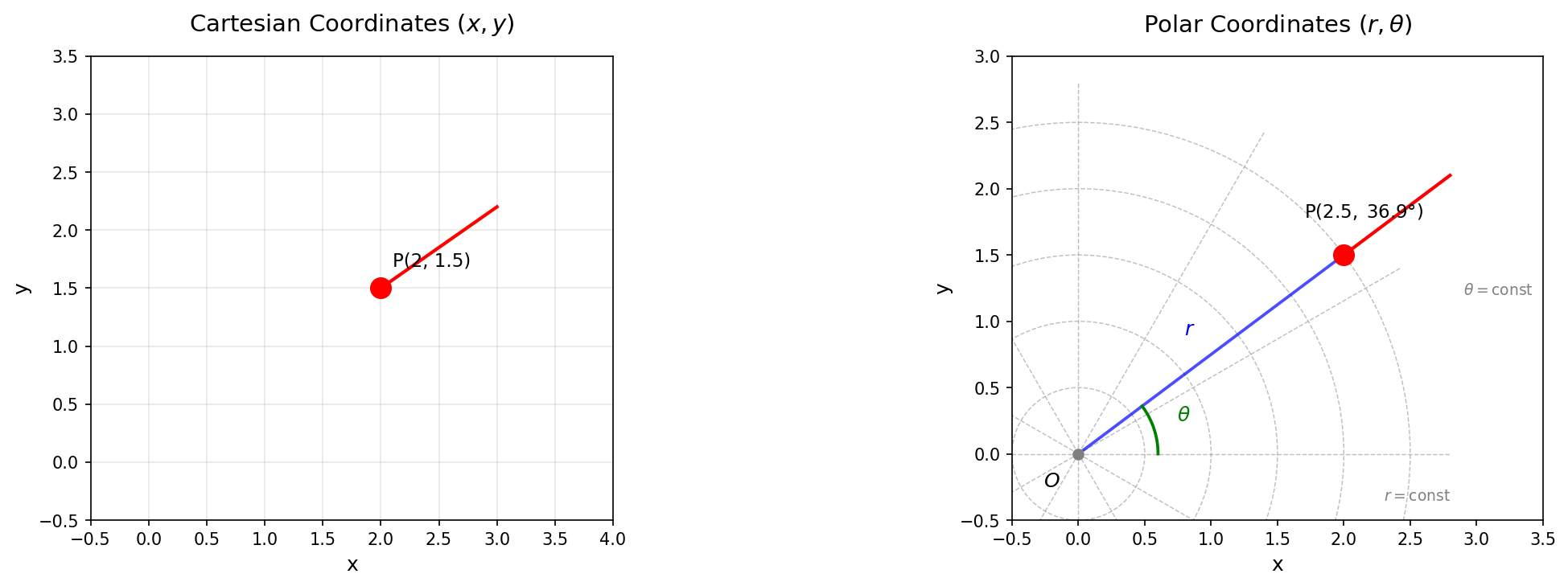
Consider the coordinate transformation \(u = x + y\), \(v = x - y\) in a 2-dimensional plane.
(a) Find the Jacobian matrix \(\dfrac{\partial(x, y)}{\partial(u, v)}\).
(b) Using the transformation law, find the metric tensor \(g'_{ij}\) in this coordinate system.
(c) Rewrite \(ds^2 = dx^2 + dy^2\) in these coordinates and verify that it agrees with the result of (b).
M-2. Derivation of the Line Element in Spherical Coordinates
Derive the line element in 3-dimensional spherical coordinates \((r, \theta, \varphi)\)
from the Cartesian line element \(ds^2 = dx^2 + dy^2 + dz^2\) and the coordinate transformation
Express the total differentials \(dx\), \(dy\), \(dz\) in terms of \((dr, d\theta, d\varphi)\), substitute them in, and show the entire process of simplification.
Hint
After computing the total differentials of \(dx\), \(dy\), and \(dz\), expand \(dx^2 + dy^2 + dz^2\). Verify that all cross terms (such as \(dr\,d\theta\)) vanish using trigonometric identities.
M-3. Metric Tensor in Parabolic Coordinates
Two-dimensional parabolic coordinates \((\sigma, \tau)\) are defined by
(a) Find the Jacobian matrix \(\dfrac{\partial x^i}{\partial u^j}\), where \((u^1, u^2) = (\sigma, \tau)\).
(b) Using the transformation law for the metric tensor, derive the metric tensor \(g'_{kl}\) in parabolic coordinates, and express the line element \(ds^2\) in terms of \((\sigma, \tau)\).
Hint
Compute \(g' = J^T J\). Verify that the result can be factored with a common factor of \((\sigma^2 + \tau^2)\).
M-4. Proof of Symmetry of the Metric Tensor
Reference figure: Figure 5.2: Metric of a sphere
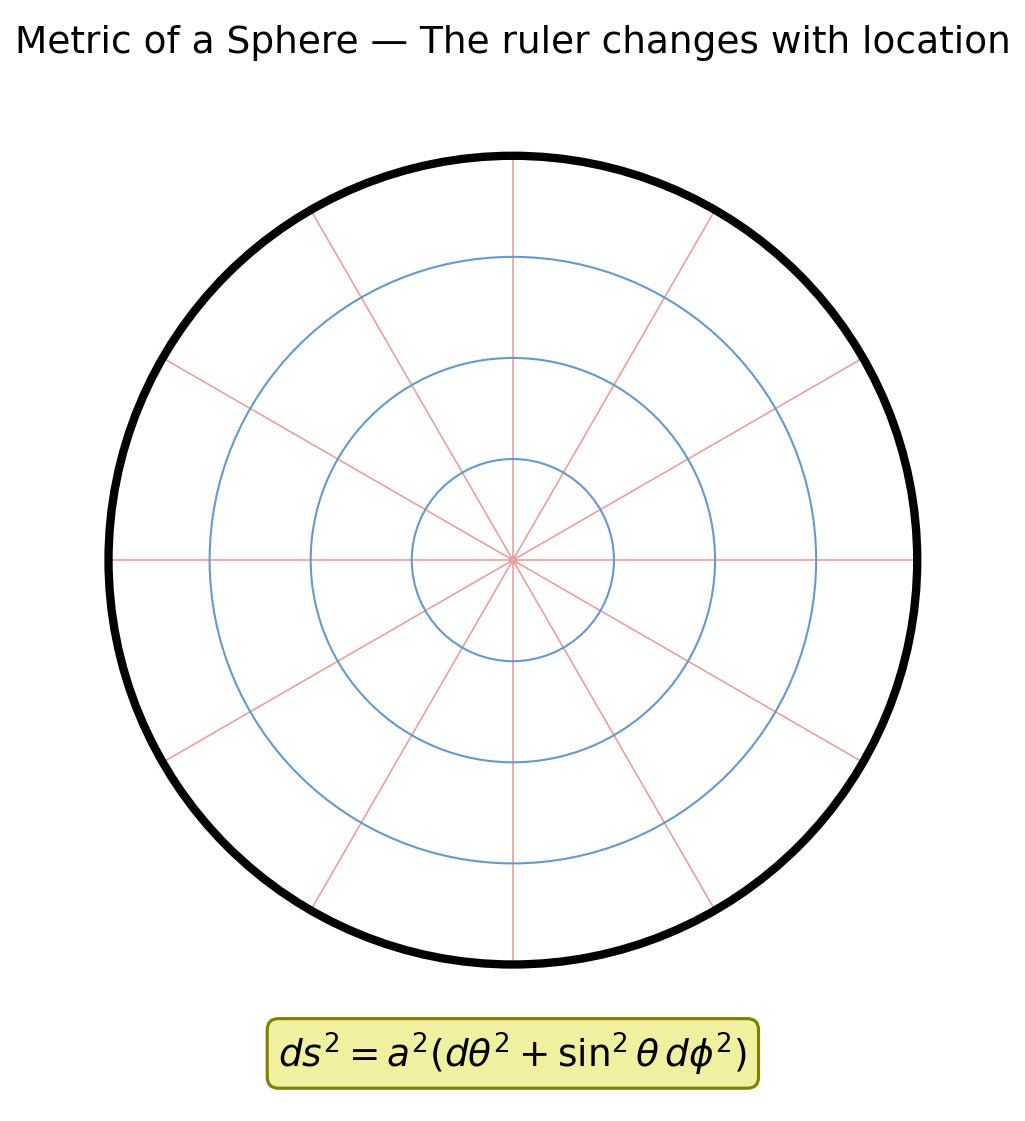
Given the transformation law for the metric tensor
show that the metric tensor is a symmetric tensor, i.e., \(g'_{kl} = g'_{lk}\), assuming symmetry in the original coordinate system \(g_{ij} = g_{ji}\).
Hint
In the right-hand side of the transformation law, swap the indices \(i\) and \(j\), and use \(g_{ij} = g_{ji}\) together with relabeling of summation indices.
M-5. Metric and Flatness of a Cylindrical Surface
When describing a cylindrical surface of radius \(a\) using coordinates \((\varphi, z)\) (where \(\varphi\) is the circumferential angle and \(z\) is the height), the line element is
(a) Write the metric tensor \(g_{ij}\) in matrix form.
(b) The components of the metric tensor for the cylindrical surface are constants that do not depend on the coordinates. Contrast this with the fact that the metric tensor components of a sphere depend on \(\theta\), and discuss whether the claim "constant metric tensor components ⇒ the space is flat" is correct, based on the content of this chapter.
Hint
Recall that a cylindrical surface can be made by rolling up a sheet of paper. Since rolling the paper does not stretch or compress it, its intrinsic geometry is flat.
M-6. Geometry of "Circles" on a Sphere
On a sphere of radius \(a\), consider a "circle" centered at the north pole (\(\theta = 0\)), defined by the line \(\theta = \theta_0\) = constant.
(a) Find the circumference \(C\) of this circle using the metric of the sphere \(ds^2 = a^2\,d\theta^2 + a^2\sin^2\theta\,d\varphi^2\).
(b) Find the distance \(r\) along the sphere's surface from the north pole to this circle (the distance along a meridian with \(\varphi\) = constant).
(c) Calculate \(C/(2\pi r)\) and verify that it becomes less than 1 as \(\theta_0\) increases. This is a manifestation of the sphere having positive curvature.
M-7. Derivation of \(g'_{33}\) using the metric tensor transformation law
Using the metric tensor transformation law
derive the 3-dimensional spherical coordinate metric component \(g'_{33} = r^2\sin^2\theta\) from the Cartesian metric \(g_{ij} = \delta_{ij}\). (Hint: Use \(\dfrac{\partial x}{\partial \varphi} = -r\sin\theta\sin\varphi\), \(\dfrac{\partial y}{\partial \varphi} = r\sin\theta\cos\varphi\), \(\dfrac{\partial z}{\partial \varphi} = 0\).)
Advanced
A-1. Metric Tensor in General Curvilinear Coordinates
Consider "general curvilinear coordinates" \((u^1, u^2)\) on a 2-dimensional plane:
where \(f\) and \(g\) are sufficiently smooth functions and the Jacobian matrix is non-singular.
(a) Express the metric tensor \(g_{ij}\) in these coordinates in terms of partial derivatives of \(f\) and \(g\).
(b) Write down the condition for the coordinate basis vectors \(\boldsymbol{e}_1\) and \(\boldsymbol{e}_2\) to be orthogonal (\(g_{12} = 0\)) using partial derivatives of \(f\) and \(g\).
(c) For polar coordinates and parabolic coordinates (see Problem M-3. Metric Tensor in Parabolic Coordinates), verify whether the orthogonality condition from (b) is satisfied in each case.
Hint
Start from \(g_{ij} = \dfrac{\partial x}{\partial u^i}\dfrac{\partial x}{\partial u^j} + \dfrac{\partial y}{\partial u^i}\dfrac{\partial y}{\partial u^j}\), and in (b) write \(g_{12} = 0\) as the condition. For (c), substitute the specific partial derivatives.
A-2. Rindler Coordinates
Reference figure: Figure 2.1: Light cones and spacetime diagrams (Chapters 3–4)
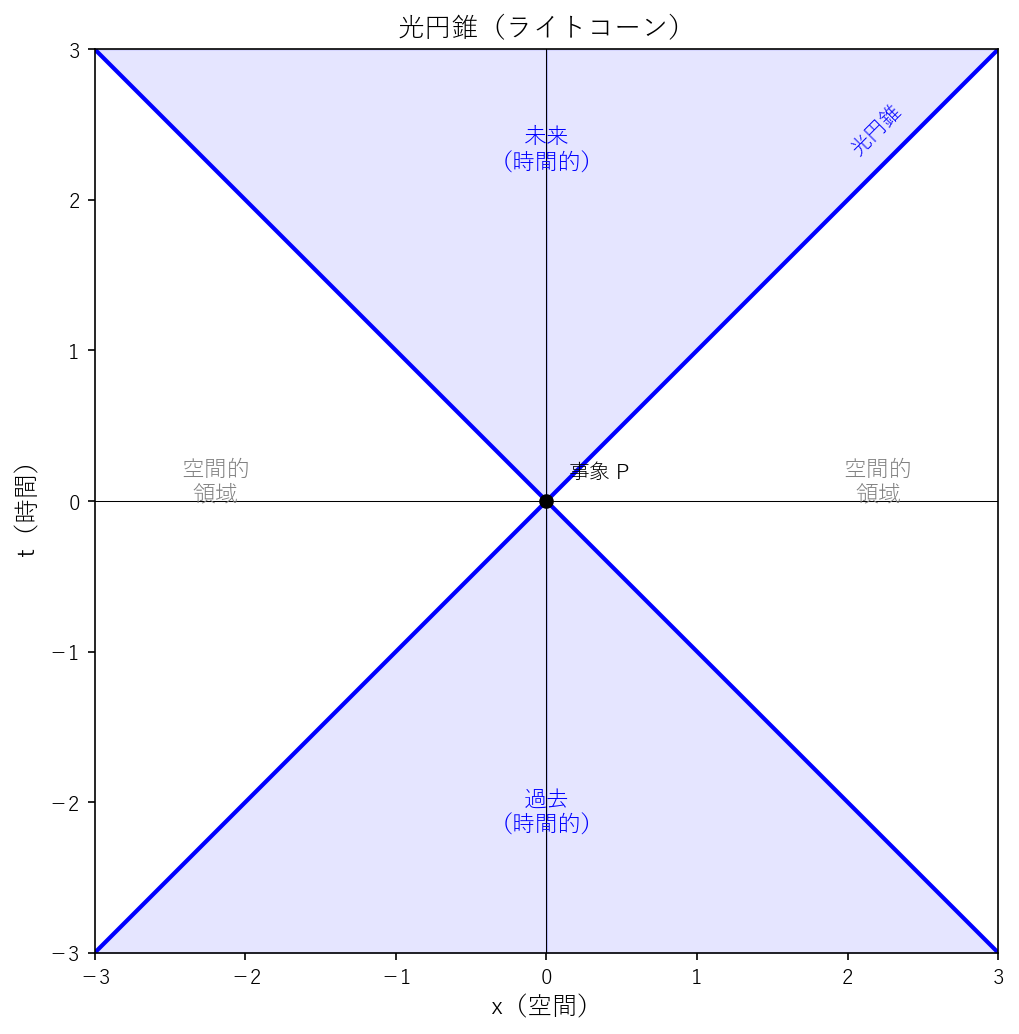
The line element of Minkowski spacetime is
We introduce Rindler coordinates \((\eta, \xi)\) defined by
(the \(y\) and \(z\) directions are left untransformed).
(a) Find the components of the Jacobian matrix: \(\dfrac{\partial(ct)}{\partial \eta}\), \(\dfrac{\partial(ct)}{\partial \xi}\), \(\dfrac{\partial x}{\partial \eta}\), \(\dfrac{\partial x}{\partial \xi}\).
(b) Using the transformation law for the metric tensor, show that the line element in Rindler coordinates is
(c) The metric tensor component \(g_{\eta\eta} = -\xi^2\) depends on \(\xi\). Discuss the physical meaning of this in relation to the equivalence principle argument from Ch. 5 — "in a uniform gravitational field, the rate at which time passes differs from place to place."
Hint
Make use of \(\cosh^2\eta - \sinh^2\eta = 1\). For (c), recall that Rindler coordinates represent the coordinate system of a uniformly accelerating observer, and consider the relationship between the \(g_{00}\) component and proper time.
Feedback on this page
Let us know if something was unclear, incorrect, or could be improved.